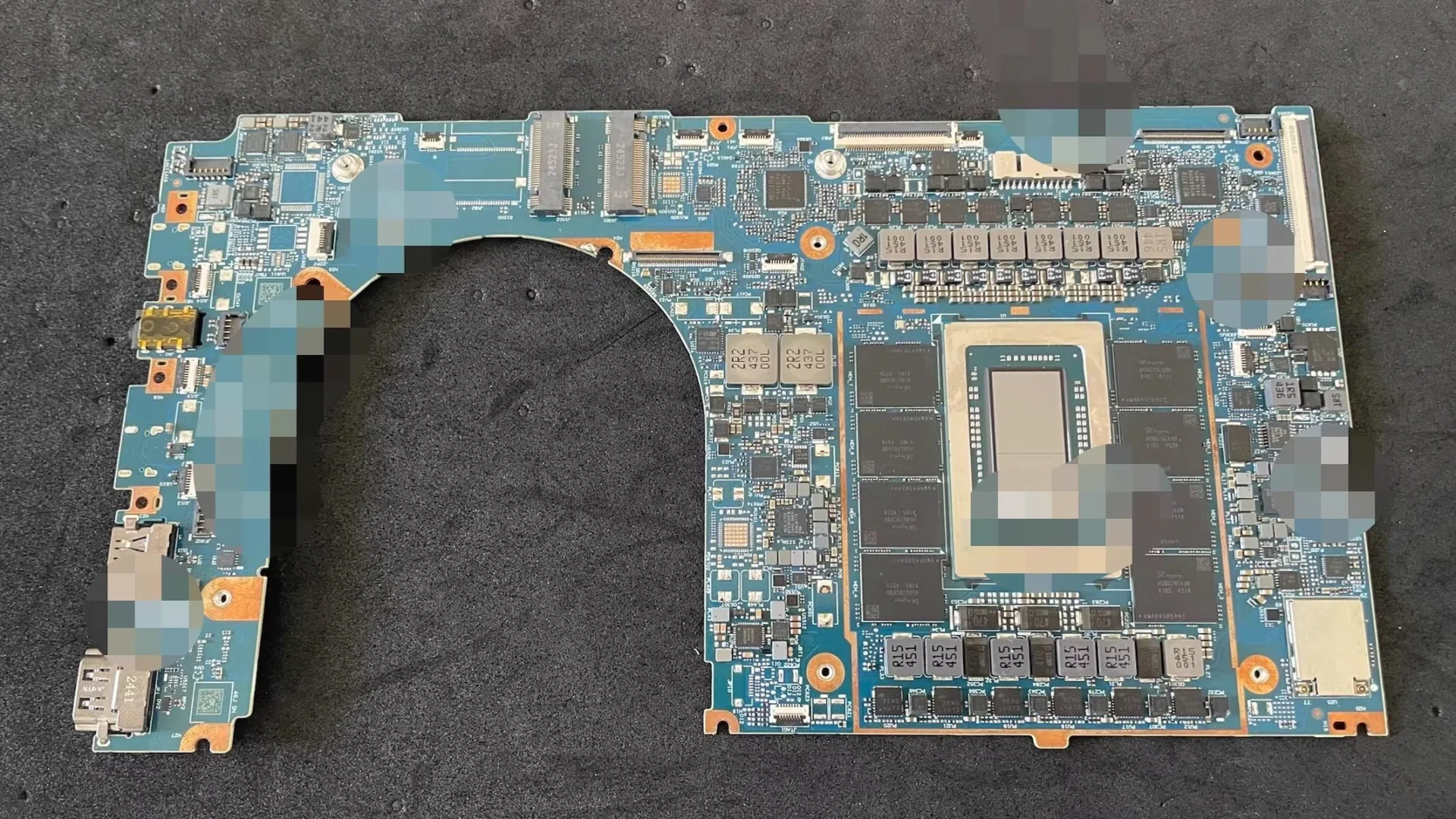
A Goofish marketplace listing has surfaced what appears to be an engineering-sample laptop motherboard built around an unannounced NVIDIA N1 SoC. The photos are the real hook: a compact board, a large NVIDIA-branded package in the middle, and eight SK hynix memory packages arrayed around it.
The big claim attached to those images is that the board carries 128GB of LPDDR5X, apparently derived from eight SK hynix packages marked H58G78CK8B, with each package interpreted as 16GB. Several outlets that examined the leak, including VideoCardz and Notebookcheck, described the board as an early NVIDIA N1 laptop platform sample.
That does not mean 128GB support is confirmed. There are still no public SPD dumps, no firmware readouts, no OS-level screenshots, and no benchmark captures from this sample. The board is also said to be non-functional without proprietary NVIDIA firmware. So what the listing shows is strong physical evidence of a high-memory configuration, not a finished product spec sheet.
What the leak actually shows
The listing and the reporting around it point to a few concrete details:
The memory interpretation is where most of the attention is going. As Club386 noted, the SK hynix part markings appear consistent with high-capacity LPDDR5X packages that could line up with a 16GB-per-package reading. But "could" matters here. Without live firmware or board telemetry, that remains an informed read of the hardware, not proof.
Why 128GB matters more on this kind of chip than on a normal laptop
If this board really is configured with 128GB of LPDDR5X, that would be one of the clearest signs yet that NVIDIA's PC SoC ambitions are not limited to thin-and-light office machines.
On a conventional x86 laptop, very high memory capacity can be useful, but it is often just one line item among many. On an ARM SoC with integrated graphics and local AI ambitions, unified memory capacity can matter a lot more. CPU workloads, GPU workloads, and AI inference all draw from the same pool. That changes the conversation.
A 128GB LPDDR5X setup would suggest a machine aimed at workloads such as:
- larger local AI models and bigger context windows
- content creation tasks that benefit from large unified memory pools
- heavier GPU-accelerated compute without a separate discrete VRAM pool
- workstation-style use cases in a mobile chassis
That also fits the broader public context. NVIDIA CEO Jensen Huang confirmed in January 2026 that NVIDIA is collaborating with MediaTek on a low-power, high-performance ARM-based SoC for AI PCs. So while the specific board is leaked and unverified in detail, the idea of NVIDIA building an ARM laptop platform is no longer speculative.
The bandwidth estimate is interesting, but still an estimate
The dossier attached to the leak claims LPDDR5X-8533 and a 256-bit memory bus, which would put theoretical bandwidth around 267 GB/s using the stated formula, as both HotHardware and RS Web Solutions echoed with similar math.
That figure should be treated carefully.
First, the 256-bit bus is inferred, not confirmed by NVIDIA. Second, theoretical bandwidth is not measured performance. Third, actual usable throughput depends on controller design, clocks, thermals, workload behavior, and how aggressively the SoC shares memory among CPU, GPU, and NPU-like functions.
Still, if the estimate is even roughly in the right neighborhood, it helps explain why this leak got attention. Around 267 GB/s would be a serious number for a laptop-class integrated platform, especially if paired with a Blackwell-derived GPU block as has been claimed in reporting around the N1 family.
The board layout hints at a higher-power class than "fanless AI PC"
Some of the less flashy details may be the more useful ones.
The reported 8+6+2 phase VRM and the large cutout that appears to accommodate a blower-style cooling fan suggest this is probably not a tablet-like or passive design. As TechSpot observed, that kind of power delivery points to a platform that may draw meaningful power under load.
That does not automatically mean a huge TGP or a gaming-laptop thermal envelope. Engineering samples often use overbuilt board layouts, and cooling provisions on prototype boards can be more conservative than final products. But it does push against the simplest reading of "ARM laptop" as synonymous with ultra-low-power.
The visible I/O also feels practical rather than glamorous: one HDMI, one USB-A, one USB-C, and a 3.5mm jack, plus reportedly two M.2 2242 slots. That's not enough to define the final product category, but it does look more like a testbed for an actual notebook platform than a lab-only carrier board.
This leak may say more about product direction than launch timing
There has been roadmap chatter for months. Tom's Hardware summarized earlier claims that N1X-based Windows-on-Arm laptops were expected in Q1 2026, with more variants in Q2. Other coverage has tied the N1 family to a broader Windows-on-Arm push rather than a one-off dev kit.
This board doesn't confirm any of that schedule. If anything, the lack of usable public firmware is a reminder that leaked hardware can appear before a platform is software-ready. Silicon is one thing; shipping notebooks need firmware, drivers, thermals, OEM integration, and Windows-on-Arm polish.
What the leak does support is a narrower point: NVIDIA appears to have hardware in the wild that looks much closer to a real laptop motherboard than a vague rumor slide. That's meaningful even if launch windows remain fuzzy.
What to watch next
The most important missing pieces are not glamorous:
Until at least some of those show up, the safer reading is that this leak reveals possible hardware capability, not final retail positioning.
If you're tracking NVIDIA's move into Windows-on-Arm PCs, this leak is worth paying attention to because it suggests a more ambitious memory setup than many expected. A 128GB unified-memory configuration, if real, would point to workloads beyond basic Copilot+ laptop duty.
But the evidence still has limits. The photos support the existence of an engineering board and a high-capacity memory layout. They do not yet verify shipping specs, real bandwidth, final power targets, or which laptops, if any, will actually expose that full configuration. The most sensible conclusion remains a conditional one: the N1 platform looks increasingly real, and it may be aimed higher up the stack than a typical ARM laptop — but the details that matter most are still trapped behind missing firmware and unfinished hardware.










Comments