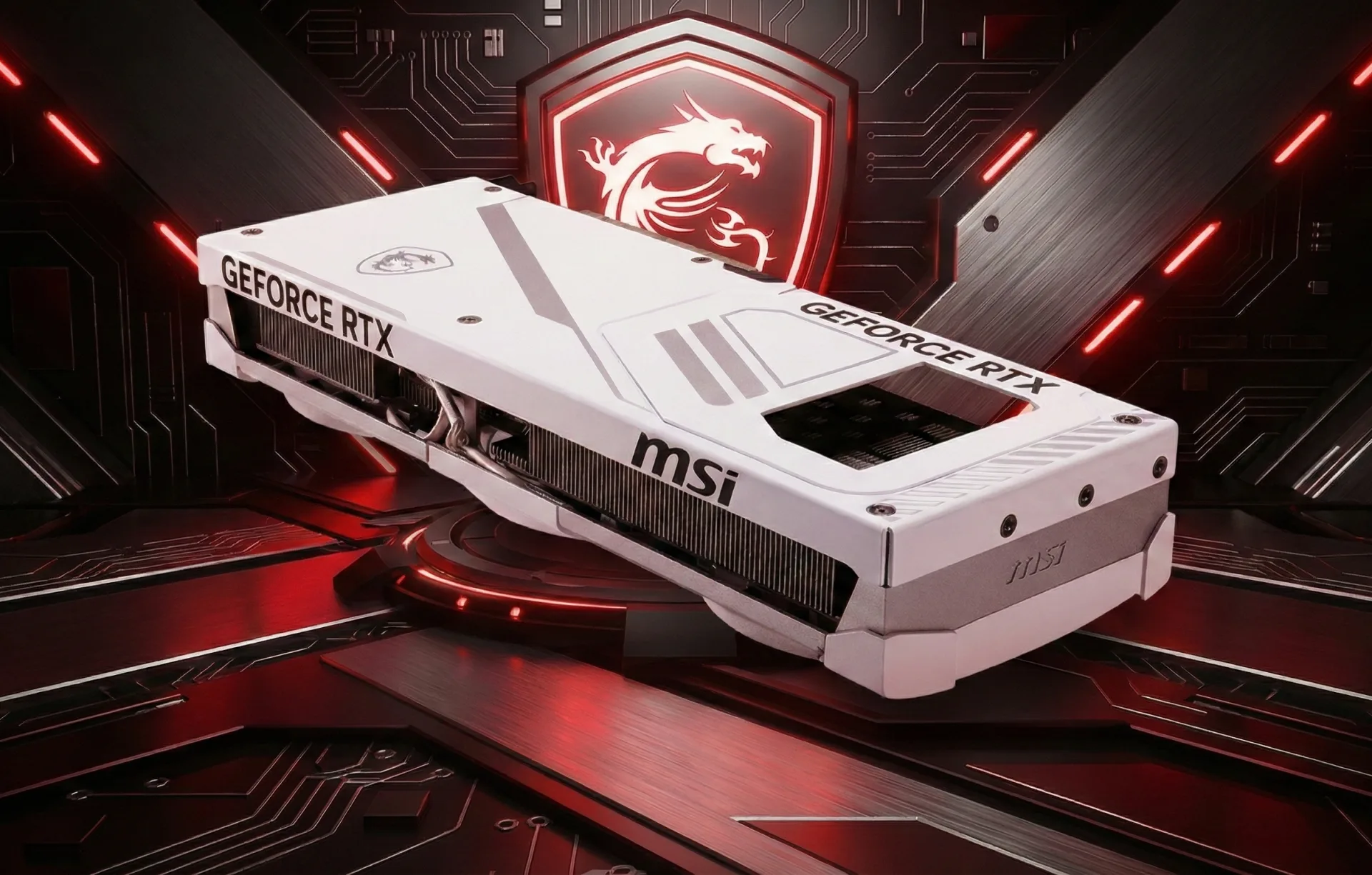
Launched in February 2025, the NVIDIA GeForce RTX 5070 Ti landed as a particularly intriguing entry in the high-end GPU market. It arrived after the initial wave of Blackwell architecture cards, including the powerful RTX 5070, RTX 5080, and RTX 5090, perhaps aiming to bring serious muscle to a more mainstream segment. Today, we've taken a deep dive into MSI's specific take on this GPU: the MSI GeForce RTX 5070 Ti 16G VENTUS 3X PZ OC. While the hardware itself is undoubtedly impressive, our glance at current retail prices paints a challenging picture for potential buyers, suggesting its road ahead may be fraught with marketplace woes.
Blackwell Unleashed: Raw Power Meets AI-Driven Future
At its core, the RTX 5070 Ti is powered by a cut-down GB203 GPU, built on NVIDIA's advanced 4nm Blackwell architecture. This is a significant architectural leap, featuring a dual-die configuration with a 10 TB/s chip-to-chip interconnect that allows NVIDIA to overcome traditional photolithography limits, essentially creating a unified, larger GPU. This design means access to the latest generation technologies like DLSS 4 with Multi Frame Generation (MFG), Ray Reconstruction, and the game-winning responsiveness of NVIDIA Reflex 2 with Frame Warp. Blackwell also introduces fifth-generation Tensor Cores with FP4 precision, enabling impressive gains in AI workloads.
And the performance gains we observed are palpable. MSI's factory-overclocked Ventus 3X PZ OC variant hits a Boost Clock of 2452 MHz out of the box, with an extreme performance mode pushing it to 2497 MHz. In raw terms, we're looking at a considerable gen-on-gen improvement, delivering roughly 20% higher performance than the RTX 4070 Ti at 4K gaming. Synthetic benchmarks and certain gaming scenarios even show it outperforming the RTX 4080 Founders Edition and AMD's Radeon RX 7900 XTX in pure rasterization. This positions the 5070 Ti as a truly high-performance card, offering a compelling upgrade for many.
However, the real showstopper, as with all Blackwell cards, is DLSS 4 and its Multi Frame Generation (MFG). With MFG enabled, the RTX 5070 Ti can achieve frame rates that even a native-rendering RTX 4090 struggles to match. For instance, in Star Wars Outlaws at 4K with 4x MFG, the 5070 Ti can hit an impressive 114 fps, compared to the RTX 4090's 90 fps natively. This is a dramatic leap for many, though it's crucial to remember this isn't "native" performance. While DLSS 4 performs black magic in making path-traced games feel like they're running on a supercomputer, a decent base framerate is still needed for the best experience. For those who dabble in more than just gaming, the card also exhibits strong AI and Compute performance, nearing the RTX 5080 FE in MLPerf token generation. This is due to Blackwell's enhanced Tensor Cores and efficient architecture, which are designed for demanding AI and deep learning tasks, with VRAM bandwidth being a key factor for model sizes.
Ventus 3X PZ: The Cool, the Loud, and the Compact
MSI has engineered the Ventus 3X PZ OC with a clear focus on effective cooling and a practical design. Its triple-fan TORX Fan 5.0 thermal solution, featuring double ball bearings and a nickel-plated copper baseplate, is indeed highly effective. The inclusion of Square Core Pipes maximizes contact with the GPU die, ensuring heat is swiftly transferred away. We found that under heavy loads, the GPU core impressively maintains low temperatures, hovering around 65.5°C in Cyberpunk 2077 and maxing out at 69.2°C in the punishing FurMark stress test. This thermal efficiency is excellent, minimizing throttling and ensuring consistent performance, which is exactly what we want to see from a high-end card.
The design itself is sturdy and refreshingly no-frills, moving away from some of the more aggressive, angular aesthetics of previous Ventus models. We particularly appreciate its SFF-Ready (Small Form Factor) designation, allowing it to fit into many compact builds despite its triple-fan cooler, thanks to its 303 x 121 x 49 mm dimensions and slightly-more-than-dual-slot occupancy. MSI's "Zero-Trace Power Path" also thoughtfully conceals power cables for a cleaner look, and the metal magnetic backplate not only adds rigidity and improves airflow through vents but also simplifies assembly. Even the inclusion of a GPU support stand in the box is a thoughtful touch we wish more manufacturers would adopt.
However, "quiet" is a nuanced term here, and it's where our skepticism arises. While MSI's Zero Frozr technology admirably keeps the fans completely off at idle, making it silent for desktop use, they can get quite vocal under load. Reviewers recorded gaming load noise levels at 43.22 dB(A), which is certainly noticeable, and pushed to 51.56 dB(A) in FurMark, which we consider genuinely loud. To put this in context, noise levels above 40 dB(A) are generally considered audible during gaming, and pushing past 50 dB(A) can easily become distracting, especially for users who value a quiet system. While this might be a trade-off for its excellent thermal performance, it's a significant point for noise-sensitive users that MSI perhaps hasn't fully addressed.
Power, Ports, And Peculiarities
Powering the RTX 5070 Ti is a single 16-Pin (12VHPWR / 12V-2x6) connector, requiring a recommended 750W PSU. The card is energy efficient, drawing around 266W in Cyberpunk 2077. Its total graphics power is capped at 300W with no option to increase the power limit – a minor restriction for extreme overclockers who might wish to push it further.
Speaking of that 12VHPWR connector, MSI's implementation on the Ventus PZ model has drawn criticism. The recessed design makes the dongle difficult to grasp and insert snugly, requiring careful handling or even a specialized tool, as one reviewer noted. We've seen similar frustrations echoed in the community. Improper connection can lead to serious issues, though the newer 12V-2x6 standard mandated for RTX 50-series cards aims to mitigate this by preventing power delivery if the sense pins aren't fully seated. Still, caution is advised.
Display outputs are generous and forward-looking, with three DisplayPort 2.1b and one HDMI 2.1b, supporting up to four monitors. On the aesthetic front, the card's lack of RGB lighting might disappoint some users who prefer illuminated components, and the absence of a dedicated VBIOS mode switch is a minor inconvenience for enthusiasts accustomed to such options.
The VRAM Question And The Pricing Predicament
The MSI RTX 5070 Ti arrives with 16GB of GDDR7 memory running at a blistering 28 Gbps on a 256-bit bus, providing a healthy 896 GB/s of bandwidth. For most current and foreseeable gaming scenarios at 1440p and even 4K, we believe this is perfectly adequate. Indeed, 16GB is often considered "good for now" for 4K gaming, with only a few games truly pushing past this limit.
However, for those pushing the absolute limits of 4K gaming with demanding settings like full path tracing in texture-heavy titles, the 16GB VRAM can become a limitation. We acknowledge reviewers noting scenarios where this could lead to "very low frame rates" – essentially a slideshow – even with DLSS and frame generation attempting to mitigate the issue. Some particularly demanding titles at max 4K settings have been observed to utilize upwards of 20GB of VRAM. While DLSS and frame generation can significantly reduce effective VRAM usage by upscaling from a lower internal resolution, this remains a niche but legitimate concern for the most extreme users targeting uncompromised 4K path tracing, raising questions about future-proofing at this card's price point.
Now, for the elephant in the room: pricing. NVIDIA's MSRP for the RTX 5070 Ti was $749, and MSI's own website lists this card at $829.99. However, our checks today, January 22, 2026, reveal real-world retail prices are significantly higher. Newegg, for instance, listed the card on January 17, 2026, for a staggering $1256. This is where the brilliant engineering and performance of the 5070 Ti clash head-on with stark market realities.
The RTX 5070 Ti is a partner-card-only launch, meaning no Founders Edition to anchor pricing, which often contributes to price volatility. Compounding this, the global GPU market in early 2026 is experiencing renewed upward pressure on prices. This isn't just a fleeting blip; demand for high-bandwidth memory (GDDR7, HBM) from burgeoning AI data centers is soaring, pushing memory costs up dramatically, sometimes accounting for up to 80% of a GPU's total bill of materials. Reports indicate that NVIDIA itself may be considering a 30-40% reduction in production for some consumer RTX 50-series cards, prioritizing higher-margin AI accelerators. This reduced supply amidst ongoing demand creates ripe conditions for price gouging.
At $1256, this card is not only far above its intended price point but also encroaches on the territory of the RTX 5080's MSRP of $999. This makes its value proposition severely compromised, regardless of its technical merits. Further compounding this, we found a concerning user report of constant freezing/stuttering and an unsatisfactory MSI support/RMA process, which adds a layer of concern regarding after-sales experience. While an anecdote, it's worth noting in such a high-value purchase.
Verdict: A Top-Tier Performer Derailed By Reality
The MSI GeForce RTX 5070 Ti 16G VENTUS 3X PZ OC is a marvel of engineering, delivering exceptional gaming performance, often exceeding the RTX 4080 FE and even challenging the RTX 4090 with DLSS 4 enabled. Its cooling solution is highly effective, maintaining impressively low GPU temperatures, and its SFF-ready design is a boon for compact builds. We also appreciate its solid overclocking headroom, which can push performance closer to the RTX 5080.
However, its positive attributes are overshadowed by significant drawbacks, leaving us with a bittersweet impression. The fan noise under load is a genuine concern for many noise-sensitive users. The 12VHPWR connector design, specifically its recessed nature, is frustrating and potentially risky if not perfectly seated. While the 16GB VRAM is generally sufficient, we acknowledge it could prove limiting in specific, ultra-demanding 4K path-tracing scenarios without heavy reliance on upscaling. But by far the biggest impediment is its real-world retail price. At its nominal MSRP of $749-$829.99, it would be an easy recommendation for enthusiasts seeking top-tier 1440p to high-refresh 4K gaming, representing a strong value in its intended tier.
But at current street prices exceeding $1200, we simply cannot recommend it. The premium is too high, negating its intrinsic value and pushing it into unfair competition with GPUs that offer better raw value at that elevated price point, or soon will. It's a fantastic card trapped in an unfavorable market.
Recommendation: If you can somehow find the MSI RTX 5070 Ti Ventus 3X PZ OC close to its MSRP ($750-$850), it is a fantastic, high-performance card for 1440p and most 4K gaming, particularly if you value its compact, efficient design and Blackwell features. However, at current street prices exceeding $1000, we simply cannot recommend it. The premium is too high, negating its intrinsic value and pushing it into unfair competition with GPUs that offer better raw value at that elevated price point. Hold out for price corrections or consider alternatives unless you have money to burn and need the specific form factor.




Comments