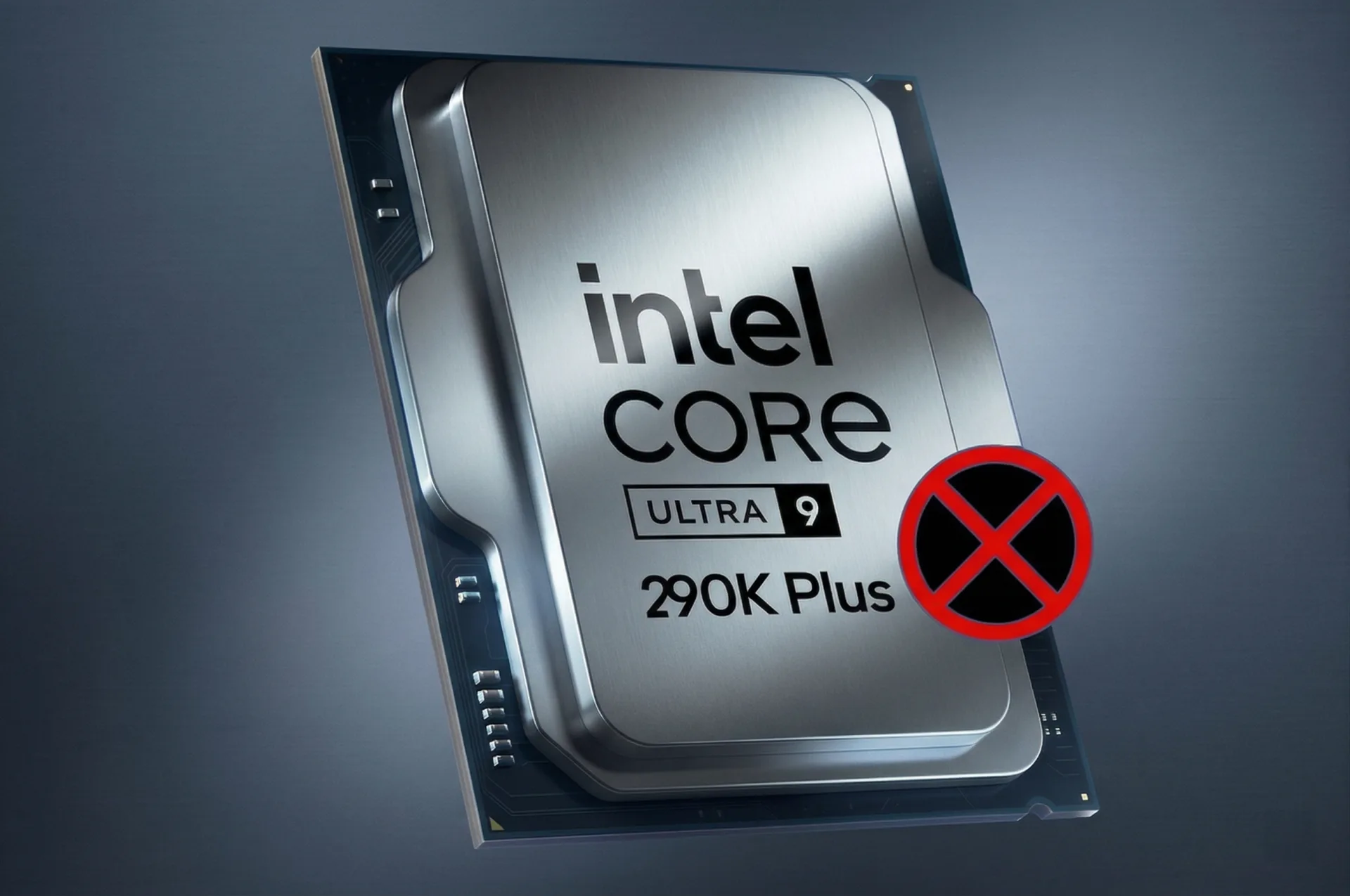
Intel did not put a Core Ultra 9 290K Plus on stage when it introduced the Core Ultra 200S Plus desktop refresh on March 11, 2026. The company launched the Core Ultra 7 270K Plus and Core Ultra 5 250K Plus / 250KF Plus instead, and its updated support documentation for desktop processor collections uses those parts as the Series 2 desktop examples. There is no 290K Plus entry in that official stack.
That matters more than another round of retailer rumor or benchmark archaeology. As of March 26, Intel still has not published a standalone cancellation notice, press release, or public product-change bulletin spelling out that the 290K Plus is dead. But the practical signal from Intel's own materials is now pretty clear: the SKU is not part of the shipping Core Ultra 200S Plus lineup.
That is not the same thing as a neat, one-line corporate cancellation statement. It is, however, the strongest public confirmation available.
What Intel has actually shown
Here is the cleanest version of the evidence so far:
The launched parts are:
Intel's own framing also puts the spotlight elsewhere. The company described the Core Ultra 7 270K Plus as "Intel's fastest desktop gaming processor ever." That line is hard to square with a still-pending higher-tier Plus-branded desktop launch, at least in the near term.
The missing piece: there still isn't a formal public cancellation notice
This is where the story needs a little discipline.
There are reports circulating today that cite an Intel representative, Florian Maislinger, saying the company is not launching a "U9 290K Plus SKU" and is instead focusing on the desktop parts that are more widely available, as The FPS Review reported. If that quote is authentic and complete, it would function as the direct confirmation many people were waiting for.
But the underlying research here is more careful than that. The strongest confirmed signal remains Intel's omission of the part from official launch and support documentation, not a publicly archived Intel press release saying the processor will not ship.
So the most accurate way to put it is this: Intel has effectively confirmed that the Core Ultra 9 290K Plus is not being released as part of the Core Ultra 200S Plus desktop refresh, even if the public-facing paper trail stops short of a formal cancellation bulletin.
Why the omission matters more than the rumor mill
There were plenty of reasons to think the 290K Plus might still appear. Leaks, retailer references, and benchmark entries made it look real enough. Some benchmark sightings even suggested that engineering samples had progressed well into validation.
That sort of evidence can tell you a product existed in some meaningful pre-release form. It cannot tell you whether the product survives contact with the final lineup.
Intel's launch stack now answers that more decisively than leaks ever could. If a desktop refresh reaches announcement day and retail day without a supposedly top-bin SKU appearing in launch materials, support pages, or buyable product lists, the burden of proof flips. At that point, anyone arguing for a later release needs stronger evidence than old benchmarks.
Historically, that matters too. There is no known Core Ultra desktop precedent for Intel excluding a planned tier from launch and then quietly reintroducing it later. Reporting around the 290K Plus has described the move as a stack adjustment rather than a delay, as VideoCardz noted.
That does not make a surprise return impossible. It does make it look unlikely.
Why Intel may have decided the 290K Plus wasn't necessary
This is where analysis needs to stay conditional, because Intel has not published a detailed rationale in the official launch materials.
Still, the likely explanation is not hard to see from the reported specs and the products Intel did ship.
Leaked and retailer-listed 290K Plus configurations generally pointed to a part with:
The key issue is that the launched Core Ultra 7 270K Plus is also widely reported as a 24-core 8P+16E chip with the same class of memory support and power envelope, just at somewhat lower clocks, as ExtremeTech noted when both parts appeared in early retailer listings.
If those leaked specs are even broadly accurate, the 290K Plus may have been awkwardly positioned from day one. It would have looked less like a fundamentally different flagship and more like a higher-binned version of a chip Intel was suddenly willing to sell much lower in the stack.
That is a plausible reason for omission. Not a proven one, but a plausible one.
The 270K Plus may have made the 290K Plus hard to justify
This is probably the biggest practical takeaway in the whole story.
Independent reporting around the Core Ultra 7 270K Plus suggests it already lands in a strange, aggressive spot for Intel. It reportedly outperforms the older Core Ultra 9 285K in some multi-threaded workloads, or at least gets close enough to muddy the stack badly, while Intel itself is marketing it heavily on gaming, as VideoCardz observed when examining the canceled chip's benchmark appearances.
If the unlaunched 290K Plus was only offering a modest clock bump on top of the same 8P+16E layout, then the likely real-world gap versus the 270K Plus may have been fairly narrow outside benchmark-friendly productivity runs.
Here's the comparison as currently understood:
That helps explain why a formal flagship refresh may have lost its urgency. Not because the 290K Plus was necessarily weak, but because the 270K Plus appears to have absorbed much of the practical appeal a 290K Plus would have needed to monetize.
What the leaked benchmarks do, and don't, tell us
Some benchmark sightings for the 290K Plus painted a flattering picture. One widely discussed set of numbers suggested roughly a 10% uplift over the Core Ultra 9 285K in Geekbench 6, with gains largely attributed to frequency increases rather than a new core layout, as TweakTown reported when the scores first surfaced.
Taken at face value, that would make the 290K Plus a legitimate halo part for heavily threaded desktop workloads.
But there are three caveats.
First, those scores come from a product that never launched, so there is no retail silicon to validate against broad review data.
Second, leaked benchmark results are often best-case snapshots. They can show what a chip can do under a particular board, firmware, cooling setup, and power policy. They do not automatically map to normal retail behavior.
Third, the likely gaming picture appears less dramatic. Even generous projections tend to imply only single-digit percentage gains over the 270K Plus in games, while AMD's X3D chips would probably have remained ahead in that metric anyway, according to PassMark's CPU benchmark data for the unlaunched part.
So the canceled part may have been impressive on paper without being indispensable in the market.
Why Intel's gaming claim around the 270K Plus is significant
Intel calling the 270K Plus its fastest desktop gaming processor ever was not just launch copy. It also looked like a clue about how the company wanted this refresh understood.
If Intel had a near-term plan to launch a 290K Plus above it, that messaging would have been oddly narrow. Instead, the company seems to have made the 270K Plus the face of the refresh. That suggests Intel wanted one of two things, or perhaps both:
- a simpler desktop refresh stack
- a better performance-per-dollar story centered on a lower-tier badge
Again, that is inference, not a stated strategy document. But it lines up with the products Intel actually released.
It also helps explain why enthusiasts have been split on the story. Some community discussion has focused on whether a 290K Plus was technically viable, citing engineering samples, benchmark entries, and presumed binning headroom. Others have argued that viability and commercial usefulness are different questions. By March 26, the evidence on the latter is stronger than the former, as HotHardware concluded after the benchmark sightings were examined.
Retail and board ecosystem signals are quiet, which tells its own story
Another detail here is what hasn't happened.
There has been no publicly surfaced retailer-facing discontinuation memo included in the available reporting. Motherboard vendors and system builders also do not appear to have issued any special compatibility guidance specifically around the 290K Plus. The ecosystem has simply moved on to the launched parts.
That kind of silence can be frustrating if you want a dramatic "canceled" stamp. But in practice, it often means the industry has already normalized around the final stack. Retailers sell what ships. Board makers validate what launches. If neither group is publicly treating the 290K Plus as an active incoming product, that reinforces Intel's omission rather than contradicting it.
What this likely means for desktop buyers
The direct impact is fairly simple.
If you were waiting for a Core Ultra 9 290K Plus, there is now little public evidence that Intel intends to bring it to retail. Not zero evidence, but not much beyond old leaks and benchmark remnants. Intel's official desktop refresh lineup has moved on without it.
For actual shopping decisions, the more relevant question becomes whether the launched lineup already covers the use case the 290K Plus was supposed to fill.
Based on the available reporting, that answer may be "yes" for a lot of people:
- Productivity-focused buyers may find the Core Ultra 7 270K Plus already reaches close enough to the rumored 290K Plus shape to make the missing flagship less important.
- Gaming-focused buyers probably were not depending on the 290K Plus to rewrite the competitive picture anyway, since leaked expectations still left AMD's X3D chips ahead in many game workloads.
- Enthusiasts chasing the fastest possible Intel desktop CPU are the group most likely to feel the absence, because the 290K Plus appears to have been the higher-clocked expression of this refresh, even if only by a modest margin.
The safest reading now is that Core Ultra 9 290K Plus is not coming as a retail Core Ultra 200S Plus desktop product, even though Intel has not issued a neat standalone cancellation notice. What Intel has officially done is omit the chip from the launch, omit it from the support stack, and put its messaging behind the 270K Plus and 250K Plus parts that are actually on sale. If that changes, it would require a new public signal from Intel, not another recycled benchmark listing. Until then, anyone tracking this part should probably treat it as an interesting almost-product: real enough to have existed in testing, but not real enough to count on for a build.











Comments