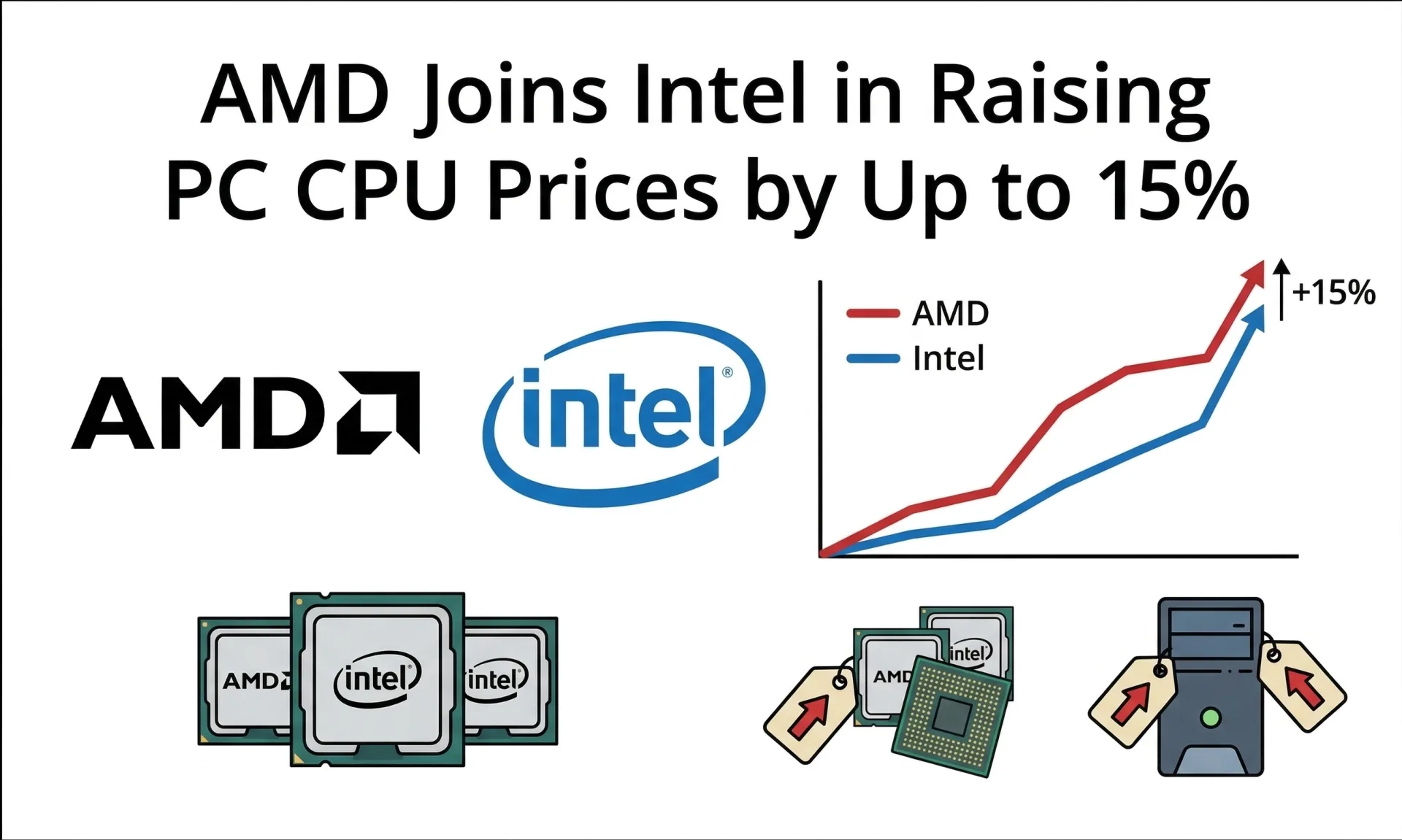
New reporting points in the same direction for both AMD and Intel: CPU prices are moving up, and April 2026 is the date to watch. The broad claim circulating this week is that both companies are implementing or preparing 10% to 15% increases across PC CPUs.
That is the clean version. It is also the part that needs the most caution.
What looks reasonably well supported is that AMD and Intel have told clients about upcoming price changes, that the changes appear to start upstream at the distributor level, and that lead times have stretched sharply, from roughly 1–2 weeks to 8–12 weeks, with some orders reportedly slipping much further. What is less settled is the exact shape of those increases once they hit desktop retail shelves, especially on AMD’s side.
For Intel, there is at least firmer public reporting that some notebook CPUs, particularly entry-level and older-generation parts, have already seen increases above 15%, with more planned in Q2. For AMD, the claim that there is a clean, universal 15% hike across desktop Ryzen retail pricing is weaker. The strongest public evidence in the 10% to 15% range appears to be tied more clearly to server CPUs than to fully documented Ryzen desktop MSRP changes.
That distinction matters. A lot.
What seems to be happening now
The current picture looks less like a neat MSRP reset and more like a channel repricing event that may only become obvious after older inventory clears.
The reported mechanism is straightforward: AMD’s price adjustment is said to begin at the distributor level, which means retailers are unlikely to flip every listing overnight. Instead, they would sell through cheaper stock first, then reorder at higher wholesale rates. That tends to produce a slower, less uniform effect in actual checkout prices.
Historically, that is how these shifts often play out. Distributor-level CPU increases have previously landed first in wholesale channels, while retail pricing lagged by days or weeks depending on inventory and promotions. In some past cases, holiday discounts temporarily hid the increase before prices drifted upward again as fresh stock arrived.
So if shoppers are expecting an obvious “+15%” sticker on every Ryzen listing by next week, that may be the wrong model. The cleaner expectation, if the current reporting holds, is fewer deals first, then selectively higher street pricing.
AMD is named directly, but the evidence is uneven
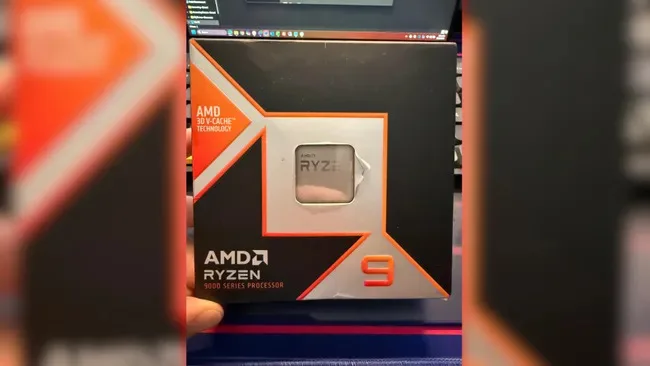
AMD’s Ryzen 7 9800X3D is explicitly mentioned as part of the pricing adjustments in the current reporting. More broadly, the reported scope includes Ryzen 9000 desktop CPUs and older Ryzen parts. That suggests the signal is not limited to one niche SKU.
But there is a real gap between “price pressure is coming to Ryzen retail” and “AMD has formally raised MSRP by 15% across the whole desktop stack.”
That gap is where most of the uncertainty sits.
The clearest public version of the AMD story is that retailers may start showing higher prices after discounted inventory sells through and replacement stock arrives at higher wholesale cost. That would fit the reports of client notifications and longer lead times. It does not, by itself, prove a universal desktop MSRP revision.
Here is the practical split:
That leaves AMD in an awkward but familiar position: enough smoke to take seriously, not enough clean documentation to call the desktop case settled.
Intel’s side is less about one desktop leak and more about broader price pressure
Intel is part of the same overall reports, but the strongest documented signals are somewhat different.
There are listings tied to Intel’s Arrow Lake Refresh “Core Ultra 200S Plus” desktop parts, including the Core Ultra 5 250K Plus and Core Ultra 7 270K Plus. What is missing, however, is hard proof that those specific desktop SKUs are the ones taking a 15% jump.
The firmer evidence around Intel is that certain notebook CPUs have already gone up by more than 15%, especially older and lower-end models, with more increases expected in the second quarter. That does not automatically map one-to-one onto the desktop chips enthusiasts care about, but it does suggest this is not just a rumor floating in one corner of the supply chain.
If both companies are pushing prices upward at roughly the same time, the useful reading is probably not “desktop buyers are being singled out.” It is more likely that PC CPUs are getting caught in a broader component and capacity squeeze.
Why the supply explanation is plausible
The context around these reports is not mysterious, even if the exact pricing numbers are.
The main theme is supply chain strain paired with production prioritization toward server CPUs and AI-related demand. That does not necessarily mean mainstream desktop CPU wafers are vanishing. The stronger argument is more indirect: as higher-margin server and AI products pull capacity, packaging, memory supply, and capital attention, the cost structure around consumer PCs gets worse too.
As Trendforce's 2026 outlook detailed, heavy investment is moving toward HBM, advanced packaging, and AI infrastructure, with standard PC memory and other mainstream components seeing tighter supply as a result. That does not prove every Ryzen desktop CPU must get a 15% hike. But it does make the overall pricing environment look credible.
The lead-time jump in the current reports strengthens that interpretation. When order windows stretch from 1–2 weeks to 8–12 weeks, and in some cases much longer, it usually signals a channel that is under stress, whether from allocation, logistics, or cautious supplier behavior.
Why this may show up as fewer discounts, not just higher list prices
One reason leak-cycle pricing stories often feel exaggerated is that retailers do not always pass cost increases through cleanly.
In highly competitive categories, sellers often react by trimming promotions, reducing couponing, or letting sale prices expire rather than immediately lifting list prices. That pattern matters here, because several of AMD’s desktop parts have recently existed in a market where street price mattered more than launch MSRP.
That is especially true for AMD’s higher-end X3D stack.
The Ryzen 9 9950X3D launched with a $699 anchor, while the Ryzen 9 9900X3D has already faced criticism for weak value relative to both the cheaper 9800X3D and the more capable 9950X3D. In other words, some AMD desktop parts were already in a delicate pricing position before this latest round of reports.
That makes a blanket “everything goes up 15% and nothing changes” reading too simple. On some chips, AMD and its retail partners may have room to let discounts fade. On others, especially where the product is already seen as expensive for what it does, sustained increases could be harder to hold.
The X3D angle makes AMD’s desktop story more complicated than Intel’s
AMD’s current desktop lineup is not one where every part occupies an equally comfortable price slot.
The Ryzen 7 9800X3D has a clearer role as a gaming-focused favorite. The Ryzen 9 9950X3D can at least lean on its top-end positioning. The Ryzen 9 9900X3D, by contrast, has already drawn scrutiny because its place in the stack looks awkward even before any rumored hike. Reviews and community discussion have repeatedly framed it as the most vulnerable model on value grounds.
That is why the desktop-Ryzen pricing story should be read in layers:
- A channel-wide cost increase can be real.
- A retail price increase can follow.
- But the ability to hold that increase evenly across all SKUs is another question.
AMD may find that some chips absorb higher wholesale prices with little friction, while others need promotions to keep moving. That would not contradict the reported price action; it would simply show how messy retail pricing becomes once value perception gets involved.
Community reaction has been skeptical for a reason
Enthusiast reaction has not been disbelief so much as qualified skepticism.
A lot of the pushback has centered on a familiar point: headline figures around CPU “price hikes” often blur together several different things — a distributor increase, the end of seasonal discounts, a temporary stock shortage, and a true MSRP change. The current AMD reporting has elements of all four, which is part of why people are arguing past each other.
That skepticism is healthy here. There have already been recent cases where supposed Ryzen price-hike stories were later reframed as discounts ending rather than permanent pricing resets. At the same time, that history does not invalidate the current reports. It just means desktop buyers should watch real street prices and stock behavior, not just the biggest percentage in the headline.
What to watch next
The next few weeks should clarify whether this is mostly a wholesale correction or a broad consumer price move.
The most useful signals will be:
The practical takeaway
The safest reading today is not that AMD has definitively raised every desktop Ryzen price by 15%. The safer reading is narrower: there are credible reports of upstream CPU price increases affecting both AMD and Intel, with desktop retail pricing likely to feel the effect as inventory turns over.
If you are tracking a specific CPU, especially an AMD desktop part like the Ryzen 7 9800X3D or one of the Ryzen 9000 X3D models, the thing to monitor is not just MSRP. Watch whether discounts disappear, whether restocked units come back higher, and whether multiple retailers move together. That would tell you more than any single leaked percentage.
For now, the evidence supports price pressure. It does not yet fully support a universal, precisely measured 15% desktop Ryzen retail hike. That is a smaller claim, but at this stage it is also the more defensible one.










Comments