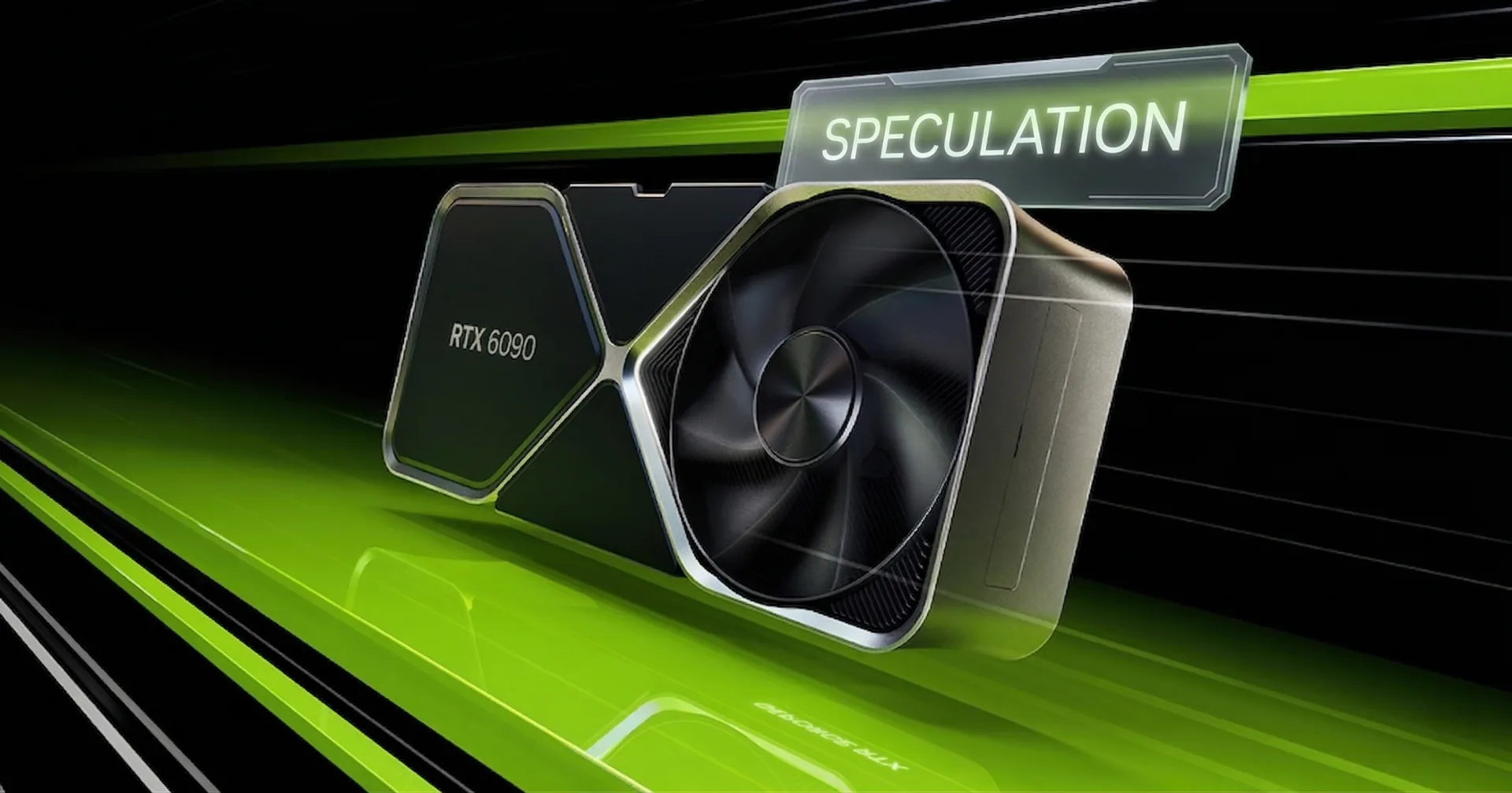
A fresh round of leaks is painting an unusually aggressive picture for NVIDIA's next GeForce generation: a Rubin-linked RTX 60-series with much bigger gains in ray tracing than in plain raster performance, plus wider memory buses and, at the top end, a very large flagship die.
That sounds dramatic. The evidence is not dramatic. It is also not settled.
As of today, NVIDIA has not officially confirmed any GeForce RTX 60-series specifications, and it also has not publicly confirmed that consumer GeForce parts will use Rubin at all. Public Rubin branding from NVIDIA has so far been tied to AI and data-center products, not gaming GPUs. That distinction matters, because the current story is being built from leak claims, part naming patterns, and extrapolation from NVIDIA's data-center roadmap.
Still, the latest listings and rumor roundups do point in a consistent direction.
The rumored lineup so far
Here's the shape of the leak as it currently stands:
The GR202/GR203/GR205 naming has shown up across multiple leak aggregations, as reported by HotHardware, Overclock3D, and TweakTown. That does not make the specs true, but it does suggest the rumor is spreading from a shared source rather than being invented independently by every outlet.
For the top card, the most eye-catching claim is 192 SMs on the RTX 6090. If that figure holds, it would be about a 13% increase over an RTX 5090 figure of 170 SMs, as Club386 has highlighted in its leak writeup.
Why the performance claim is getting attention
The headline rumor is not just "more cores." It is the suggestion that NVIDIA is aiming for up to 2x path-tracing performance over the RTX 50-series, while targeting a more modest 30% to 35% uplift in raster performance without ray tracing.
That split is believable in one narrow sense: ray tracing performance does not scale only with shader count. It can move much more sharply if a company changes the RT hardware itself, the scheduling around it, memory behavior, or the software stack driving denoising, reconstruction, and frame generation. The leak package claims 5th-generation RT Cores and 6th-generation Tensor Cores, which is exactly the kind of architectural change that could create a bigger gap between traditional rendering gains and path-traced gains.
But "could" is doing real work there.
A claimed 2x path-tracing uplift does not automatically mean 2x in every ray-traced game, 2x in full native rendering, or 2x in the way enthusiasts often compare cards on launch day. It could reflect a narrower mix of workloads, heavier use of neural rendering assistance, or scenarios where RT hardware was the main bottleneck to begin with.
That uncertainty is one reason some reporters have pushed back on the idea that full GeForce specs have really leaked at all. As VideoCardz reported this week, NVIDIA has not disclosed performance targets for its next gaming GPUs, clocks remain unknown, and Rubin gaming chips may not even have taped out yet. If that reporting is right, then the current RTX 60 story is better read as an early direction-of-travel leak than as a near-final spec dump.
The memory bus rumors may matter more than the SM count
The 192 SM figure is easy to turn into a headline. The memory configuration may be the more useful clue.
A rumored 512-bit bus and 32 GB of GDDR7 on an RTX 6090 would suggest NVIDIA is at least considering a flagship with very high bandwidth and a fairly clean memory configuration. Likewise, the rumored 320-bit/20 GB RTX 6080 and 256-bit/16 GB RTX 6070 fit a tidy pattern for upper-tier gaming cards.
That matters because path tracing and high-end ray tracing workloads can become bandwidth-hungry fast. Wider buses and faster GDDR7 do not guarantee a huge RT leap, but they are consistent with one. They would also help in 4K workloads, large texture sets, and heavy reconstruction pipelines.
Just as important, those bus widths line up neatly with the leaked capacities. The 6080's rumored 20 GB on 320-bit and the 6070's 16 GB on 256-bit look more coherent than the awkward memory splits PC buyers have complained about in past generations. Current leak reports on those two models, including coverage from GameGPU and TechNetBooks, broadly match that structure.
Again, though, a clean leak is not the same thing as a final board spec. NVIDIA has changed product segmentation before, sometimes late.
Rubin is real. Rubin GeForce is not official.
This is the part that needs the most caution.
Rubin is an official NVIDIA architecture name. Jensen Huang has discussed Rubin and Rubin Ultra on the company's AI roadmap, and NVIDIA has publicly launched Rubin-branded data-center systems. Coverage around GTC and CES makes that plain, including reporting from CNBC and Tom's Hardware. NVIDIA has also attached the Vera Rubin name to AI hardware outside the standard rack story, including the "Space Module" announced in March, as Tom's Hardware reported.
What NVIDIA has not done, at least publicly, is say: "Rubin is the GeForce RTX 60-series architecture."
So when leaks describe GR202, GR203, and GR205 as Rubin-based gaming chips, that is still an inference from leaked naming and historical product-family behavior, not a confirmed consumer roadmap.
That may sound fussy, but it changes how much confidence readers should assign to every downstream claim. If the architecture linkage itself is unconfirmed, then all of the attached expectations about RT core generations, Tensor changes, and performance targets should be treated as provisional too.
Why a 3nm process rumor is plausible — and why that doesn't solve everything
The current rumor points to a customized TSMC 3nm FinFET node, not some leap to sub-2nm consumer graphics.
On its face, that is one of the more plausible parts of the leak. A move to a refined 3nm-class process could support some mix of higher density, better perf-per-watt, or room for more fixed-function hardware. It also fits better with realistic manufacturing timing than more exotic node speculation.
But process alone does not explain the full rumor package.
If NVIDIA really is chasing around 30% to 35% more raster while claiming much larger ray-tracing gains, then the story is probably less "node shrink equals everything" and more "node shrink plus different silicon priorities." In other words, these rumors point to a design that may be spending transistor budget on RT, Tensor, cache, memory subsystem, or scheduling changes rather than merely scaling shader count as far as possible.
That would be a very NVIDIA-like direction. It would also fit the company's recent habit of talking about rendering increasingly as a combination of conventional graphics and neural assistance, rather than as a pure brute-force race.
The 675W rumor is the least useful number here
One speculative report says the RTX 6090 could reach up to 675W TGP. That figure is currently unverified, and it should be treated carefully.
It is easy to see where the guess comes from: if the card really combines a larger die, 32 GB of GDDR7, a 512-bit bus, and more RT/Tensor hardware, then power could rise. But there is a big difference between "power may rise" and "the flagship will definitely ship at 675W."
The number is also less analytically useful than it looks. Board power depends on clocks, voltage behavior, binning, cooling targets, and how aggressively NVIDIA chooses to position its flagship. Without those details, a leaked wattage figure can turn into little more than a placeholder for "very high-end part."
If there is one sensible conclusion to draw from the power rumor, it is only this: if the RTX 6090 leak is broadly accurate, buyers should probably expect demanding thermals and PSU requirements. Not necessarily 675W. Just not a gentle card.
There's also a timeline problem
The biggest tension in this story is timing.
Some leak coverage says Rubin GeForce parts are coming with huge gains. Other reporting argues the next gaming generation may be much further out. The FPS Review has summarized one claim that RTX 60-series mass production may not begin until 2028, while VideoCardz has cast doubt on how mature the underlying gaming chips even are.
Those two things are not impossible to reconcile. Early architecture targets can leak long before final products are close. But readers should understand what that means: if these reports are describing a target configuration rather than a nearly finished retail stack, then specific capacities, bus widths, and even product names could still shift.
In other words, "NVIDIA may be planning a Rubin-era GeForce family with much stronger RT scaling" is one claim. "These are the final specs of the cards you'll buy soon" is a much stronger one, and the current evidence does not support it nearly as well.
What this would mean if the leak is directionally right
If the broad shape of the rumor holds, the likely takeaway is not that NVIDIA is simply building "bigger Blackwell." It would suggest the company is trying to push GeForce further toward path tracing as a premium feature, with memory bandwidth and RT hardware doing more of the visible work than raw shader scaling alone.
That could have a few consequences:
- Flagships may become even more specialized. A top card could look disproportionately better in path-traced showcases than in older-style raster-only comparisons.
- Mid-to-high-tier SKUs may get cleaner memory configs. The rumored 20 GB and 16 GB capacities on 6080 and 6070 would be easier to defend than stranger splits.
- Power and cooling could stay ugly at the very top. Even on a newer node, a huge die with aggressive clocks and a wide GDDR7 subsystem is not likely to be modest.
- Marketing may lean harder on neural rendering. If 6th-gen Tensor and 5th-gen RT claims are real, NVIDIA would have every reason to present performance in those terms.
None of that is guaranteed. It is simply what the current leak pattern points toward.
Practical takeaways for readers
For now, the sensible reading is pretty straightforward:
- Treat the RTX 6090, 6080, and 6070 specs as provisional. The bus widths and memory capacities are plausible, but they are not official.
- The "up to 2x path tracing" claim is more plausible than "2x everything." If accurate at all, it likely depends on RT-heavy or neural-assisted workloads.
- Do not assume Rubin branding in AI hardware automatically confirms Rubin GeForce. NVIDIA has made Rubin official in data center. It has not publicly done the same for gaming.
- Watch the memory subsystem rumors closely. The 512-bit, 320-bit, and 256-bit claims may end up being more revealing than the top-line performance promises.
- Ignore exact power numbers for now. The 675W figure is too speculative to treat as more than an early warning that a flagship could be very power-hungry.
The most credible version of this story today is not "NVIDIA's next GeForce cards are fully known." It is narrower than that: multiple leaks are converging on a Rubin-era GeForce family that may prioritize ray tracing and bandwidth much more aggressively than raster growth alone would suggest. That is interesting. It is not the same thing as confirmed.








Comments