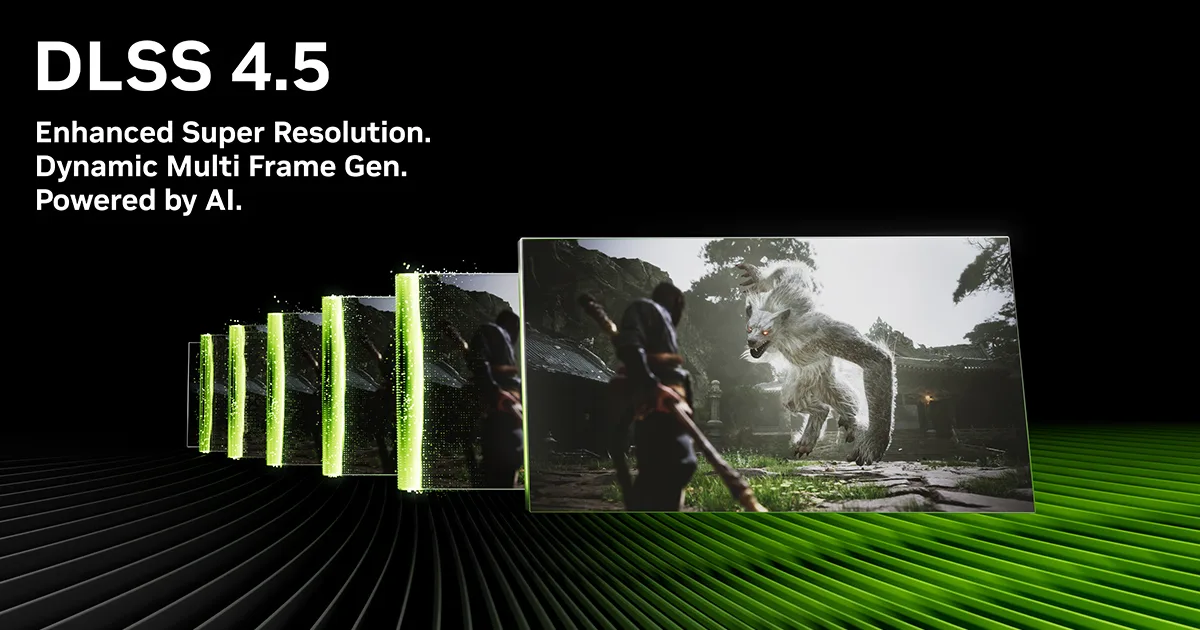
Nvidia's DLSS has come a long way from its "blurfest" beginnings. The latest iteration, DLSS 4.5, released in January 2026, aims to refine the experience even further. Its second-generation transformer model for Super Resolution headlines this update, bringing sharper details, finer edges, and reduced visual artifacts. But does it deliver for everyone, or is it a feature best suited for the newest GPU technology? After putting it through its paces, our take is nuanced: DLSS 4.5 is a clear step forward for some, a questionable upgrade for others, and an outright step backward for a notable segment of the RTX user base.
The Sharper Vision: Unpacking Super Resolution 2.0
A redesigned Super Resolution model is central to DLSS 4.5. It was trained on a much larger, high-fidelity dataset with considerably more compute capacity. Nvidia states the new transformer model has five times the inference compute requirement of its predecessor. The ambitious goal is to operate directly in linear space, with greater context awareness, preserving high-contrast lighting and complex details while intelligently using both pixel sampling and motion vector data from the game engine. Ideally, the result is an image with finer edges, sharper details, and a reduction in common visual nuisances like shimmering and ghosting. Our tests show DLSS 4.5 refines its predecessor's rougher edges. Especially for fast-motion gameplay, the image can look noticeably better.
DLSS 4.5 introduces a variety of presets – K, M, and L – each optimized for different upscaling scenarios. Preset K remains the default for DLAA, Quality, and Balanced modes, offering lower overhead. Preset M, the default for Performance mode, provides artifact fixes with less cost. Preset L is tuned for heavy upscaling in Ultra Performance scenarios, such as 4K Ultra Performance. Our observations suggest Preset M can improve hair artifacts and, alongside Preset L, brighten highlights more than Preset K. On a 4080 Super in Kingdom Come: Deliverance 2, Preset M brought a slight visual improvement, particularly for distant objects, despite a minor performance drop from 55 fps to 49-50 fps.
The Generational Divide: Who Benefits, Who Suffers?
DLSS 4.5's story gets complicated here. Nvidia's latest innovation is not a universal boon; the generational divide in its performance impact is pronounced.
The New Guard: RTX 40 and 50 Series
For owners of Nvidia GeForce RTX 40 Series GPUs, the transition to DLSS 4.5 is largely smooth. We found negligible performance differences – at most a 2.5% frame rate change compared to DLSS 4. These cards benefit from FP8 precision acceleration, which mitigates the new model's greater performance cost. For these users, Preset M often strikes the optimal balance between quality and performance, while Preset L delivers peak performance in the most demanding scenarios.
Nvidia GeForce RTX 50 Series GPUs are the primary target for DLSS 4.5. Some users report a 10-20% performance drop, though Nvidia anticipates a more modest 2-3% impact, thanks to FP8 acceleration. The RTX 50 series is set to unlock DLSS 4.5's full potential with Dynamic Multi-Frame Generation (MFG) and a new 6X MFG mode, slated for spring 2026. This dynamic system can generate up to five extra frames per rendered frame, adapting in real-time based on GPU performance and display refresh rates and working with NVIDIA Reflex Low Latency. Early reports from RTX 5070 Ti users in games like Hogwarts Legacy and Dying Light: The Beast describe "fake frames feeling more like real frames," with considerably less ghosting and artifacts, leading to more stable gameplay. An RTX 5080 with Preset M on a 4K ultrawide with DLSS performance saw excellent visuals for only a 3-5% performance cost, and an RTX 5090 using Preset M improved image quality, motion clarity, and sharpness at 4K resolution with 2x frame generation and DLAA.
The Older Generations: RTX 20 and 30 Series
The major caveat lies here. Nvidia GeForce RTX 20 Series and 30 Series GPUs "will greatly underperform" with DLSS 4.5's new second-gen transformer presets. Community tests confirm this, showing "considerable performance drops" compared to DLSS 4 Super Resolution. These older architectures lack vital FP8 precision support, taking a major performance hit, often 20% or more, when using DLSS 4.5 profiles compared to DLSS 4.0.
Forcing Preset M or L on these cards can cause a "big performance hit". For instance, an RTX 2070 Super in Cyberpunk 2077 went from 90 fps on Preset K to 62 fps on Preset M and 55 fps on Preset L. Similarly, an RTX 3060 in a DLAA test saw 52 fps on Preset K drop to 38 fps on Presets L or M. In Fortnite at 3K, an RTX 3070 plummeted from 160-170 FPS (default model) to 90-95 FPS with Preset M. For many, DLSS 4.5 proves to be challenging on 30-series cards, with some even returning to Preset K due to performance issues.
The User Experience: Navigating the New Nvidia App
DLSS 4.5 was rolled out for all GeForce RTX GPU users in January 2026 via updates to the Nvidia app and Game Ready driver (version 591.74). The Nvidia App now offers DLSS 4.5 override capabilities, allowing users to set Super Resolution model presets globally or per-game. The "Recommended" option matches the appropriate model to the selected quality mode (K for DLAA/Quality/Balanced, M for Performance, L for Ultra Performance).
The implementation isn't without its problems, however. Nvidia should actively highlight DLSS 4.5 Super Resolution's incompatibility with DLSS Ray Reconstruction. If Ray Reconstruction is active, DLSS 4.5 SR overrides do not work; the game will instead use the older combined upscaling/denoising model. This creates confusion because enabling Ray Reconstruction effectively disables the new DLSS 4.5 presets. Users forcing "Latest" in "DLSS Override – Model Presets" get Preset M, which doesn't automatically adapt to the in-game DLSS mode selection. This means users must manually match the preset letter to their desired DLSS mode to avoid forcing a heavier model where it might not be beneficial, or even detrimental.
Image quality is generally improved, but the new models are not flawless. We've observed instances of "overly sharpened visuals" and minor reconstruction errors in some games. New DLSS 4.5 models can sometimes exacerbate foliage rendering artifacts, leading to "visible and distracting flickering". For DLAA on 1440p, sticking to Preset K is often recommended, as Preset M can introduce jaggy and shimmery edges in some titles.
DLSS 4.5: A Targeted Upgrade
DLSS 4.5 represents a major technological leap in Nvidia's upscaling prowess, pushing the boundaries of what is possible at extremely low internal render scales. Playability can begin at internal resolutions as low as 20% (or 768x432 for 4K output), which is impressive, showing how far DLSS has come from its early, blurry days. When it works as intended, particularly with the new Preset M and L, the image quality improvements in motion clarity, sharpness, and artifact reduction are clear and welcome.
For RTX 40 and especially RTX 50 series owners, DLSS 4.5 is an appealing update. It offers superior image quality with minimal to no performance cost, setting the stage for Dynamic Multi-Frame Generation later this spring. We recommend these users explore the new presets, especially M for performance mode; the visual benefits are often worth the minor overhead.
For RTX20 and 30 series GPU owners, the situation is far less optimistic. The considerable performance hit, often 20% or more compared to DLSS 4.0, makes the new second-gen transformer presets (M and L) largely unviable. These users are better off sticking to Preset K for Quality, Balanced, and Performance modes, or considering older DLSS 3 versions for maximum frame rates if they are already struggling. The image quality improvements do not justify the severe performance penalty, making it a noticeable impact on gameplay.
The current incompatibility with DLSS Ray Reconstruction is a drawback Nvidia needs to address promptly, ideally with clearer communication within the Nvidia App itself. Users should not have to guess whether their preferred upscaling method is active when using ray tracing.
DLSS 4.5 highlights Nvidia's continued innovation in AI-powered upscaling. It also emphasizes the growing chasm between its latest hardware and older generations. This review leaves us impressed with the potential for future GPUs, but cautious about recommending a blanket upgrade for all existing RTX users.



Comments