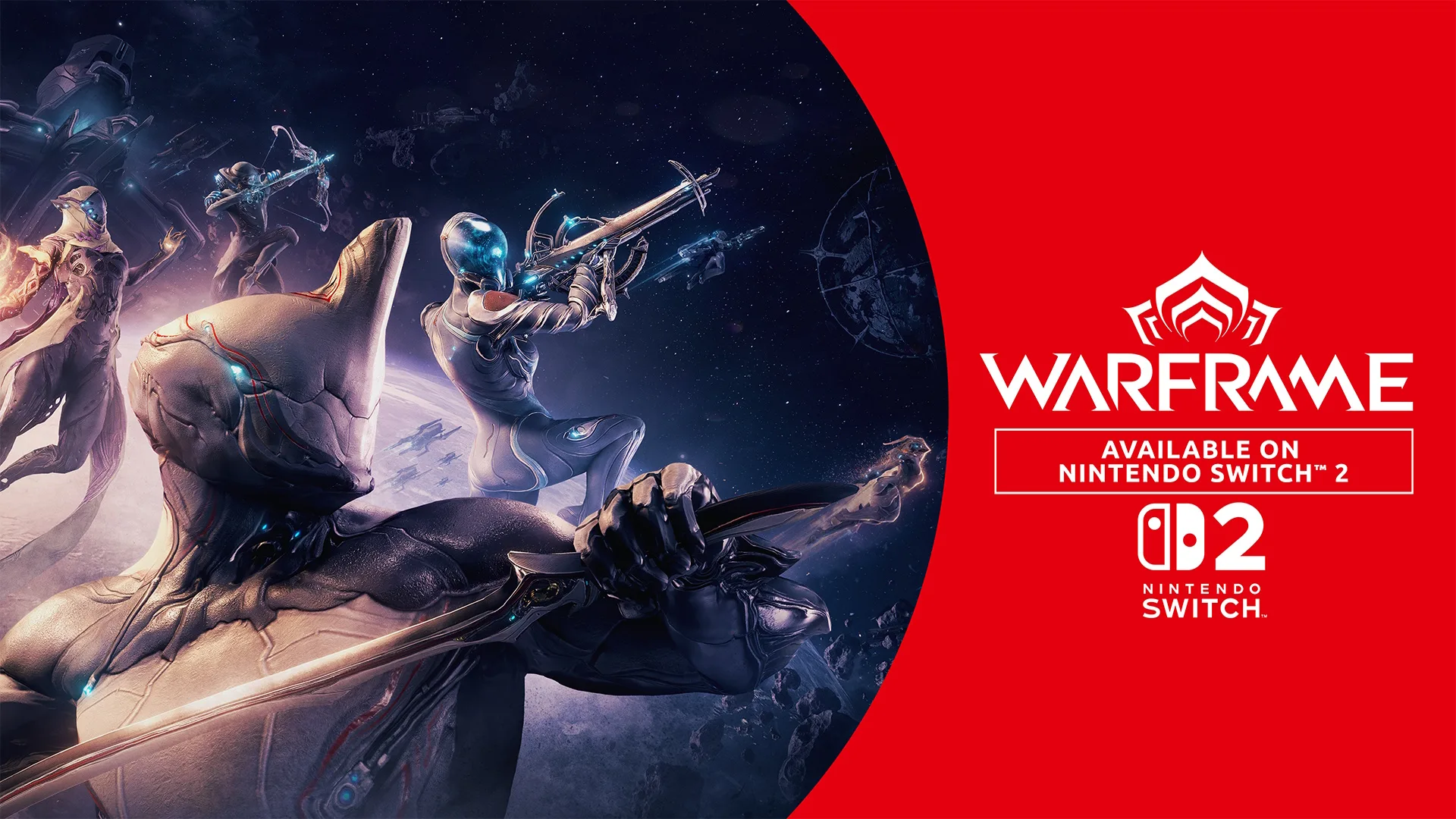
Digital Extremes launched a native Nintendo Switch 2 version of Warframe on March 25, 2026, and the headline specs are unusually straightforward for a portable live-service release: 1080p and 60 FPS targets in both handheld and docked play, DLSS support, faster loading, higher-resolution textures, volumetric lighting, improved audio, and Joy-Con 2 mouse controls.
That list matters because Warframe's first run on Nintendo hardware always came with visible tradeoffs. The original Switch version was playable, sometimes impressively so, but it was also the kind of port where players learned to live with softer image quality, longer waits, and frame-rate dips in busier fights. A native Switch 2 build suggests Digital Extremes thinks the new machine can handle something much closer to the "real" Warframe experience rather than a carefully managed side version.
That doesn't mean every question is settled. There's no official benchmark sheet for load times, and some broader claims floating around about exact parity should be treated carefully. But the official feature set alone is enough to say this is more than backward compatibility doing a little extra work.
What Digital Extremes has actually confirmed
Here's the part that's no longer rumor or inference.
Nintendo announced Switch 2 on April 2, 2025, and the console has been available globally since June 5, 2025, with the usual regional exceptions and staggered rollout in some markets. The machine is backward compatible with Switch software, which makes a native Warframe build more meaningful: players could already run the old version on newer hardware, but Digital Extremes has chosen to ship a separate version with platform-specific features.
That usually signals enough headroom to justify bespoke work.
Why 1080p/60 on a handheld matters more for Warframe than for a lot of other games
Warframe is not a turn-based RPG where an occasional hitch is annoying but survivable. It's a fast, effects-heavy online action game. Movement is constant, aiming matters, enemy density can spike, and combat readability gets messy fast if image quality collapses or frame pacing goes sour.
The original Switch version had exactly those pressures. Comparison reporting in community tests and earlier hands-on impressions has described the older port as running at dynamic resolutions well below 1080p, with a 30 FPS target that could dip in hubs or heavy combat, as the r/Warframe community has noted in its Switch 2 status thread. That doesn't make it bad, but it does explain why a native 60 FPS target changes the conversation more than a bullet point on a store page usually would.
If Digital Extremes can keep frame pacing reasonably stable, the benefit is simple: movement should feel cleaner, aiming should feel less draggy, and the game's already hectic visual language should be easier to read. The 1080p target in both modes matters for the same reason. Warframe throws a lot of metallic surfaces, particle effects, and dense environment detail at the player. Sharper output helps.
The key word, though, is target. That's the official language. Without a full technical breakdown, nobody should confuse target performance with locked performance in every mission type, every hub, or every four-player effects storm.
DLSS is probably doing some heavy lifting here, even if the exact mode hasn't been detailed
Digital Extremes has confirmed DLSS support for the Switch 2 version. What it hasn't broken out publicly, at least in the materials available so far, is the exact preset behavior or per-mode implementation.
That leaves room for interpretation, but not much mystery about the broad purpose. DLSS would plausibly let Warframe render below output resolution and upscale toward its 1080p target, which is one of the cleaner ways to chase 60 FPS on handheld-class hardware without stripping away too much visual detail. Both RPG Site's coverage of the Devstream 190 preview and Nintendo Everything's launch breakdown described DLSS as part of the package that helps the game hit its performance goals in both play modes.
The practical implication is less "Warframe has DLSS" and more what kind of compromises players might not have to stare at anymore. On older portable hardware, the usual trade is obvious image softness during intense scenes. Upscaling tech can reduce how often that softness becomes distracting. It can't repeal hardware limits, but it can make them less visible.
One caution here: if you're running the old Switch version on Switch 2 through backward compatibility, these native upgrades reportedly do not carry over. The native app is the important part.
The visual upgrades aren't just decoration
The official feature list also calls out higher-resolution textures, volumetric lighting, improved audio, plus docked-mode additions like sun shadows and enhanced decals.
That can sound cosmetic, but in Warframe, visual quality affects more than screenshots. Cleaner textures and stronger lighting can improve scene clarity. Better shadows and decals in docked mode may help environments feel less flat and less obviously pared back. Volumetric lighting, if implemented well, can make the game's spaces look closer to its other current-platform versions rather than an adaptation built around omission.
Again, restraint matters here. The launch materials do not provide a forensic graphics audit, and "full parity" language in some secondary writeups should be handled carefully. But the confirmed additions do point in one direction: this version is trying to narrow the experiential gap, not merely run the same content on stronger silicon.
Mouse mode might be the quietly important feature
One of the more specific additions is Joy-Con 2 mouse mode for aiming and menu navigation. That's not just a novelty bullet. Warframe is the sort of shooter-melee hybrid where precision aiming can matter a lot, especially when the game is moving at 60 FPS instead of 30.
There's a plausible read here that Switch 2 gives Digital Extremes a chance to make Warframe feel less "portable-console compromised" in controls as well as performance. Mouse-like input on a Nintendo handheld won't suit everyone, and there's no reason to assume it instantly turns the game into a PC-equivalent control experience. But for players who bounce off analog-stick aiming in faster shooters, this could be one of the most useful platform-specific features in the whole release.
It also says something about how the port was approached. A straight conversion could have stopped at resolution and frame-rate upgrades. Adding support for a new input method suggests the team wanted to do more than simply certify an old build for new hardware.
Cross-save and cross-play are doing a lot of the work here
Warframe's Switch 2 version supports full cross-save and cross-play, with progression syncing across platforms, including Warframes, weapons, and cosmetics. That may be the least flashy announcement and the most important one.
For live-service games, hardware improvements matter less if the platform still feels isolated. Cross-save changes that equation. It means the Switch 2 version can function as a proper extension of an existing account rather than a separate ecosystem that asks players to start over or maintain duplicate progress. Digital Extremes has leaned into that message publicly, with Creative Director Rebecca Ford saying the launch means Warframe is now live on every major gaming platform with cross-play and save, as RPG Site's launch-day report documented.
That doesn't settle every quality-of-life concern around a cross-platform economy or platform-specific quirks. Community reactions around cross-play in Warframe and other online games have often been mixed, especially when players feel one input method or storefront environment gets better treatment. But the basic proposition here is strong: Switch 2 is being added to the same Warframe, not a side branch of it.
The timing with The Shadowgrapher looks deliberate
The Switch 2 release landed the same day as The Shadowgrapher, a standalone update shipping across platforms. That timing could be read a few ways, but the simplest and safest one is that Digital Extremes wanted the new version to arrive in step with the rest of the game rather than as an off-cycle port.
That matters because Nintendo versions of large online games have often ended up feeling one update behind, either literally or perceptually. Shipping a new platform version alongside a broader content update helps avoid that. It signals, at minimum, that Digital Extremes wanted the Switch 2 debut framed as part of Warframe's current live game, not as archival support for another storefront.
Enrichment reporting also suggests this fits a broader pattern for the studio: after bringing Warframe to Android in early 2026, Digital Extremes appears to be pushing toward broader platform coverage rather than treating portable devices as edge cases, as WCCFTech's coverage of the simultaneous launch noted. That doesn't tell us everything about internal strategy, but it does support the idea that the Switch 2 launch is part of a wider portability push.
What we still don't know
For all the concrete feature details, there are still some obvious gaps.
That missing benchmark data is the main reason to resist overselling what this release proves. Faster loading is believable and broadly supported by early user impressions, including posts on the official Warframe Forums describing sub-5-second mission transitions on Switch 2 hardware. But anecdote is not the same as an official benchmark suite, and practical results may vary by mission type, network conditions, and whether players are comparing backward compatibility against the native app.
Early reaction suggests the official pitch is landing, but technical scrutiny will matter
Initial community chatter has been broadly positive, with players in the r/Warframe Switch 2 status thread describing a much sharper image and smoother feel than the original Switch version. That lines up with what Digital Extremes is advertising.
Still, the real test for a game like this won't be the first ten minutes in a quiet mission. It'll be crowded hubs, open areas, long sessions, and the kinds of multiplayer fights where Warframe tends to flood the screen with effects. It'll also be whether the native Switch 2 build keeps up over time as future updates pile on. One clean launch does not guarantee painless long-term maintenance.
What this probably means for players
The careful read is pretty simple.
If you already play Warframe on other platforms, the Switch 2 version looks positioned as a legitimate secondary or portable home for your account, mainly because cross-save and cross-play are fully supported.
If you played on original Switch, the official targets and feature list suggest a noticeably better experience, especially in frame rate, image quality, and loading. The exact size of that jump will need more technical testing, but the direction is clear.
If you were hoping backward compatibility alone would be enough, this launch suggests the native build is where the meaningful improvements live, particularly DLSS, visual upgrades, and mouse controls.
And if you're waiting for hard numbers, that's still reasonable. Digital Extremes has given a solid feature outline, but not a full benchmark dossier. For a live-service game with a lot of performance edge cases, that missing data still matters.


Comments