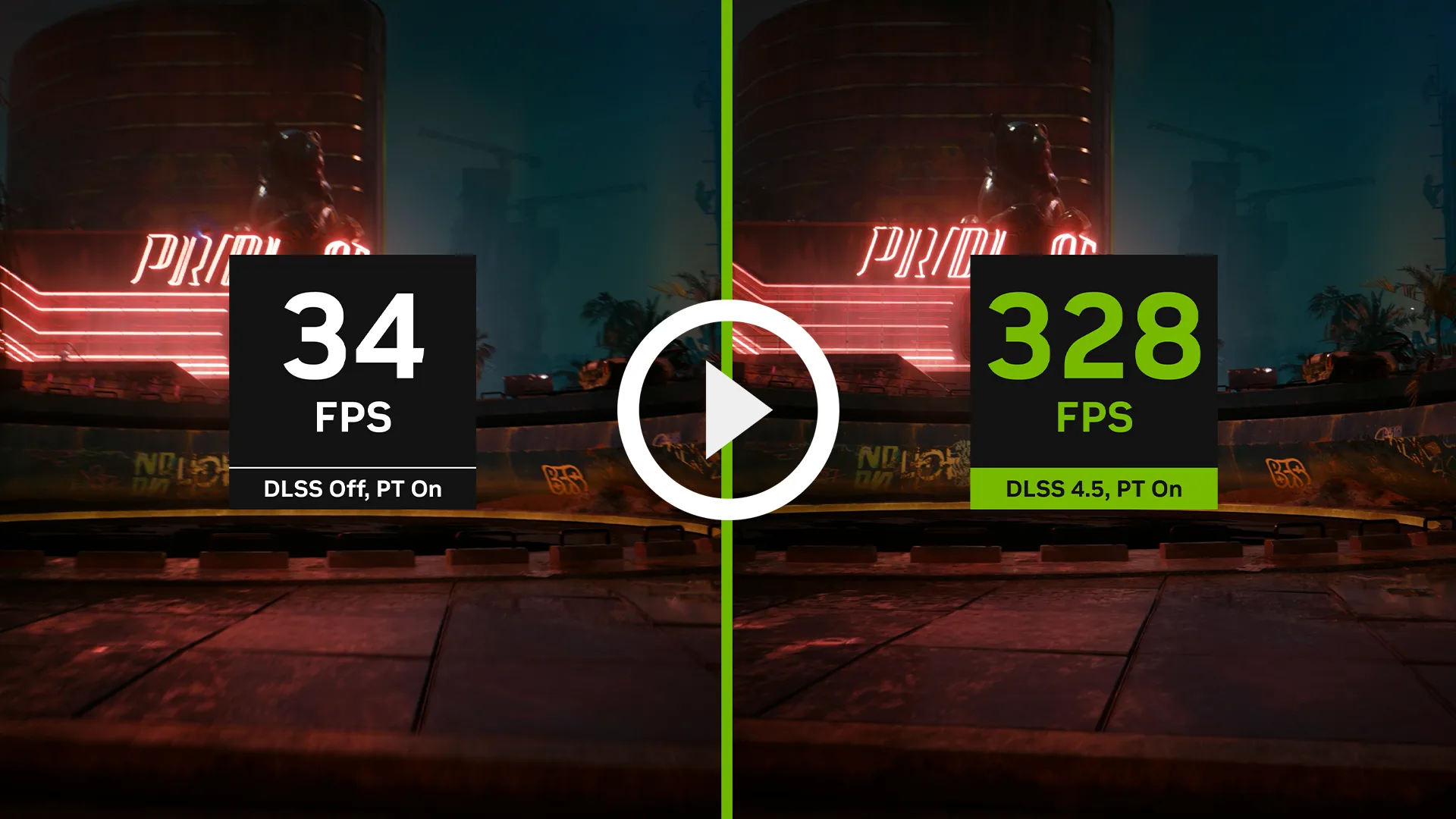
NVIDIA is rolling out DLSS 4 this week, aiming to deliver significantly enhanced performance and visual fidelity in a fresh wave of game launches. Kicking things off today, February 11, we see SEGA's Yakuza Kiwami 3 & Dark Ties arrive with full DLSS 4 support. Not far behind are Squanch Games' High On Life 2 and THQ Nordic and Tarsier Studios' REANIMAL, both scheduled for February 13, and also integrating DLSS.
Beyond these new titles, NVIDIA DLSS 4.5, the latest evolution of its AI-powered rendering technology, is now broadly available for all GeForce RTX GPUs directly through the NVIDIA App. NVIDIA claims this update allows players to instantly upgrade image quality in over 400 DLSS-supported titles, including these new releases, without requiring developer patches. While this sounds incredibly convenient, we've seen in our testing and community reports that the experience isn't entirely uniform across all RTX generations, something we'll delve into later.
The Week's Big DLSS Debuts: Our Take
This latest crop of games promises a premium PC experience for GeForce RTX players, at least on paper. Here’s how each title is leveraging NVIDIA’s AI upscaling.
- Yakuza Kiwami 3 & Dark Ties (Launching February 11, 2026): Celebrating the Like a Dragon & Yakuza series' 20th anniversary, this release isn't just a simple remaster. It’s an "extreme remake" of Yakuza 3 with a new story, "Dark Ties," focusing on antagonist Yoshitaka Mine's rise through the yakuza ranks. The title launches today with DLSS Frame Generation, DLSS Super Resolution, and NVIDIA Reflex, promising smoother, more responsive brawling action in the reimagined streets of Okinawa and Tokyo. Players can further enhance visuals with DLSS Multi Frame Generation and DLSS 4.5 Super Resolution via the NVIDIA App, a move we appreciate for its flexibility, allowing users to push fidelity even higher. A downloadable demo is currently available for those eager to jump in.
- High On Life 2 (Launching February 13, 2026): Squanch Games' highly anticipated sequel throws players back into a universe where they'll "shoot, stab, and skate through dangerous worlds" with an arsenal of talking weapons called Gatlians. The game introduces new movement mechanics like skateboarding, which effectively replaces the sprint button and allows for wall runs and grinds. The plot sees the player character, now a successful bounty hunter, embroiled in a quest to save their sister from an alien pharmaceutical conglomerate that turns humans into pills—a characteristically absurd premise for the series. It launches with DLSS 4 Multi Frame Generation, which should deliver significant frame rate boosts, and can be upgraded to DLSS 4.5 Super Resolution through the NVIDIA App. Given the first game's quirky visual style and fast-paced action, we think DLSS integration here is a natural fit for maintaining high frame rates in what we expect to be a chaotic experience.
- REANIMAL (Launching February 13, 2026): From Tarsier Studios, the acclaimed creators of Little Nightmares, comes this co-op horror adventure. Described as a "spiritual successor" and "more terrifying" than its predecessors, REANIMAL tasks a brother and sister with escaping a hellish island to rescue their missing friends. The game features both single-player and two-player online or local cooperative multiplayer. Launching with DLSS Super Resolution and DLAA to accelerate frame rates and enhance image quality, REANIMAL should benefit greatly from these technologies, especially in a horror setting where atmosphere and smooth visuals are paramount. It can also be upgraded to DLSS 4.5 Super Resolution through the NVIDIA App, which could be particularly beneficial for maintaining detail in the game’s eerie environments.
DLSS 4.5: A Step Forward, But Not Without Caveats
NVIDIA DLSS 4.5, which initially rolled out via the NVIDIA App on January 14, 2026, represents a significant upgrade to NVIDIA's AI-powered upscaling technology. It features a second-generation Transformer model for Super Resolution, which NVIDIA highlights as developed with "five times the computational investment" of the first DLSS 4 Transformer. While such marketing speak always makes us raise an eyebrow, our deeper look at the technology reveals genuine improvements.
Key improvements in DLSS 4.5 include:
- Enhanced Image Quality: NVIDIA claims DLSS 4.5 minimizes ghosting, shimmering, and afterimages while boosting anti-aliasing, temporal stability, and motion clarity. Reports suggest that Performance and Ultra Performance modes for Super Resolution can now rival native 4K quality, a claim that, if consistently true, is a huge win for those chasing high frame rates. The model also addresses previous issues with "muted lighting, clipped details, and crushed shadows" in high-contrast scenes, leading to more physically accurate lighting. Digital Foundry also notes that DLSS 4.5, even without Ray Reconstruction, can "almost perfectly" reconstruct ray-traced reflections in some titles by simply turning off in-game denoisers, which is a surprising and welcome development.
- New Transformer Models: This update introduces "Model M" for Performance mode, which prioritizes clarity during aggressive upscaling, and "Model L," designed to excel in Ultra Performance mode (especially at 4K) by minimizing blur and enhancing details. Model L also supports Quality, Balanced, and DLAA modes.
- Broad Compatibility... with a Catch: DLSS 4.5 is indeed available for all GeForce RTX GPUs (RTX 20, RTX 30, RTX 40, and RTX 50 series) and can be applied immediately to over 400 DLSS titles via overrides in the NVIDIA App. However, this broad compatibility comes with a significant caveat. Performance and Ultra Performance modes, particularly with Model M and L, benefit most from the FP8 precision capabilities of RTX 40 and 50 series GPUs. Our testing, consistent with community benchmarks, indicates that older RTX 20/30 series GPUs lacking native FP8 support can actually see a performance drop (ranging from 7-30%) when using DLSS 4.5 compared to DLSS 4.0. In these instances, NVIDIA itself recommends sticking with Model K (DLSS 4.0) for an optimal balance of performance and image quality, a detail that undermines the "broad compatibility" message somewhat. This means users with older cards need to be mindful of their settings and may not automatically benefit from the "latest" option.
- Dynamic Multi Frame Generation (Coming Spring 2026): This advanced feature, exclusive to RTX 50 Series GPUs, is set to intelligently adjust frame generation multipliers up to 6x (generating five extra frames per rendered one), potentially boosting frame rates by up to 35% in demanding path-traced scenes when paired with NVIDIA Reflex. While DLSS 4.0 Multi Frame Generation (MFG) for RTX 50 series already generates up to three AI frames per rendered frame compared to one in DLSS 3, the upcoming 6x multiplier is an aggressive push for higher frame rates. It's worth noting that while MFG promises substantial FPS gains, initial reports suggest that latency with DLSS 4 MFG and Reflex 2 remains roughly similar to the original frame generation technology.
When we look at the competition, AMD's FSR 4 is also showing "remarkable improvement over FSR 3" and is "approaching" the latest DLSS in quality. However, DLSS 4 generally retains more detail and offers superior stability compared to both FSR and Intel's XeSS, particularly in handling sub-pixel details and complex scenes.
The NVIDIA App: Your New Command Center
The NVIDIA App is positioned as the central hub for accessing these latest DLSS innovations. We see this as NVIDIA consolidating control over user experience, offering a more streamlined approach than previous, more scattered methods. It allows users to:
- Upgrade DLSS Frame Generation to DLSS Multi Frame Generation for RTX 50 series GPUs.
- Upgrade DLSS Super Resolution to DLSS 4.5 Super Resolution, enabling the latest Transformer models for an instant image quality boost. This includes the ability to apply Model M (Performance) or Model L (Ultra Performance) globally or per-game.
- Access NVIDIA Surround settings and new diagnostic tools like "Debug Mode," which instantly disables all overclocking and voltage modifications to address GPU instability.
The global DLSS override feature, in particular, is a welcome addition, simplifying the process of applying optimal settings across an entire game library, rather than tweaking individual profiles.
GeForce RTX 50 Series: The "Ultimate" Experience?
NVIDIA paints the GeForce RTX 50 Series GPUs, including the RTX 5090, 5080, 5070 Ti, and 5070, as the definitive gaming experience. These GPUs, based on the Blackwell architecture and featuring fifth-generation Tensor Cores, are indeed designed for high performance. They offer exclusive access to the full capabilities of DLSS 4 Multi Frame Generation, including the upcoming Dynamic Multi Frame Generation with up to a 6x increase in rendered frames. This power, NVIDIA suggests, is particularly evident in games featuring demanding path-traced effects.
While the RTX 50 series undoubtedly delivers impressive performance – with the RTX 5090 promising double the frame rates of the RTX 4090 in some titles with Multi Frame Generation – we're always skeptical of "ultimate experience" claims, especially when key features like the 6x Multi Frame Generation are locked behind the latest (and priciest) hardware. Older RTX series are limited to a 2x frame generation multiplier, meaning a significant portion of the RTX user base won't experience these peak frame rates. This tiered approach, while understandable from a business perspective, clearly segregates the user experience.
To mark the launch of highly anticipated titles using these capabilities, NVIDIA has announced a Resident Evil Requiem GeForce RTX 50 Series Bundle. Starting February 10, 2026, customers purchasing qualifying GeForce RTX 50 Series GPUs, graphics cards, or laptops from participating retailers will receive a free Steam copy of Resident Evil Requiem. This is a solid bundle, as Resident Evil Requiem is the ninth main game in the Resident Evil series, featuring a return to the Raccoon City narrative some 30 years after the missile strike. The game, directed by Resident Evil 7's Koshi Nakanishi, promises a blend of survival horror with protagonist Grace Ashcroft and action-oriented gameplay with Leon S. Kennedy. It's also confirmed to feature breathtaking path-traced effects, accelerated by DLSS 4 Multi Frame Generation and DLSS Super Resolution, and enhanced by NVIDIA Reflex, making it a good showcase for the RTX 50 series' capabilities. The game is scheduled for release on February 27, 2026.





Comments