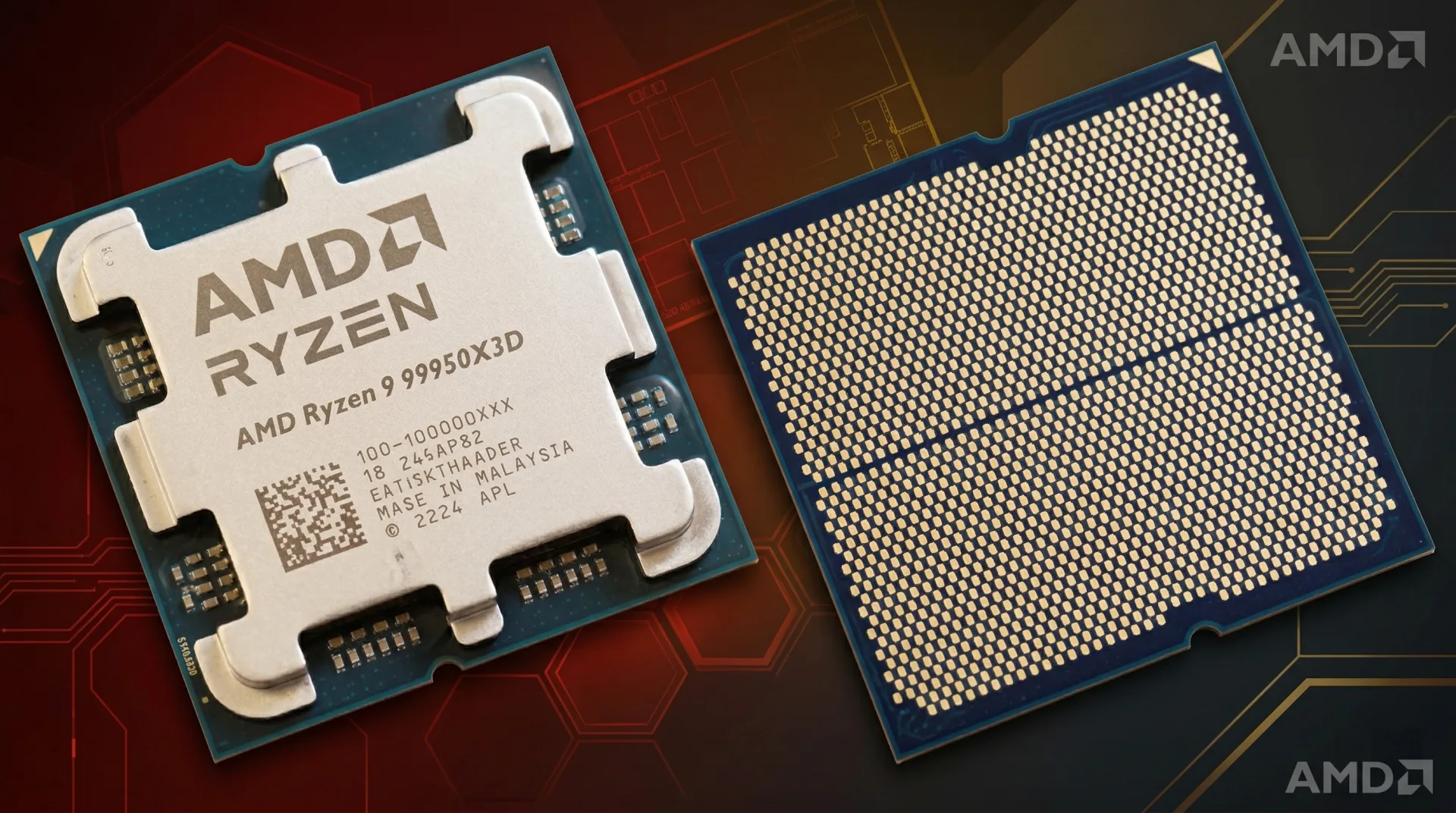
After months of leaks, partner slips, and plenty of speculation around a "dual V-Cache" desktop part, AMD has now put a name and date to it: the Ryzen 9 9950X3D2 Dual Edition, a 16-core Zen 5 AM5 chip with 192MB of L3 cache and 208MB of total on-chip cache once L2 is included.
There was good reason to be cautious before treating this as settled. Earlier reporting leaned more on partner material and deleted posts than on a clean AMD launch. But the picture is firmer now: AMD's own product page is live here, and multiple outlets independently matched the core spec table and the April 22 release date, including Tom's Hardware and Phoronix. The chip's name, 16-core configuration, 192MB L3 cache, 208MB total cache, 200W TDP, and AM5 positioning are now official rather than inferred from partner materials or CES-era hints.
That still leaves one important distinction: the chip is announced, but much of the performance story is still incomplete. AMD is talking up gains in content creation and simulation workloads, while gaming benchmarks have not been published in the launch material.
What AMD is actually shipping
The 9950X3D2 is, broadly speaking, a more extreme version of AMD's usual two-chiplet high-end desktop design. It keeps the familiar 16-core / 32-thread layout on AM5, with a 4.3 GHz base clock, up to 5.6 GHz boost, and a 200W default TDP. It supports DDR5 memory, PCIe 5.0, AMD EXPO, and Ryzen Master tuning.
The headline change is simple enough: both CCDs get 3D V-Cache.
On this chip, each CCD carries 32MB of native L3 cache plus a 64MB stacked cache slice, for 96MB per CCD and 192MB total L3 across the package. Add 16MB of L2, and AMD gets to the 208MB total on-chip cache figure Jack Huynh has been highlighting publicly. As Engadget and PC Gamer noted, Huynh's pitch is that more game data, assets, and working data can sit closer to the CPU cores.
Specs at a glance
Why "dual V-Cache" matters more than the raw number
AMD's X3D chips have usually involved a compromise. On prior multi-CCD parts, one chiplet typically got the extra stacked cache and the other did not. That arrangement could work very well, especially in games, but it also created an uneven topology. Some workloads benefit from landing on the cache-rich CCD; some care more about frequency; and the scheduler has to make smart choices.
What this new design does is remove that asymmetry. With both CCDs carrying the extra cache, AMD is trading some clock headroom and power simplicity for a more uniform high-cache layout across all 16 cores.
That matters because not every cache-sensitive workload is a pure gaming scenario. Large simulation datasets, compilation, certain rendering tasks, and some AI-adjacent workloads can benefit when more hot data stays on-package. That does not guarantee dramatic gains, but it does make AMD's own guidance — 5% to 10% over the prior 9950X3D in content creation and simulation workloads — sound directionally plausible.
The catch is that cache scaling is messy. Some applications respond strongly. Others barely care. And once a workload is more constrained by raw frequency, memory bandwidth, software behavior, or GPU acceleration, a bigger L3 number can stop being the main story.
The tradeoff is already visible in the clocks and TDP
AMD isn't pretending this part is free lunch silicon. The up-to-5.6 GHz boost clock is lower than what enthusiasts might expect from a no-compromise flagship bin, and the 200W TDP is notably high for an X3D-branded Ryzen desktop CPU, as Tom's Hardware called out directly.
That combination suggests the obvious reading: putting stacked cache on both CCDs likely came with thermal and voltage-management costs, and AMD may have tuned the part accordingly. That's an interpretation, not an engineering note from AMD, but it fits the numbers on the page. More cache can help, but stacked structures also make it harder to run a chip as aggressively.
For buyers who mostly care about all-core productivity, this chip may be attractive if the extra cache helps specific workflows enough to offset the clock behavior. For buyers who only care about gaming, the missing benchmark set matters more than the cache headline.
AMD is reviving an idea it once didn't ship
One of the more interesting parts of this launch is historical. AMD had previously tested a prototype 12-core Ryzen 5000-series design with dual stacked V-Cache across both CCDs, but that configuration never reached consumers. So the 9950X3D2 is not a bolt-from-the-blue invention so much as a concept AMD appears to have revisited now that Zen 5 and current packaging can support it at retail scale.
That makes this release feel less like a gimmick SKU and more like an experiment AMD has wanted to commercialize for a while.
Still, "wanted to ship" and "will be broadly better" are not the same thing. The earlier unreleased prototype is useful context because it shows the idea has been around. It does not tell us how well this specific 2026 implementation behaves in shipping systems.
The leak trail was messy, but it pointed in the right direction
This CPU had one of those modern launch arcs where unofficial material started looking official before the official material was easy to pin down.
A rumored tease tied the chip to Alienware China back in January. Then a now-deleted ASRock release in mid-March referred to the processor as "newly launched" and supported across AM5 boards, which PC Gamer and Overclock3D both documented.
That matters mainly because those leaks got two big things right: full AM5 compatibility and the dual-cache concept itself. It doesn't mean every early claim was cleanly sourced, but it does suggest the broad outline of the product was stable well before launch day.
AM5 compatibility is broad, though that doesn't mean every board is equally ideal
AMD lists compatibility across a very wide AM5 range: X870E, X870, B850, B840, X670E, X670, B650E, B650, and even A620.
That sounds generous, and it probably is from a BIOS-support standpoint. But support and ideal pairing are different things. A 200W flagship chip on an entry-level board is the sort of setup where VRM quality, BIOS tuning, power limits, and cooler choice matter more than a compatibility list alone suggests.
So yes, this looks like an upgrade path chip for existing AM5 users. But if you're reading the A620 line and concluding all AM5 boards are equal homes for it, that would be reading more into the compatibility statement than it actually says.
What's still unknown
The biggest gap is straightforward: gaming data.
AMD, through Jack Huynh's comments, has framed the cache design in gaming-friendly language, and that makes technical sense. But the launch materials also say gaming benchmark results haven't been released yet. That leaves real uncertainty around how much dual-V-Cache changes outcomes versus the standard 9950X3D in actual shipped titles.
A few possibilities are on the table:
- Some games may benefit clearly because both CCDs now have the same expanded L3 pool.
- Some titles may show smaller gains than the cache size suggests, especially if they were already well-served by the prior X3D layout.
- Some workloads may benefit more outside gaming than within it, particularly simulation and content creation tasks that touch large working sets in a cache-friendly way.
AMD's own expectation of 5% to 10% better performance in content creation and simulation sets a useful tone here: promising, but not revolutionary.
The practical read
If you already have an AM5 system and were waiting for the most cache-heavy Ryzen desktop CPU AMD could build, the 9950X3D2 is now a concrete product, not just a leak-cycle artifact. The broad platform support also means many current AM5 owners may be able to consider it without a board swap.
But the sensible caveat is the same one AMD's own launch leaves hanging: wait for workload-specific reviews, especially if your priority is gaming rather than mixed productivity. Right now, the strongest evidence supports three things: the chip is real, the cache configuration is unusual in a meaningful way, and AMD expects modest but tangible gains in certain creator and simulation workloads.
Whether that translates into the right fit for your setup will depend on cooling, motherboard quality, power tolerance, and the applications you actually run.









Comments