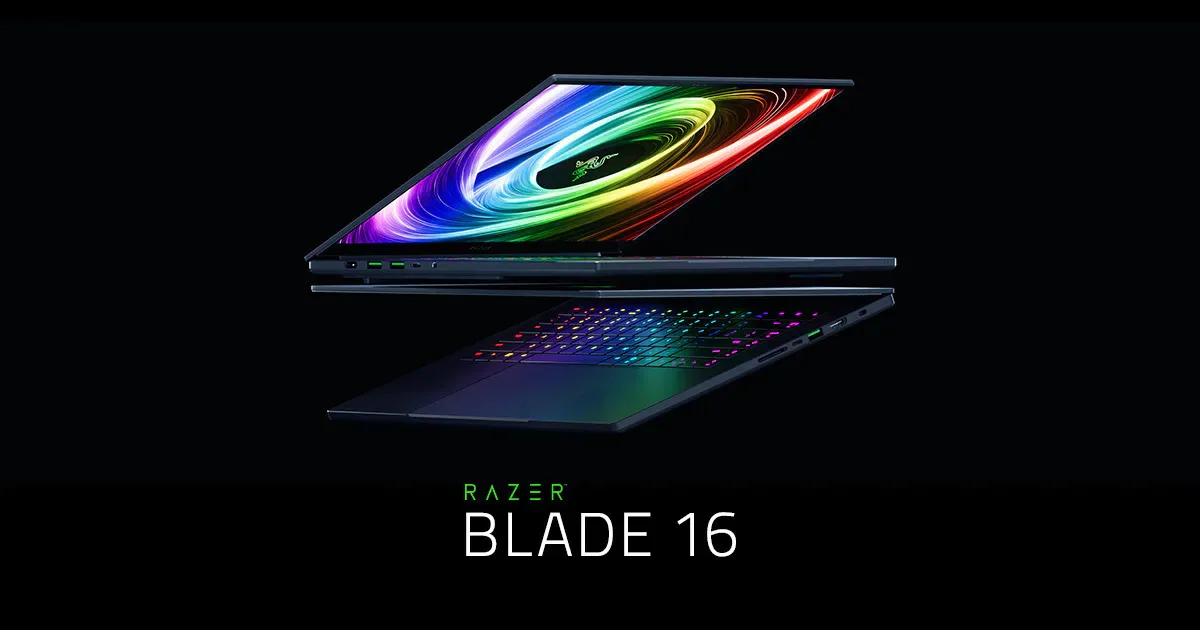
Razer says the 2026 Blade 16 is now official, in a March 25, 2026 announcement. On paper, it's a familiar Blade update: the same premium thin-and-light 16-inch formula, newer silicon, faster memory, and the usual eye-watering pricing. The changes are real. So is some of the confusion about how broad this lineup actually is.
What looks firm right now is at least one new Intel Core Ultra 9 386H configuration, paired with RTX 5080 or RTX 5090 Laptop GPUs, a 16-inch QHD+ 240Hz OLED panel, and LPDDR5X-9600 memory. Razer's materials also peg the chassis at 14.9mm thick and list modern I/O including Thunderbolt 4, Wi-Fi 7, Bluetooth 5.4, HDMI 2.1, and a UHS-II SD card reader.
What looks less firm is the broader idea that the Blade 16 has cleanly moved from AMD to Intel. Storefront evidence cited in the reporting shows AMD- and Intel-based Blade 16 configurations coexisting on Razer's US site, including an AMD model with Ryzen AI 9 365 and RTX 5060/5070 options. That doesn't negate the Intel launch. It does mean the neat version of the story — "Blade 16 moves to Intel" — is probably too tidy for what Razer is actually selling right now.
The headline upgrade is the CPU switch, but the real story is positioning
The new Intel configuration uses the Core Ultra 9 386H, which Razer describes as a 16-core Panther Lake part with boost clocks up to 4.9GHz. The chip also includes a 50 TOPS NPU, which qualifies the system as a Copilot+ PC.
That matters, but in a fairly narrow way. The Copilot+ badge gets the Blade 16 into Microsoft's current bucket for local Windows AI features such as Recall, Live Captions, Cocreator, and other NPU-assisted tools. In practical terms, that puts it on similar footing to other premium Copilot+ laptops rather than making it uniquely capable. As broader analysis of Copilot+ hardware has shown, the gap between a machine that just clears Microsoft's 40 TOPS threshold and one that hits 50 TOPS is often smaller in everyday use than the branding suggests. For gaming and heavier local AI work, the discrete GPU will still do most of the heavy lifting.
So the Intel move may be less about a dramatic reinvention and more about rounding out the Blade's identity: still a high-end gaming laptop, but one trying to present itself as an all-purpose premium machine for work, travel, and creator use too.
That reading fits the rest of the spec sheet.
The OLED display looks like one of the cleanest wins here
The display details are unusually specific, which helps. Razer says the Blade 16 uses a 16-inch 2560 x 1600 OLED panel at 240Hz, with a 0.2ms response time, 100% DCI-P3 coverage, Calman Verified factory calibration, and VESA DisplayHDR TrueBlack 1000 certification. It also claims up to 1,100 nits in HDR mode.
This part of the launch looks solidly supported. Both the Razer product page and the Razer Newsroom describe the 2026 Blade 16 as OLED, not Mini-LED, and report the same brighter HDR behavior. That matters because earlier Blade generations and third-party listings helped muddy the waters: some older models offered Mini-LED, and some outside sources were still circulating conflicting panel or battery specs.
For buyers, the practical takeaway is simple enough. If the official specs hold, the Blade 16 is leaning harder into the "premium mixed-use" argument than the "maximum brightness in all conditions" argument. OLED at 240Hz with true-black HDR and fast response times is a strong setup for both games and color-sensitive work. If you preferred Mini-LED for sustained full-screen brightness, though, this doesn't appear to be that machine.
Razer is still chasing the same Blade trick: thin chassis, big GPU, acceptable compromises
Razer says the new system can be configured with RTX 5080 or RTX 5090 Laptop GPUs. The RTX 5090 model is described as running at up to 165W TGP, with a claim that HyperBoost can push select configurations to 175W TGP when paired with the Razer Laptop Cooling Pad.
Those are big numbers for a machine this thin. They're also the sort of numbers that deserve caution.
Recent coverage of prior Blade 16 generations found that Razer's high-end GPU configurations didn't always sustain their top advertised power targets in real gaming loads, especially early on. Tom's Hardware, for example, documented launch-period driver rough edges and inconsistent power behavior on the RTX 5090 Blade 16. Broader reporting suggested some of that wasn't exclusive to Razer and improved with newer Nvidia drivers.
The point isn't that Razer's claim is wrong. It's that "up to 165W" and "up to 175W with an accessory" are ceiling numbers, not guarantees of sustained behavior in every game, every thermal profile, or every driver state. In a chassis this thin, cooling and firmware are always part of the performance story.
Razer says cooling is handled by a refined vapor chamber design with ultrathin fins and dual fans. That sounds appropriate. Whether it translates into meaningfully better sustained performance than the last generation is something reviews will need to verify.
The Blade's old compromise is still there: soldered memory
The new Blade 16 supports up to 64GB of LPDDR5X-9600MHz memory. That speed is one of the launch's cleaner technical upgrades, and faster memory can help both integrated platform responsiveness and some creator workloads. But the catch is unchanged: the RAM is soldered.
That means memory capacity has to be chosen up front, and there's no upgrade path later. For a machine that starts at $3,499.99 and climbs to $4,499.99 or, in one listed configuration, $4,999.99, that's not a small caveat. Community reaction so far has reflected exactly that tension. There's broad appreciation for the thin chassis and premium build, but also familiar irritation that a laptop at this price still asks buyers to get the memory decision right on day one, as discussed on Reddit and noted by The Verge.
Storage is more forgiving. Razer lists 1TB or 2TB PCIe 4.0 SSDs as standard depending on the configuration, and says there's a second M.2 slot for expansion. That doesn't solve the RAM issue, but it does leave one major component more flexible.
The pricing tells you who this is for, and who it probably isn't
Here's how the currently cited US configurations stack up:
UK pricing comes in at £3,099.99 for the RTX 5080 / 32GB / 1TB configuration and £4,399.99 for the RTX 5090 / 32GB / 2TB.
Those prices make more sense if you think of the Blade 16 as a luxury portable workstation that also happens to be a gaming laptop, not as a pure performance-per-dollar play. Compared with chunkier high-end competitors, Razer is still selling the industrial design, the size, the display, and the port selection as much as the frame rates.
That can be a reasonable pitch. It's just a narrow one. Early community reaction suggests many people still see the RTX 5080 model as the less painful configuration, because the jump to RTX 5090 pricing is steep relative to the likely gaming uplift. That isn't a final verdict, and we don't yet have a full review stack for this exact Intel generation, but it's a plausible reading of the lineup.
The port selection is unusually practical for something this thin
One thing Razer continues to do well is avoid the "thin laptop means dongles everywhere" trap. The 2026 Blade 16 includes:
That's a better mix than a lot of premium thin gaming systems manage, especially for creators who still care about full-size HDMI and SD. Thunderbolt 5 is the standout. In practice, it could matter more for docks, high-speed external storage, and future external display setups than for gaming itself, but it gives the Blade 16 a more workstation-friendly bent than some of its direct rivals.
Battery claims sound ambitious, but they're framed narrowly enough to read carefully
Razer lists a 90 Whr battery and claims up to 13 hours productivity and up to 15 hours video playback under defined conditions. The same materials also acknowledge that heavy gaming and creative workloads can pull that down to around 2–3 hours.
That split is believable in broad terms and familiar in the gaming-laptop sense. It also tells you how these numbers should be read. The Blade 16 may well be materially better unplugged for office work than prior high-end gaming machines, especially with a newer Intel platform and NPU-assisted Windows features. But nobody should confuse that with all-day battery life while doing the thing the RTX 5090 is there for.
The biggest unresolved question isn't the hardware. It's the lineup itself
The oddest part of this launch isn't the spec sheet. It's the overlap.
One set of evidence points to a new Intel-led Blade 16 generation with Panther Lake and RTX 5080/5090 options. Another points to a still-live AMD Blade 16 configuration on Razer's storefront. That could mean several things: a staggered transition, regional or channel differences, old and new sub-lines under the same Blade 16 name, or simply a storefront in mid-refresh.
What it probably doesn't support is a clean, singular message that every 2026 Blade 16 is now Intel-based.
That matters because it changes how readers should interpret this launch. If AMD and Intel variants are both in market, then "Blade 16" is less a single laptop than a family with increasingly messy internal divisions. And once that happens, buyers have to pay closer attention to the exact CPU platform, memory amount, GPU tier, and storage bundle than the product name alone would suggest.
What to watch if you're considering one
A few practical takeaways, matched to what's actually confirmed so far:
- The Intel Blade 16 is real and high-end. The official specs support a premium 16-inch OLED gaming laptop with Panther Lake, Copilot+ support, RTX 5080/5090 options, Thunderbolt 5, and fast soldered memory.
- The broader lineup still looks muddled. Storefront evidence suggests AMD versions haven't simply disappeared, so the exact configuration matrix may depend on region or timing.
- The display upgrade looks trustworthy. OLED, 240Hz, TrueBlack 1000, and 1,100-nit HDR claims are among the better-supported parts of the launch.
- The GPU power claims should be treated as upper limits until reviews land. In a thin chassis, sustained behavior matters more than spec-sheet ceilings.
- Soldered RAM is a real purchasing constraint. If you need 64GB, that decision likely has to be made at checkout, not later.
- The value question is still conditional. If your priority is a thin premium machine with strong gaming hardware and better-than-usual ports, the Blade 16's pitch is coherent. If your priority is pure performance per dollar or easier upgradeability, the same specs may look a lot less convincing.
That's the Blade 16 story in 2026: impressive hardware, familiar compromises, and just enough SKU confusion to make the launch messier than Razer's design language suggests.










Comments