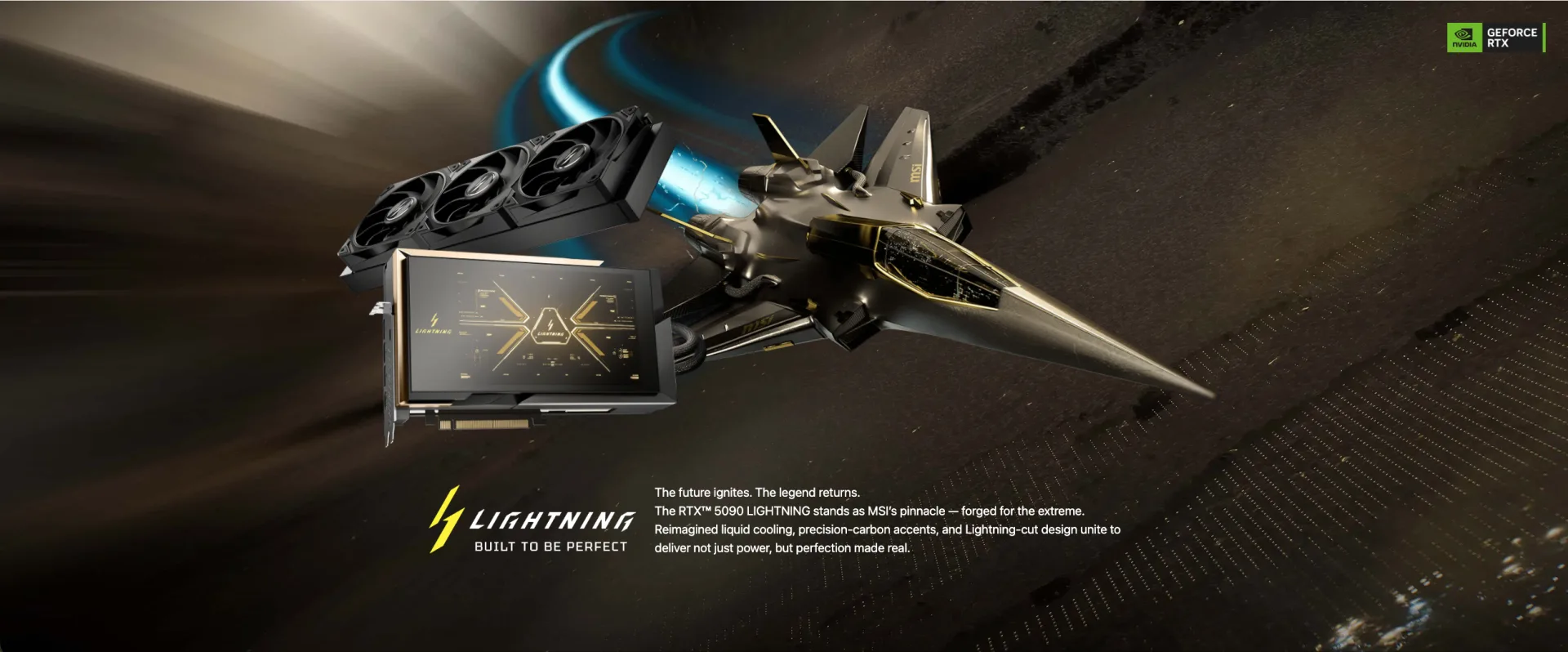
For PC enthusiasts and extreme overclockers, the release of MSI's GeForce RTX™ 5090 32G LIGHTNING Z graphics card isn't just a new product launch; it's a battle for a golden ticket. With only 1,300 units produced worldwide, this top-tier GPU has been relegated to a lottery system, confirming its status as a collector's item as much as a performance beast. Today, winners in Taiwan received their official purchase links, kicking off what we anticipate will be a frenzied global rollout for this highly exclusive hardware.
We can't help but feel a touch of skepticism when a product, no matter how powerful, is released through a lottery. While it certainly builds hype, it also smacks of artificial scarcity, forcing eager buyers—including those eyeing the "OPEN DRAW" button on the MSI USA Store—into a digital raffle just for the chance to spend upwards of five thousand dollars. It’s a bold move, undoubtedly, but one that challenges the notion of fair access to cutting-edge technology. The MSI RTX 5090 LIGHTNING Z isn't merely a graphics card; it's a statement piece, designed for the upper echelon of hardware enthusiasts and record-breakers.
Blackwell Unleashed: A Performance Deep Dive
At its core, the MSI GeForce RTX 5090 LIGHTNING Z harnesses NVIDIA's GeForce RTX 5090 GPU, built on the Blackwell Architecture, and comes equipped with a hefty 32GB of GDDR7 memory on a 512-bit bus. Out of the box, it boasts a boost clock of 2730 MHz, which can be further pushed to an extreme performance core clock of 2775 MHz via MSI Center. This represents a significant factory overclock over a base RTX 5090.
While NVIDIA's Blackwell architecture delivers substantial improvements for AI and neural workloads, with a reported 30% increase in floating-point operations per second (FLOPS) and enhanced 4th-generation Tensor Cores, the raw gaming performance uplift over its predecessor, the Ada Lovelace (RTX 40 series), is more nuanced. Early tests suggest Blackwell provides an average IPC advantage of only 1% in rasterized rendering, with more significant gains coming from increased clock speeds, more execution units, and new features like DLSS 4 with Multi-Frame Generation. However, the RTX 5090 does show a notable 27% average performance increase over the RTX 4090 at 4K resolution, and a 33% increase in CUDA cores. The switch to GDDR7 memory alone provides a massive 78% increase in memory bandwidth compared to the RTX 4090's GDDR6X. This means faster loading times and better handling of high-resolution textures, especially crucial for future-proofed 4K gaming with ray tracing.
This 2026 model marks MSI's first water-cooled LIGHTNING GPU, featuring a next-gen liquid cooling system with a full-copper, full-cover cold plate, an advanced pump, a patented hybrid-fin radiator, and a 360mm AIO. The inclusion of such a robust cooling system is critical, as the card is engineered to sustain 1000W loads with stability. We consider this level of cooling an absolute necessity, given the extreme power targets.
A standout, if somewhat extravagant, feature is the world's first integrated 8-inch GPU display. While a novel visual element directly on the card for system stats or personalized animations sounds appealing, we question its practical value for the core enthusiast. For many, such a feature adds complexity and cost without directly contributing to in-game performance, potentially being more of a marketing flourish than a functional enhancement.
Beyond the display, the card boasts a custom PCB with 3oz copper, dual BIOS, Lightning-Grade Components, and V-Check Point for precise voltage tuning. These are the details that truly matter to the extreme overclocking community, offering the foundational stability and control needed to push hardware far beyond factory settings.
The Cost of Elite Performance
The MSI GeForce RTX 5090 32G LIGHTNING Z comes with a U.S. price tag of $5,090.99, and an approximate price of $5,220 - $5,230 USD in Taiwan (including sales tax). This pricing places it firmly in the ultra-premium segment, significantly above standard RTX 5090 GPUs, which typically retail between $3,000 and $4,000.
To put this into perspective, let's look at how it stacks up against other high-end, limited-edition RTX 5090 variants:
The price point for the LIGHTNING Z makes it roughly $1,000 more expensive than the Asus ROG Matrix Platinum RTX 5090, which itself was limited to 1,000 units and quickly sold out. While some custom RTX 5090 models, like certain Asus ROG Astral variants, have been listed for similar or even higher prices, the LIGHTNING Z firmly plants itself at the pinnacle of cost. We believe this extreme premium is less about a proportionate performance increase and more about exclusivity and bragging rights for a niche market of collectors and extreme overclockers. One Reddit user aptly summarized the sentiment, stating, "Unless this card is somehow 20% faster than a regular 5090 it is not worth it."
The Power Quandary: When 'Extreme' Becomes Unsafe
Perhaps the most compelling, and concerning, aspect of the LIGHTNING Z is its raw power consumption. While engineered for stable 1000W loads, the extreme overclocking (XOC) BIOS allows for an astonishing 2500W consumption. This pushes the boundaries of what is practical and safe for a consumer product. MSI explicitly warns that enabling the XOC BIOS voids the warranty, a clear indication of the inherent risks.
This raises serious questions about the feasibility of running such a card in a typical home setup. Most household electrical circuits in the U.S. are limited by 15-amp breakers, safely handling approximately 1500 watts. Drawing 2500W from a single component, alongside the rest of a high-end system, could easily trip breakers, lead to power instability, or even cause damage to household wiring over time. Even the recommended 1600W power supply for "optimal operation" is a significant demand that not all existing high-end systems are equipped to handle.
Furthermore, MSI's directive that 1-to-3 power connector dongles are not supported due to safety protection underscores the gravity of the power delivery. Users will need two native 16-pin power connectors from a sufficiently powerful PSU. We urge extreme caution for anyone considering operating this card at its maximum potential. While overclocking can offer performance gains, pushing voltages and power limits too far without adequate cooling and electrical infrastructure carries significant risks, including shortening component lifespan, system instability, and even permanent damage. For the vast majority, the practical benefits of the XOC BIOS will be overshadowed by the logistical and safety challenges it presents.




Comments