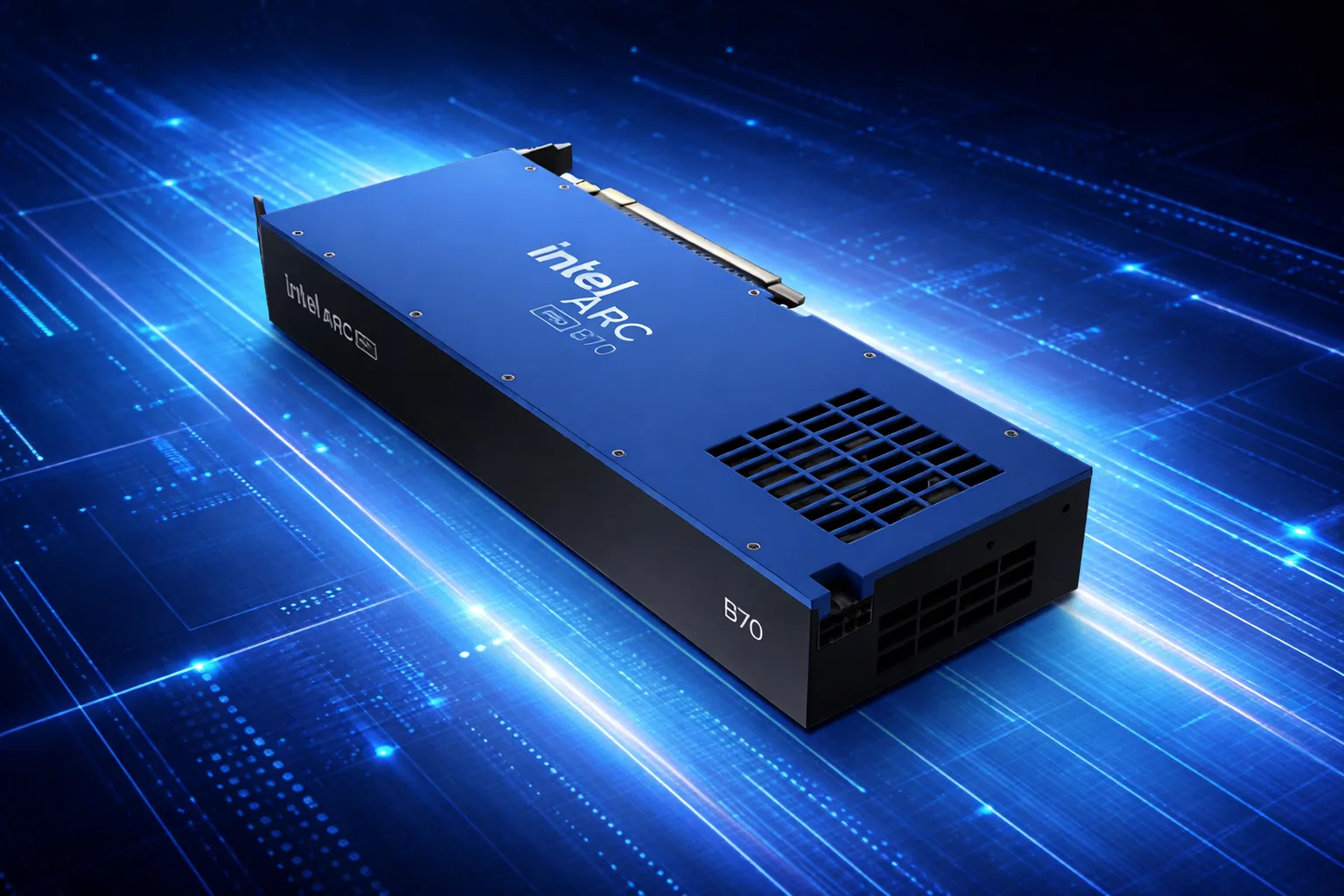
Intel’s new Arc Pro B70 is now showing up where plenty of US buyers would expect to find it: Newegg. That matters partly because Intel’s Arc Pro cards have used Newegg as a real retail channel before, and partly because the first public storefront is often where launch messaging meets the messier reality of SKU-by-SKU availability.
The broad outline is clear enough. Intel introduced the Arc Pro B70 on March 25 in New York as a workstation and AI inference GPU, with a starting price of $949. Intel says it will be available through its own channels and through board partners including ASRock, Gunnir, MAXSUN, Sparkle, Senao, Lanner, and Onix. The Newegg listing, though, reportedly shows the Intel-branded card at $949.99 with a preorder release date of April 24, 2026.
That gap does not necessarily mean anything dramatic. It could be as simple as different launch timing for Intel’s own retail-branded board versus partner cards, or a delay specific to Newegg’s listing pipeline. But it does mean buyers should read “available now” a little more narrowly than a launch presentation might suggest.
What We Know, and What’s Still Thin
Some parts of the B70 story are established. Others are still hanging off listings, support-page breadcrumbs, and Intel’s own event claims.
Arc Pro B70 At A Glance
For the B70 itself, the commonly cited specs are strong on paper:
- BMG-G31 “Big Battlemage” GPU die
- Xe2-HPG architecture
- 32 Xe2 cores
- 32 GB GDDR6
- 256-bit memory bus
- ECC support
- 367 TOPS of AI performance, according to Intel
- TSMC manufacturing
But a lot of the board-level detail still is not public, or not independently verified:
- Clock speeds are still unclear
- Board power/TDP is still unclear
- PCIe lane configuration is still unclear
- Display outputs are still unclear
- Intel’s full public product spec page was not visible live on ARK as of March 25
That missing data matters more here than it would for a gaming card rumor. On workstation hardware, power limits, thermals, output configuration, and certification support often decide whether a GPU fits an actual deployment.
Why the 32 GB and ECC Story Is the Real Headline
Intel is pitching the B70 as a workstation and AI inference part, not a consumer gaming GPU. In that context, the number that jumps out is not the 367 TOPS claim. It’s the 32 GB of GDDR6, paired with ECC support.
For local LLM work, memory capacity often sets the floor for what models you can run comfortably without heavy compromises. Raw throughput still matters, but there is a real class of users for whom “can fit the model” comes before “can run it fastest.” That appears to be why Intel also introduced the B65: another 32 GB card, but with clearly lower compute performance, aimed at workloads where capacity matters more than peak speed.
The B-series memory ladder now looks very deliberate:
- B50: 16 GB
- B60: 24 GB
- B70: 32 GB
That gives Intel a cleaner story than it had a year ago. If you are shopping for local inference, creative work with large assets, or workstation tasks that benefit from more framebuffer headroom, the lineup now makes sense in simple increments. The question is whether the software side keeps up.
ECC support also deserves more attention than it usually gets in launch blurbs. On a professional card, ECC is less about headline speed than about reducing the chance of silent memory errors in long-running jobs. For some AI inference and workstation users, that is attractive even if the card does not top every performance chart. The practical value depends on how Intel implements and exposes it in drivers and software stacks, but the feature itself lines up with professional use more than gaming-adjacent positioning.
Intel’s Performance Claim Is Aggressive. It’s Also Unproven Outside Intel.
Intel says the Arc Pro B70 beats Nvidia’s RTX Pro 4000 Blackwell in AI performance at roughly half the cost. If that holds up in independent testing, it would be one of the more interesting workstation GPU pricing stories this year.
Right now, though, that is still Intel’s claim from a controlled event. There are no independent third-party B70 benchmarks available yet.
That makes comparison tricky. Nvidia’s RTX Pro 4000 Blackwell has an established place in the professional GPU market, and Nvidia still has the advantage in mature CUDA tooling, broad software support, and a deep bench of workstation certifications. Intel can argue price and memory capacity all day, but for many professional buyers the actual decision lives in a more mundane place: driver behavior, app certification, deployment friction, and whether the software they already use behaves on day one.
Some early community reaction reflects that split. Enthusiast and local-LLM circles seem genuinely interested in a 32 GB card under $1,000, especially if mainline software support lands early. There has also been immediate skepticism around Intel’s benchmark framing and around how mature the stack really is for less curated workloads. Both reactions are reasonable. The B70 looks attractive where memory-per-dollar matters, but that does not settle the software question.
The Quiet Signal From Newegg
The Newegg appearance matters beyond simple availability because it reinforces that Intel is trying to put Arc Pro in normal retail view, not only in enterprise catalogs. That was already partly true with the B50, which showed up on Newegg in September 2025 and briefly climbed high in workstation card rankings there. The B70 listing continues that pattern.
There is also an interesting detail in the partner mix. MAXSUN reportedly has both a blower-style Turbo model and a passive-cooled variant. That suggests Intel’s board ecosystem for Arc Pro is trying to cover more than one install scenario: classic workstation chassis, denser rack-oriented setups, and environments where passive cooling matters. Without reported board power figures, we should be careful not to read too much into that. Still, passive and blower options usually indicate Intel and its partners expect the card to land in more varied professional deployments than a standard desktop-only design would.
ASRock’s Creator-branded B70, reportedly listed at $999, points in a similar direction. If that price holds, board-partner premiums over the $949 base may be fairly modest. Again, that needs direct confirmation, but it hints that Intel may be trying to keep B70 pricing tightly bounded rather than letting it drift far above the launch number.
The B770 Question Is Still Lurking In The Background
There is an obvious subtext to any BMG-G31 product right now: where is the consumer version?
Intel has not announced a consumer Arc B770 gaming card using this die, and the chatter around a cancellation remains unconfirmed rumor. So the careful reading is simple: the B70 is real, it uses the bigger Battlemage silicon, and Intel is bringing that die to market first, or at least publicly, as a professional product.
That does not prove anything about Intel’s internal plans for a gaming card. It does, however, show where the company is comfortable talking about BMG-G31 today. Right now, that place is workstation and inference, where 32 GB of memory and software-stack messaging can matter more than a straight gaming performance shootout.
If you were hoping to use the B70 as a proxy for a future B770, that may only work in limited ways. Shared silicon can still behave very differently across clocks, board power, memory configs, drivers, and firmware targets. Until those details are public, any direct read-across from “Arc Pro B70 exists” to “this is what a gaming B770 would be” is speculative.
Where Intel May Have An Opening
Intel’s strongest angle here is not that it has suddenly overtaken Nvidia in the workstation market. It hasn’t. Nvidia still dominates discrete GPU share by a huge margin, and workstation inertia is real. Certification, ecosystem support, and software trust tend to move slowly.
The more plausible reading is narrower: Intel may have found a price band and workload mix where some buyers are willing to tolerate a younger software stack in exchange for more VRAM per dollar.
That is especially relevant for:
- local LLM users who care about fitting larger models
- developers already comfortable with oneAPI or OpenVINO
- smaller studios or labs buying for inference experiments rather than standardizing a whole fleet on one vendor
- workstation users whose applications do not hinge on Nvidia’s long certification history
That opportunity is real enough to watch, but it is still conditional. Intel’s professional software certifications still trail Nvidia and AMD in breadth, and “supports PyTorch” is not the same thing as “works cleanly in every workflow people care about.”
What To Watch Next
The B70 is one of those launches where the first listing is useful mostly because it tells you what questions to ask next.
Here’s what will actually decide whether the card matters beyond launch-day interest:
- Independent benchmarks: especially AI inference tests outside Intel’s own demos, plus workstation app behavior in real software
- Board power and thermals: a passive variant sounds appealing, but power draw will shape where the card can actually go
- Driver and framework maturity: oneAPI, OpenVINO, Intel compute libraries, and day-one support in common inference tools matter more than the keynote TOPS figure
- Certification growth: professional buyers will want to see app certifications accumulate, not just promised support
- Actual retail timing: Intel says available at launch; the Newegg Intel-branded SKU reportedly says April 24. We need to see how that sorts itself out across partner boards
Practical Takeaways
If you’re tracking the Arc Pro B70, the early signal is pretty straightforward.
- The pricing looks aggressive, assuming the $949 floor holds across real retail stock
- The 32 GB memory capacity is probably the feature that matters most, especially for local inference and memory-hungry workstation tasks
- Intel’s performance story is still provisional, because the headline comparisons are Intel’s own and not independently verified yet
- Availability is murky at the SKU level, with a launch-day message on one side and a reported April 24 Newegg date on the other
- Software support will likely decide the card’s real audience, not the spec table alone
For now, the B70 looks less like a settled win and more like a credible opening bid: lots of VRAM, an aggressive asking price, and just enough uncertainty to make the next round of reviews matter more than the launch event.




Comments