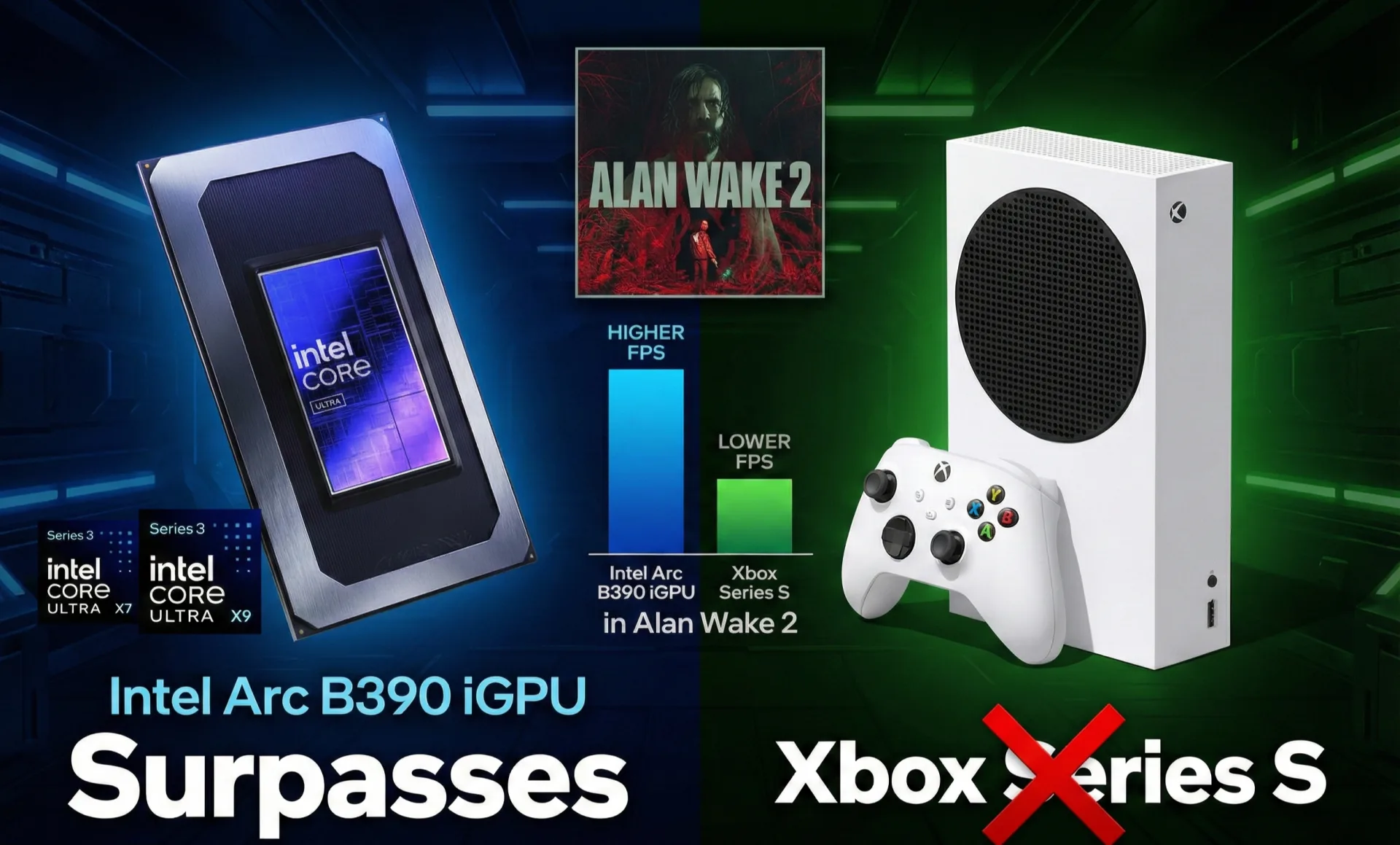
The lines between console and PC gaming have been blurring for years, a tired observation we've all heard. Yet, rarely do we witness an integrated GPU (iGPU) so directly challenge dedicated console hardware. This is precisely the surprising narrative emerging around Intel's new Arc B390 iGPU, codenamed "Panther Lake" and built on the Xe3 architecture. Recent benchmarks have revealed a startling reality: this integrated graphics solution can deliver a gaming experience in demanding titles like Alan Wake 2 that not only rivals but, in some crucial aspects, surpasses that of the Xbox Series S.
We believe this signals the potential for high-fidelity gaming in thin-and-light laptops and portable devices, fundamentally reshaping our expectations for what integrated graphics can achieve.
The Alan Wake 2 Showdown: Integrated Graphics Takes on a Console Mainstay
The comparison that has rightfully captured the industry's attention comes from Digital Foundry and pausehardware.com, zeroing in on Alan Wake 2 – a graphically intensive title known for pushing even high-end modern hardware to its limits. Testing the Arc B390, integrated into a Core Ultra X9 388H CPU in test systems like the Lenovo IdeaPad Pro 5, revealed impressive results.
At a targeted 30W power draw—a "standard wattage" we often see in gaming handhelds—the Arc B390 achieved an average of 29.54 frames per second (fps) in Alan Wake 2. This was at a 1440p output, utilizing FSR 2 Balanced upscaling from an unspecified lower internal resolution, with tweaked low PC settings and a 30fps cap. The performance was described as a "reasonably steady 30fps with mostly even frame-pacing."
How, then, does this stack up against the Xbox Series S? The console, running Alan Wake 2 with a 1440p output (upscaled from an internal 720p using FSR2), a 30fps cap, and a "more compromised feature set" including reduced fidelity in areas like foliage and shadows, delivered a "far less stable, more jerky experience." The Arc B390's 29.54 fps average represents approximately a 7% higher frame rate than the Series S in this specific scenario.
We find this achievement particularly noteworthy, even with the stated caveats. While Digital Foundry points out that the test isn't a "clean one-to-one match" due to differing PC and console settings, and that Alan Wake 2 can "behave oddly" on mobile iGPUs, the fact that an integrated solution can compete in such a challenging title shows real progress from Intel. The Arc B390's newer Xe3 architecture appears to outmaneuver the approximately six-year-old custom RDNA 2 architecture found in the Xbox Series S. In our view, this highlights the stagnation of the lower-end console hardware as PC integrated solutions surge forward.
Beyond the Benchmarks: Intel's Aggressive Ascent
The Alan Wake 2 results are far from an isolated fluke. The Arc B390 demonstrates a significant leap across a range of titles and benchmarks, signaling a new performance tier for Intel.
- Generational Improvement: This new iGPU boasts a ~70% performance advantage over previous Arc Graphics 140T/140V iGPUs. This isn't just an incremental step; it's a generational leap that demands attention.
- Dominating AMD's Offerings: Intel's new chip shows a 50-80% advantage over smaller Radeon 800 series iGPUs (AMD Zen 5) and reportedly leads the Radeon 890M by "wide margins," supposedly 63% faster at 24/25W. While AMD's higher-power Strix Halo iGPUs remain faster, they operate at significantly higher wattages, placing them in a different thermal and power envelope.
- Challenging Discrete GPUs:
- Intel itself claims the Arc B390 is around 10% faster on average than an Nvidia RTX 4050. While this is a bold claim, and one that has met with skepticism in online discussions, with some suggesting selective benchmarking, the overall picture from independent tests still points to surprisingly strong performance for an iGPU.
- In games without ray tracing or upscalers, the B390 generally performs between a Radeon RX 580 and a GeForce RTX 2060, occasionally matching the RTX 2060. It consistently beats the GTX 1060 and RX 580 in average performance.
- For ray tracing, the B390's newer architecture often outperforms the RTX 2060 and even the RX 7600 in some games. It can even appear steadier than the RX 6600 due to its ability to use system memory as VRAM, avoiding bottlenecks seen with 8GB VRAM caps on some discrete cards – a clever architectural advantage we don't often see in integrated solutions.
Real-world gaming benchmarks further solidify its capabilities:
- Cyberpunk 2077 (1080p, Medium, XeSS Balanced): 99.45 FPS, jumping to 165.74 FPS with Frame Generation (FG) 2x.
- Forza Horizon 5 (1080p, Medium, XeSS Quality): 111 FPS.
- Doom: The Dark Ages (1080p, High, XeSS Balanced): 58.4 FPS, boosting to 97.8 FPS with FG 2x.
- Assassin's Creed Shadows (1080p, Medium, XeSS Balanced): 58 FPS, soaring to 118 FPS with FG 2x.
- Shadow of the Tomb Raider (1200p, High, no upscaling): 75 fps average.
Even notoriously demanding titles like Baldur's Gate 3 (50 fps, 1080p maximal settings) and Elden Ring (61 fps, 1080p maximal settings) are playable without the need for frame generation. This isn't just "playable for an iGPU;" it's genuinely enjoyable performance.
The XeSS and Multi-Frame Generation Ace Up Intel's Sleeve
A significant factor behind the Arc B390's prowess is its robust support for Intel's advanced technologies: XeSS 3 upscaling and, notably, Multi-Frame Generation (MFG) up to 4x. The B390 is the first and currently only iGPU to support MFG at this level. These technologies are absolutely crucial for bridging the performance gap in modern games, delivering massive frame rate uplifts (e.g., 66% in Cyberpunk 2077 with 2x FG) that make otherwise challenging games playable at higher settings and resolutions. In our view, this strategic inclusion is what truly allows Intel to punch above its weight class.
The Broader Implications: Redefining Portable Gaming, But With Caveats
"Intel’s Arc B390 represents a leap forward, offering competitive performance that rivals entry-level and even mid-range discrete GPUs. This changes the market for integrated graphics," comments an industry analyst. We couldn't agree more. This leap has profound implications for the laptop market and casual PC gaming:
- Portable Gaming: The Arc B390 ushers in an era where high-quality gaming is genuinely possible on thin-and-light laptops without the need for a discrete GPU. This could democratize gaming performance, making it accessible in a wider range of form factors than ever before.
- Pressure on Competitors: Intel's aggressive performance puts considerable pressure on AMD's integrated graphics offerings and directly challenges entry-level discrete GPUs from both AMD and Nvidia. The low-end discrete GPU market may soon find itself in an existential crisis if iGPUs continue on this trajectory.
- Shifting Expectations: Consumers will likely begin to expect much more from "integrated graphics" going forward, potentially reducing the necessity for discrete GPUs in all but the most demanding gaming machines.
However, we must temper expectations; it is not a complete victory. While it rivals the Xbox Series S, the Arc B390 still trails dedicated current-gen consoles like the PlayStation 5, which showed a 92% performance lead in Alan Wake 2 (55.25 fps vs. 28.91 fps for B390 with PS5-equivalent settings). It also generally trails the RTX 2060 and RX 6600 in overall average performance and often falls short of the RTX 5060 Laptop. There have also been reports of specific issues, such as memory-related quirks in F1 25 and Frame Generation not reliably working in Borderlands 4 during one test – a reminder that new hardware often comes with early adopter hurdles.
Furthermore, a significant hurdle for widespread adoption today, February 13, 2026, is the current scarcity and high cost of Panther Lake devices. For comparable Alan Wake 2 performance, an Xbox Series S remains a considerably cheaper alternative, priced at around $299 USD for the 512GB model. This highlights that while the technology is undeniably ready, market availability and pricing need to catch up before it truly disrupts the budget gaming space.
Looking ahead, Intel plans future Xe3P implementations with Nova Lake this year, promising a "full Xe3 implementation," suggesting even greater potential. With AMD's mainstream mobile parts likely sticking to RDNA 3.5 for a while, Intel appears well-positioned to lead the integrated graphics segment for the near future. The Arc B390 iGPU is a statement of Intel's serious intent in the graphics space, demonstrating that integrated solutions can now deliver genuinely capable gaming experiences. While it may not yet be a "console killer" for every gamer, it unequivocally marks a new benchmark for integrated graphics, empowering a new generation of portable PC gaming.







Comments