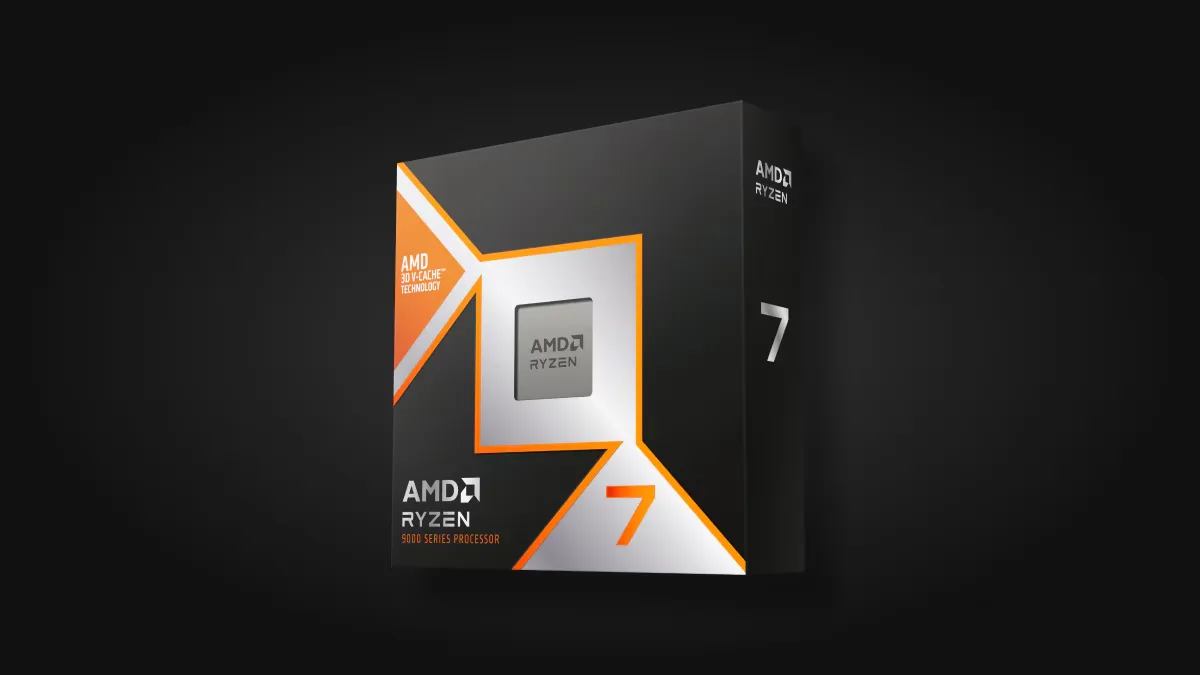
AMD's Ryzen 7 9800X3D has dropped to a reported low of $409.95 on Amazon US, down from its $479 MSRP and below earlier Amazon lows of $429.95 in mid-March and $419.95 in late March.
That price appears to be real enough to track. camelcamelcamel logged $409.95 on April 10, and VideoCardz reported the same Amazon price a day later. What is not fully clear from the available evidence is the exact listing condition: whether the offer was sold directly by Amazon or a third-party seller, whether Prime was involved, and whether any coupon or promo mechanic was attached at the time.
That uncertainty matters. A one-day dip tied to a marketplace seller is not the same signal as a stable Amazon first-party price cut. Still, even with that caveat, a move to $409.95 is meaningful for a chip that launched on November 7, 2024 and has spent much of its life as AMD's premium 8-core gaming option.
What the listing shows, and what it doesn't
Here's the clean part first: the reported low is about $69 off MSRP, or roughly 14 percent below launch pricing, matching the discount math highlighted by Tweaktown.
Here's the murkier part: the available snapshots do not fully prove that this was a no-strings, broadly available Amazon deal. The camelcamelcamel entry also shows "Best Price Amazon Price" and separately references third-party conditions, which makes the record useful but not exhaustive. So the safest reading is this: $409.95 was a documented Amazon US listing price, but the exact purchase conditions are not completely pinned down.
That distinction may sound fussy, but for deal-watchers it changes the takeaway. A documented low is one thing. A repeatable street price is another.
Why this CPU still gets attention at $409
The 9800X3D is not just another 8-core desktop part. On paper, it is still tuned very specifically for gaming:
That large L3 cache is the obvious headline because it usually does the heavy lifting in frame-rate-sensitive games. The broad market view of this class of chip is straightforward: X3D parts tend to trade some all-core productivity performance for stronger gaming behavior. The 9800X3D fits that pattern.
The pricing matters because this is the kind of CPU that often lands in an awkward middle zone. At launch, it was a premium buy for people chasing top-end gaming performance without moving up to pricier Ryzen 9 X3D models. At $409.95, it starts to look less like a halo-adjacent part and more like a mainstream upper-tier option for an AM5 build.
The performance angle: the discount lands because the chip is already established
This drop would be less interesting if the CPU had a shaky performance story. It doesn't.
One benchmark cited in the available material puts the 9800X3D at 58 FPS in Microsoft Flight Simulator 2020 at 4K Ultra, with 35 FPS 1% lows, versus 24 FPS for the older Ryzen 7 5800X3D in the same comparison. As with any single-game result, that should be treated as workload-specific rather than universal. Flight Simulator can be unusually sensitive to cache behavior and CPU-side latency, so it is a favorable title for a chip like this. But it does help explain why the part keeps showing up in "best gaming CPU" discussions.
More broadly, Tom's Hardware has described the 9800X3D as well ahead of Intel's current flagship gaming option in its test suite, including a roughly 35 percent lead over the Core Ultra 9 285K in one aggregate gaming comparison. That does not mean every buyer should care about that exact delta, or that every GPU-and-resolution setup will show anything close to it. It does mean the 9800X3D is not being discounted because it is irrelevant. If anything, the unusual part is that a still-desirable gaming CPU has slid this far this soon.
A price move like this can mean a few different things
This is where reported analysis has to stay disciplined. A lower Amazon listing does not automatically tell us what AMD, Amazon, or channel sellers are trying to do.
A few plausible interpretations fit the evidence:
1. The 9800X3D may simply be settling into its long-term street price
This is the least dramatic explanation, and probably the safest one. Plenty of enthusiast CPUs launch high, hold for a while, then drift lower once supply normalizes and first-wave demand fades. A move from $479 to the low $400s over time is not unusual on its face, especially for a product that launched in late 2024 and now sits in a market with newer adjacent options.
If that is what is happening, then $409.95 may be less of a one-off shock and more of a preview of where the chip wants to live.
2. Retail pricing may be reacting to newer chips above it
The surrounding context mentions a newer Ryzen 7 9850X3D at $499. That alone could pressure the older model downward, particularly if sellers want cleaner spacing between an older 8-core X3D part and a faster-binned successor. That does not prove AMD directed anything. It just makes the pricing ladder easier to understand.
If buyers can get close enough gaming performance from the older part at around $410, then the newer chip needs either a clear speed story or enough price separation to justify itself.
3. AM5 upgrade economics are getting better
This is probably the most practical implication. The 9800X3D works on AM5, with support across many 600-series and 800-series boards via BIOS updates, and AMD's platform promise still extends through at least 2027. That means a price drop on the CPU alone can have outsized impact because many existing AM5 owners may not need a motherboard replacement.
As Switchblade Gaming has pointed out in its coverage of AM5 longevity, that kind of socket continuity changes how people think about CPU deals. A $409 processor is one thing in a full-platform rebuild. It is another if it mostly comes down to a BIOS update and a chip swap.
The Amazon wrinkle is real, even if it may not change the bottom line
There is also a timing oddity here. Amazon updated its Fair Pricing Policy on April 6, with an April 23 effective date, tightening how list prices and reference discounts can be presented, as EcommerceBytes reported and PPC Land detailed.
That does not mean the 9800X3D's $409.95 listing was shaped by the policy update. There is no evidence for that. But it does add context to why deal language around Amazon pricing now deserves a little more caution. "Record low" can still be true while the exact framing around reference pricing, seller status, and discount presentation gets messier than a simple MSRP-minus-sale-price screenshot suggests.
There is still one practical limitation with the 9800X3D: total build cost
The CPU price is only part of the story. AMD officially supports DDR5-5600, but the available material says the chip performs best with EXPO-enabled DDR5-6000 or higher. That likely means buyers trying to get the most from the processor may still end up budgeting around memory tuning and motherboard compatibility rather than just the CPU itself.
And while 120W TDP sounds manageable, the listed 162W peak load power suggests this is not a low-effort cooling chip if you plan to run it hard. For many gaming builds that will not be a problem, but it keeps the 9800X3D from becoming a truly cheap path to top-tier gaming. The processor may now be cheaper; the ideal platform around it is not necessarily bargain-bin hardware.
What to watch next
The main thing to watch is not whether $409.95 happened. It did, at least as a documented Amazon price. The bigger question is whether it sticks, and under what conditions.
If the chip keeps reappearing around this level from clearly identified sellers with no coupon gymnastics, then the market has probably reset around a lower normal price. If instead this turns out to be a brief, hard-to-repeat listing with unclear fulfillment details, then the "record low" label will matter more to tracking sites than to actual buyers.
For anyone already on AM5, that distinction could be the whole story. If the 9800X3D starts living around $410 in a repeatable way, it becomes a much more straightforward upgrade proposition. If the price bounces back and the low was tied to narrow listing conditions, then it is better read as an interesting data point than a new baseline.









Comments