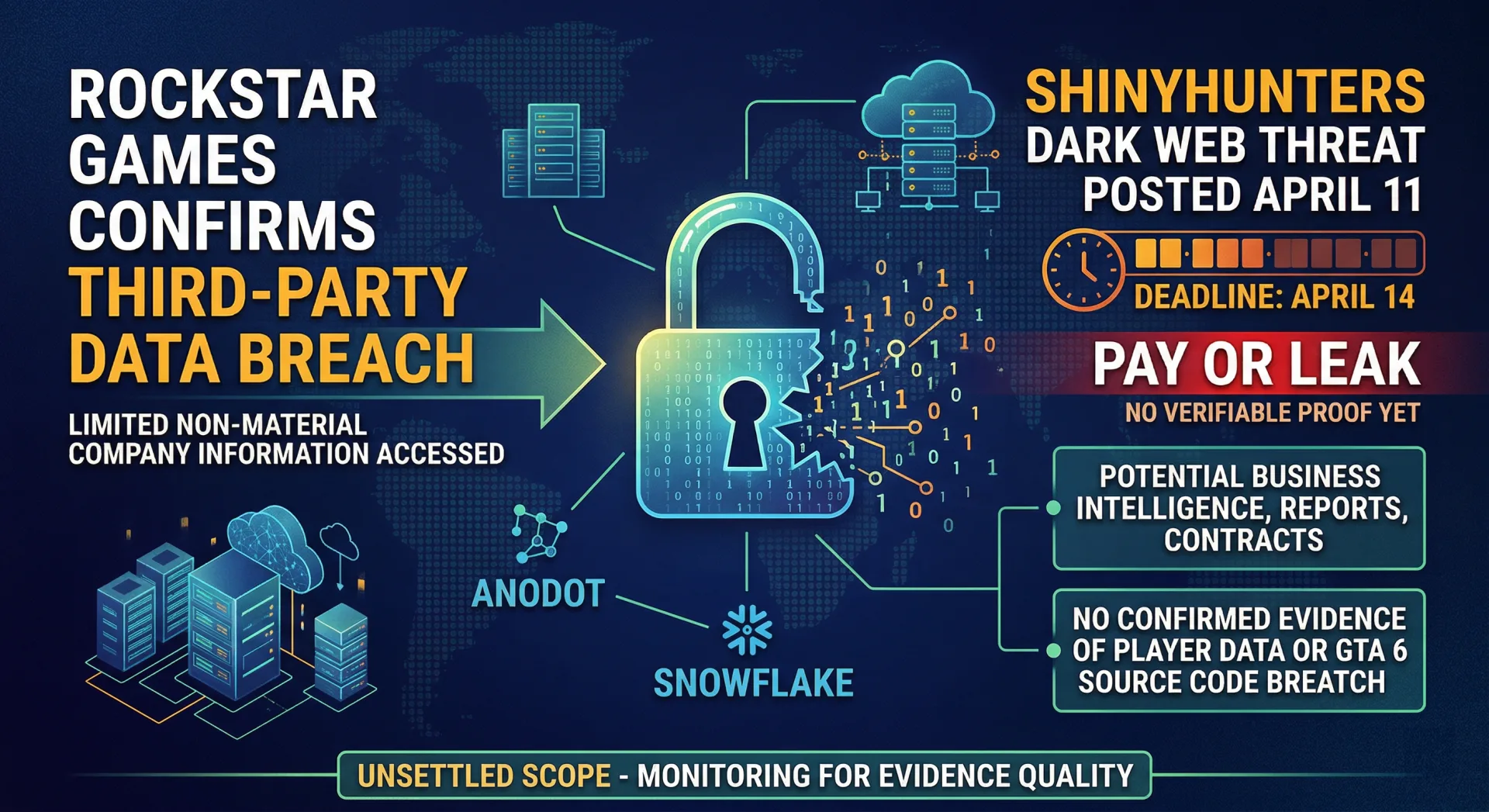
Rockstar Games has confirmed that some company information was accessed in what it describes as a third-party data breach, after ShinyHunters posted a threat on its dark web leak site on April 11 and set an April 14 deadline for a response.
That much is real. The part that still isn't settled is the scope.
As of April 12, ShinyHunters had not published verifiable proof tying its claims to Rockstar: no file samples, no screenshots, no hashes, no obvious evidence of access. That absence matters. Leak-site threats are designed to create pressure, and pressure works best when the target company, journalists, and the public are left filling in blanks.
Rockstar's public line is much narrower. The company stated: "a limited amount of non-material company information was accessed in connection with a third-party data breach. This incident has no impact on our organization or our players," as reported by IGN and Eurogamer.
That statement doesn't suggest that a formal ransom demand was received. It also doesn't say how much data was touched, what systems were involved beyond the third-party link, or whether the dataset categories circulating online are accurate.
What the threat post actually suggests
The ShinyHunters message reportedly said: "Rockstar Games, your Snowflake instances were compromised thanks to Anodot.com. Pay or leak," with a final warning to reach out by April 14, as quoted by Hackread and echoed by PC Gamer.
Two details stand out.
First, the post names a path in: Anodot, a third-party analytics platform, and Snowflake, the cloud data platform where customer environments can hold large amounts of business information.
Second, the post does not name a ransom amount. That's unusual enough to notice, though not enough on its own to prove anything. It may simply mean the public post is meant to force private contact rather than disclose negotiation details.
Snowflake has separately confirmed that Anodot suffered a security incident affecting a small number of customers and that stolen authentication tokens were involved, according to BleepingComputer and TechRadar. That doesn't prove every claim made about Rockstar, but it does make the alleged attack path plausible in a way it wouldn't be otherwise.
Why the "third-party breach" wording matters
Rockstar's wording does two things at once.
It suggests that something happened, and it confines the problem to a supply-chain style exposure rather than a direct compromise of Rockstar's own core systems. If that framing holds up, it would suggest a familiar 2026 problem: attackers getting in through integrations, tokens, or delegated access rather than smashing through the front door.
That distinction matters because the likely risk profile changes. A third-party analytics or monitoring integration can expose business intelligence, reports, metadata, contracts, forecasts, and operational dashboards without necessarily opening the door to customer account systems or development repositories.
That's broadly consistent with what has been alleged so far. The categories circulating in reports include financial records, player spending habits, geographic data, marketing timelines, and contracts involving Sony, voice actors, and music labels. But those remain alleged categories, not verified leaked contents. So far, there is no confirmed evidence that customer passwords, payment details, or game source code were accessed.
That last part matters because breaches involving a game studio quickly get flattened into one question: "Did they get GTA 6?" Based on what's publicly substantiated right now, there's no evidence for that leap.
The GTA 6 angle is mostly heat, not light
Rockstar's statement says the incident has no impact on the company or players, and the company's schedule still lists GTA 6 for November 19, 2026 on consoles. As GamesRadar noted, Rockstar has not indicated any change to release timing.
That doesn't mean the incident is trivial. It means the currently supported evidence points more toward a corporate-data exposure than a production disruption.
Those are different kinds of damage. One threatens roadmaps, deal terms, internal reporting, and partner relationships. The other threatens builds, release dates, infrastructure continuity, and player accounts. Right now, Rockstar is saying this falls in the first bucket, and nothing public has disproved that.
This also fits a broader extortion pattern
The Rockstar claim didn't appear in a vacuum. Reporting around the Anodot incident points to a wider run of cloud and SaaS-linked data theft affecting multiple organizations. Tom's Hardware described Rockstar as part of a broader wave tied to ShinyHunters, while Polygon noted the group's recent expansion across multiple campaigns.
That context doesn't validate the Rockstar-specific claims by itself. What it does suggest is that the alleged method and extortion style are not outliers. ShinyHunters has a reputation for "pay or leak" pressure tactics, and current threat-intelligence reporting has increasingly described data-theft extortion, rather than encryption-led ransomware, as the preferred model for some groups.
If the access really came through stolen third-party tokens, that would line up with a practical criminal logic: target the connective tissue between companies and their cloud data, then monetize the embarrassment and sensitivity of whatever business information is exposed.
What remains murky
The most frustrating part of this story is that both sides are giving partial pictures.
ShinyHunters has made a loud claim but, as of now, no public proof. Rockstar has confirmed access but described it only as a limited amount of non-material company information. Those aren't equivalent levels of detail, but neither one tells outside observers much about scale.
Here's the state of play:
What to watch over the next 48 hours
The practical thing to watch is not rumor volume. It's evidence quality.
If ShinyHunters releases sample files, screenshots, hashes, or contract excerpts that can be independently verified, the story changes immediately from "credible-but-unproven extortion claim" to a more concrete data exposure. If nothing material appears by or after April 14, Rockstar's narrower description may end up looking closer to the truth than the leak-site post implied.
There are a few conditional takeaways:
- Players should pay attention to whether Rockstar or Take-Two issues any updated notice about account risk. Right now, there is no confirmed evidence that passwords or payment details were accessed.
- Industry observers should watch whether any partners named in rumored data categories acknowledge exposure, since contract or scheduling documents are often easier to validate than broad claims about "internal data."
- Anyone tracking GTA 6 should separate security headlines from development impact. At the moment, there is no confirmed link between this incident and the game's November release plan.
- Security teams elsewhere may want to treat this as another reminder that third-party integrations and token-based access can be the weak point, especially when attackers blend into normal service traffic.
For now, the most accurate reading is also the least dramatic one: Rockstar has acknowledged a breach connected to a vendor incident, ShinyHunters is trying to turn that into leverage, and the biggest unanswered question is whether the group can prove the scale it's hinting at before the April 14 deadline hits.



Comments