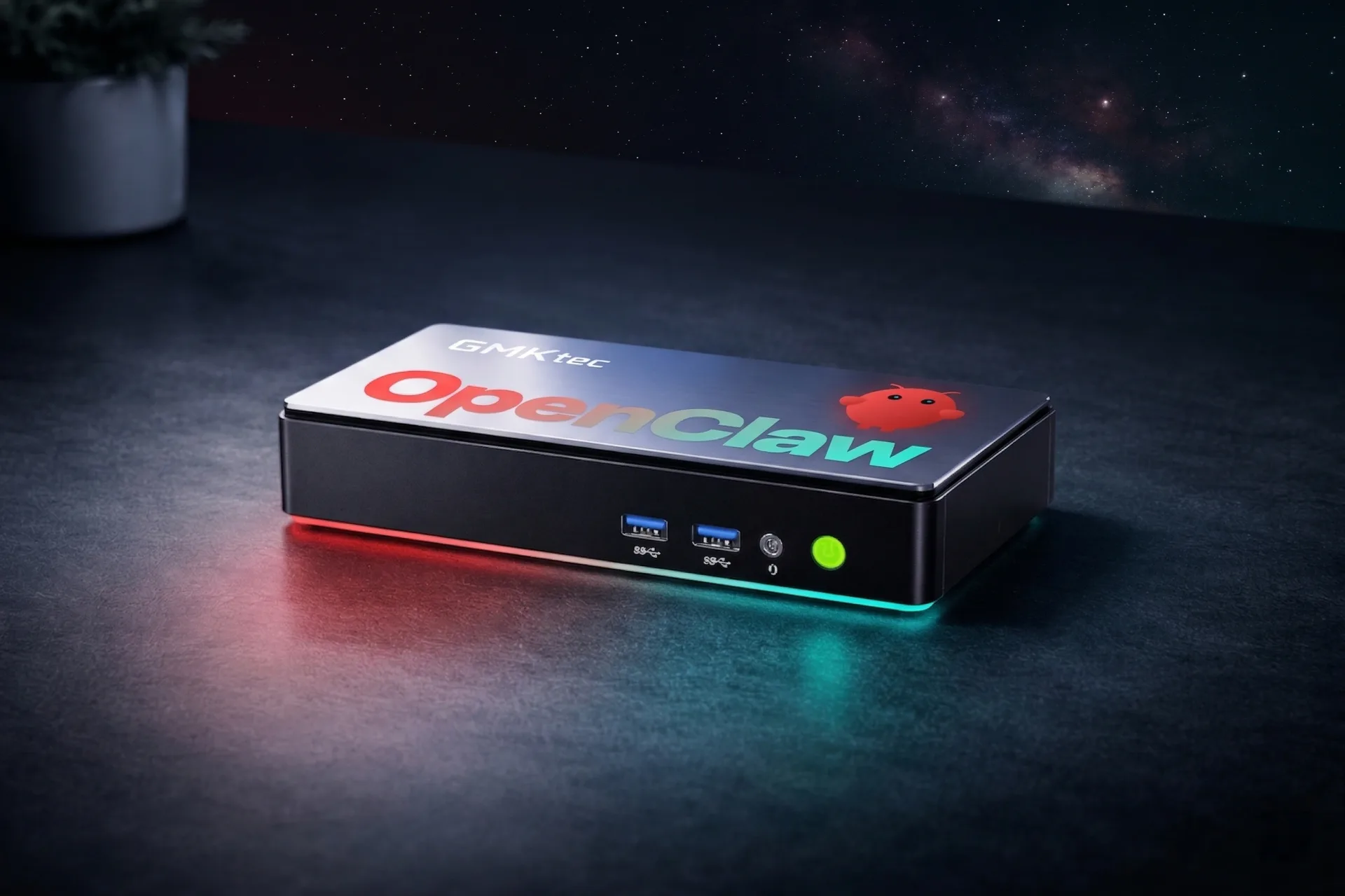
The mini PC market has spent the last three years racing to the bottom on price while recycling the same mobile chips found in mid-range laptops. GMKtec’s NucBox K13 attempts a different approach. By integrating Intel’s Lunar Lake architecture with a pre-installed autonomous AI agent named OpenClaw, GMKtec is trying to escape the commodity hardware trap and reposition itself as an AI appliance manufacturer.
The NucBox K13 occupies a tiny 0.6L footprint, but its goals are much larger. Strip away the marketing, and the hardware reveals a device caught between next-generation silicon and frustratingly dated design choices.
The Lunar Lake Architecture: Efficiency Over Raw Power
The Intel Core Ultra 7 256V powers the K13. Fabricated on TSMC's N3B 3nm process, this silicon marks Intel’s most serious effort to match Apple’s efficiency. On paper, the 115 total platform TOPS (Tera Operations Per Second) sounds like a major leap for AI workloads.
A closer look at the breakdown clarifies what this actually means for the user. That 115 TOPS figure is an aggregate: 47 from the NPU, 64 from the Arc 140V GPU, and a mere 4 from the CPU. For most users, the NPU’s 47 TOPS is the number that matters for background AI tasks; it barely clears the 40 TOPS requirement for Microsoft’s Copilot+ PC designation.
Regarding traditional compute, multi-core performance is roughly equivalent to the Apple M2—a chip that debuted nearly four years ago. For a device launching in early 2026, the performance profile shows that GMKtec and Intel are prioritizing efficiency and AI throughput over raw multi-threaded muscle.
Hardware vs. Ambition
The NucBox K13 features some of the fastest memory available in a mini PC, but it comes with a major caveat: it is non-upgradeable.
Soldering 16GB of RAM is shortsighted for a machine marketed as an AI workstation. AI models are notoriously memory-hungry; while 16GB is sufficient for basic LLM (Large Language Model) orchestration today, it will likely become a bottleneck well before the processor itself is obsolete.
The inclusion of a single USB 2.0 port on the rear is baffling in 2026. In an era where even budget peripherals are moving to USB 3.0 or Type-C, seeing a legacy port on a $900 machine feels like a relic.
The OpenClaw Integration: Gimmick or Utility?
The most intriguing aspect of the K13 is the inclusion of OpenClaw, an autonomous AI agent designed to run 24/7. GMKtec is leaning into the "dual-boot" nature of the device, offering native support for both Windows 11 Pro and Ubuntu.
OpenClaw acts as a local orchestrator, executing tasks and managing tools without sending data to the cloud. By shipping this pre-installed or via a one-click setup, GMKtec is targeting a specific niche: users who want the benefits of an AI agent but are wary of the privacy implications of cloud-based services like OpenAI or Google Gemini.
OpenClaw’s maturity will dictate whether this actually improves the user experience. If it remains a glorified macro-runner, it adds little value. But if it can utilize the 47 TOPS NPU to handle local scheduling and data processing, the K13 becomes a local server for your digital life.
Price Volatility and Reliability Concerns
The K13 saw an aggressive promotional launch with prices as low as $669.99, but the jump to an $899.99 MSRP for the 512GB model is a tough pill to swallow. At nearly $900, the K13 enters a price bracket where it competes with high-end workstations and even some entry-level gaming desktops.
We also cannot ignore the elephant in the room: hardware reliability. Community feedback regarding GMKtec has frequently highlighted inconsistent customer service and longevity issues. When you pay a premium for a specialized AI device, the support should match. Given the soldered memory and the complexity of the Lunar Lake platform, a hardware failure outside the warranty period could turn this $900 investment into an expensive paperweight.
TTEK2 Verdict: A Specialized AI Experiment
The GMKtec NucBox K13 is a fascinating experiment in what a modern AI-first mini PC should look like. It nails the networking with a massive 5GbE port and offers an intriguing vision of local AI via OpenClaw and Ubuntu dual-boot support.
But the flaws are impossible to ignore. Soldered 16GB of RAM is a major limitation for anyone serious about AI development, and the lack of an OCuLink port means external GPU options are limited to the overhead of USB4. The multi-core performance, while efficient, won't set any records.
Practical Takeaway:
If you are a developer or a privacy-conscious user looking for a low-power Linux box to run local AI agents 24/7, the K13 is a unique, highly specialized tool. If you are looking for a general-purpose powerhouse or a gaming-capable mini PC, the soldered RAM and M2-level performance suggest you should look elsewhere—or at least wait for a deep discount.





Comments