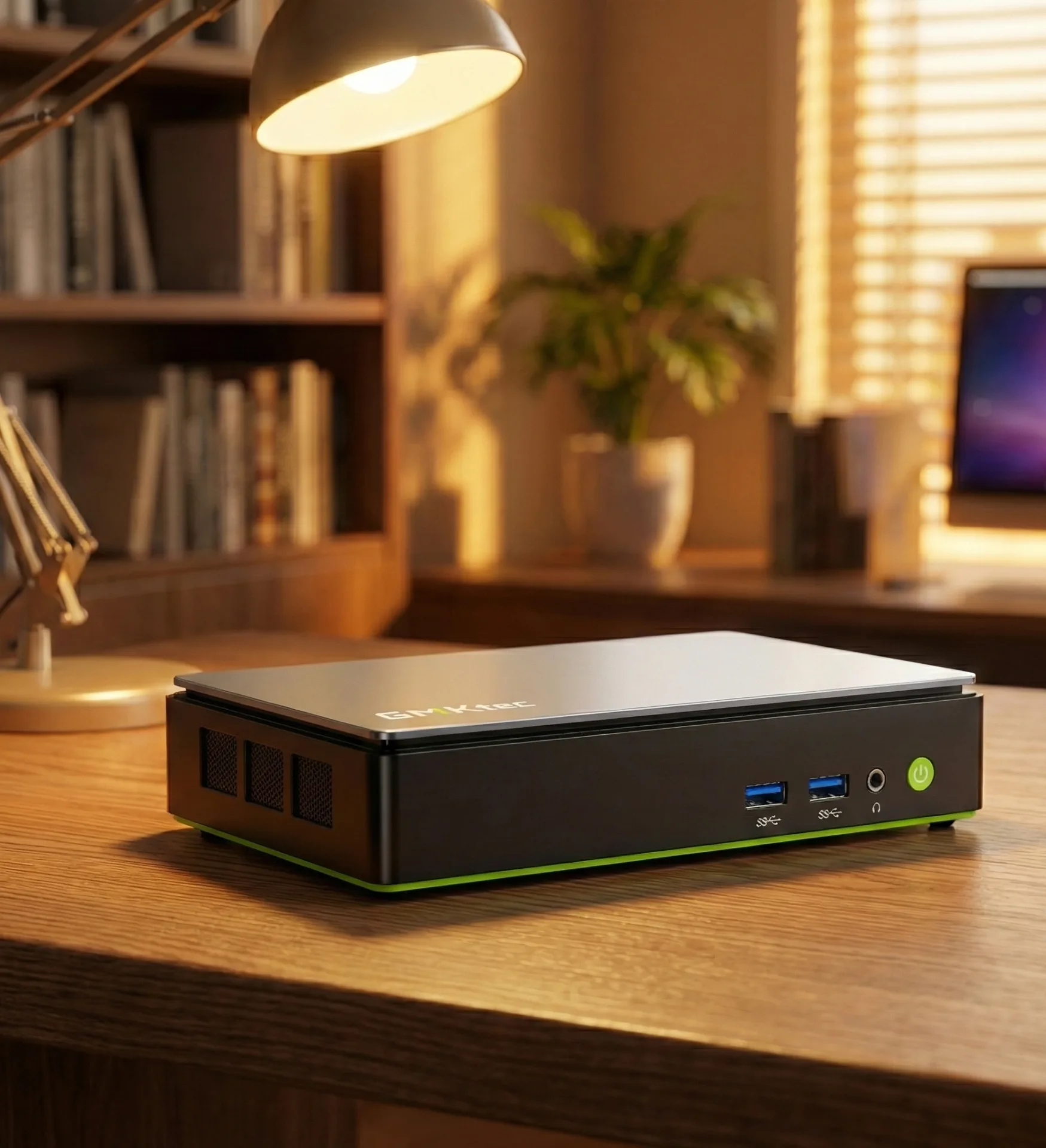
GMKtec is pushing into the global market with its NucBox K13 mini PC, a compact contender aiming to bring Intel's latest Core Ultra 7 256V "Lunar Lake" processor and a combined AI performance of 115 TOPS to desks everywhere. This global rollout, which saw the NucBox K13 debut between January 31 and February 2, 2026, signals GMKtec's clear intent to carve out a niche in the burgeoning AI PC landscape.
During its initial launch window, the NucBox K13 was available with promotional pricing starting at $669.99 for the 16GB RAM and 512GB SSD configuration. GMKtec had previously hinted at price increases post-February 2, 2026, citing escalating material costs. While we expect international pricing to largely mirror its initial Chinese launch, even after any adjustments, we remain somewhat skeptical of rapid, significant increases, particularly in a competitive market segment.
Lunar Lake's Brains and AI Muscle: Is It a True Contender?
At the heart of the NucBox K13 lies the Intel Core Ultra 7 256V processor, a member of the "Lunar Lake" Series 2. This upper mid-range chip boasts 8 cores and 8 threads, fabricated using TSMC's N3B process. With a base frequency of 2.2 GHz, P-cores boosting to 4.8 GHz, and E-cores reaching 3.7 GHz, all backed by 12MB of Smart Cache, it's designed for efficiency. The configurable power modes, ranging from a quiet 15W to a peak of 37W, confirm its mobile-first origins, typically found in slimmer laptops and tablets.
Intel positions Lunar Lake as a low-power, yet competitive, performer. Indeed, early benchmarks suggest the Core Ultra 7 256V can deliver a 10% improvement in single-core performance over the Core Ultra 7 155U and even outpace AMD's Ryzen 7 8840HS (a chip with a higher 28W TDP) in Geekbench, despite Lunar Lake's lower thermal design power. However, some tests indicate its multi-thread performance is roughly on par with an Apple M2, a chip that's over three years old. While certainly capable for most daily tasks, we don't anticipate the NucBox K13 to be a raw performance behemoth, but rather a power-efficient workhorse.
Where the NucBox K13 truly leans into the future is its AI computing capabilities. Integrating the Intel Arc 140V GPU, which contributes 64 TOPS of AI performance, alongside an Intel AI Boost NPU adding another 47 TOPS, results in an impressive total peak AI performance of 115 TOPS. This positions the NucBox K13 squarely in the realm of local AI agent capabilities and creative workloads, easily surpassing the 40+ NPU TOPS required for Microsoft's Copilot+ AI standard. To put this in context, some rivals like the GEEKOM IT15 AI Mini PC offer up to 99 TOPS, while the Minisforum MS-S1 Max can hit 126 TOPS, showing GMKtec is very much in the game for on-device AI acceleration.
The integrated Intel Arc 140V GPU is a significant step forward for Intel's integrated graphics. It's a successor to the Arc 8 iGPU and is said to handle "modern games at 1080p resolution with adjusted visual settings". Our research confirms this, with some reports showing playable frame rates (over 30 FPS, sometimes 40-60 FPS) in titles like Ghost of Tsushima and Baldur's Gate 3 at 1080p on low or adjusted settings. While it might not dethrone AMD's top-tier integrated GPUs like the Radeon 890M, it certainly offers a compelling option for casual gaming on a mini PC.
One aspect we do have to call out is the memory. The NucBox K13 comes with 16GB of LPDDR5X memory running at 8533 MT/s, which is integrated directly onto the chip. This design choice, common with Lunar Lake, means it's not user-upgradeable. While 16GB is often sufficient, the lack of future-proofing or flexibility for power users who might need more RAM for intensive creative or AI tasks is a genuine drawback in our view.
Design, Storage, and Connectivity: Small Footprint, Big Ambitions
GMKtec has clearly prioritized an ultra-compact design for the NucBox K13, measuring a mere 186 x 88 x 36.6 mm with a volume of just 600 ml and a weight of 523g. This indeed makes it smaller than many other mini PCs featuring Lunar Lake processors, a definite win for those seeking minimal desk clutter. The cooling system, featuring a dual copper heat pipe and single fan with intelligent control and a dust-resistant design, is a crucial component to maintain performance under heavy loads in such a small chassis.
For storage, the device offers commendable flexibility with two PCIe 4.0 M.2 2280 NVMe SSD slots, supporting a hefty total capacity of up to 16TB. This is a generous offering for a mini PC, allowing for extensive storage expansion. The absence of internal SATA SSD expansion is a minor point, as NVMe has largely become the standard for performance-focused compact machines.
Connectivity is where the NucBox K13 tries to make a distinctive mark. It features the first-ever 5 Gigabit Ethernet (5 GbE) LAN port on a GMKtec mini PC, powered by an RTL8126 controller. For many, 1 Gigabit Ethernet has been the standard, but with the proliferation of faster internet plans, local networks, and NAS devices, 5 GbE offers a tangible leap in transfer speeds, nearly doubling 2.5 GbE and quadrupling 1 GbE. This is a forward-thinking inclusion, though users will need compatible networking equipment to fully exploit its potential. Wireless connectivity is covered by Wi-Fi 6E (802.11 a/b/g/n/ac/ax) with an RZ616 controller, offering speeds up to 2.4 Gbps, alongside Bluetooth 5.2. While robust, it's worth noting that some newer chips support Wi-Fi 7 and Bluetooth 5.4.
The port selection is decent for a mini PC:
- Front I/O: Two USB 3.2 Gen 2 (10 Gbps) ports, a 3.5mm CTIA audio jack, and a power button with a white LED indicator.
- Rear I/O: Two USB4 ports (40 Gbps, supporting 100W PD 3.0 and DP 1.4 for 4K@60Hz display output, enabling eGPU support), one USB 2.0 port, one HDMI 2.1 TMDS port (4K@60Hz), the 5G RJ45 LAN port, a DC IN (5525) port, a security lock slot, and a reset button for clearing CMOS.
The inclusion of dual USB4 ports is a strong point, offering high bandwidth for external devices and crucially, eGPU support, which can significantly boost graphics performance beyond the integrated Arc 140V. The ability to support up to triple 4K displays simultaneously via HDMI 2.1 and the dual USB4 ports is also a welcome feature for productivity or multi-monitor setups. However, the presence of a single USB 2.0 port in 2026 feels like an unnecessary step backward, purely there to fill a slot rather than offer modern utility. The NucBox K13 comes pre-installed with Windows 11 Pro and supports Linux and Ubuntu, providing operating system flexibility.
Pricing and Our Availability Outlook: Value Versus Reputation
While the NucBox K13 launched with promotional pricing of $669.99 for the 16GB RAM + 512GB SSD model and $719.99 for the 16GB RAM + 1TB SSD model, its official MSRPs are notably higher at $899.99 and $949.99, respectively. GMKtec's indication that prices would adjust after February 2, 2026, means potential buyers should check current pricing closely.
From an editorial perspective, this pricing strategy, coupled with GMKtec's general reputation, gives us pause. Community feedback on GMKtec products has been mixed, with some praising their value and performance, but others reporting significant issues with delivery, customer service, and product reliability, including early hardware failures. While the NucBox K13 on paper offers a compelling package, especially with its AI capabilities and 5GbE port, its initial promotional pricing makes it more attractive against rivals like Minisforum and Geekom, which often have better overall review scores and a more established presence. The higher MSRPs place it in direct competition with some truly powerful mini PCs that might offer better brand trust or more robust support, something we often emphasize for long-term user satisfaction. We think potential buyers should weigh the innovative specs against these considerations, especially if the price settles closer to the higher MSRP.



Comments