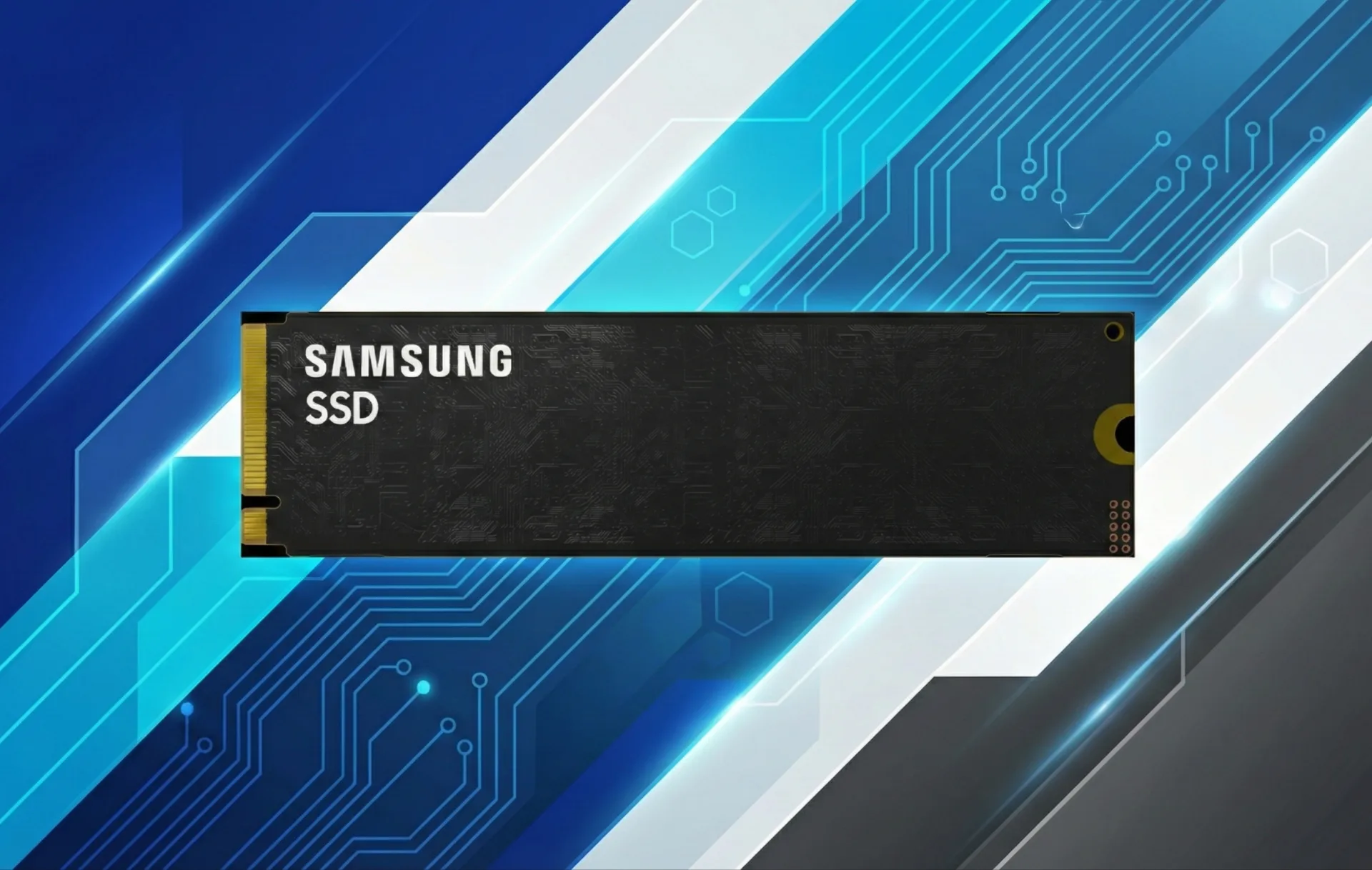
Samsung's PM9E1: A Glimpse into the AI Storage Future (And a Pinch of Skepticism)
Samsung is clearly making a strong play for the burgeoning AI PC market with its PM9E1 NVMe SSD, an "AI-optimized" storage solution that recently garnered a CES 2026 Innovation Awards Honoree distinction for its remarkably compact M.2 22x42 variant. We believe this move positions Samsung strategically as on-device AI gains traction, but the true impact for everyday users remains to be seen beyond the enterprise sphere. This enterprise-grade SSD, which entered mass production on October 4, 2024, is being championed as a vital component for on-device AI PCs and high-performance computing, even qualifying for use in NVIDIA's DGX Spark desktop AI supercomputer.
The PM9E1 isn't just about raw speed; it's a statement of technological prowess. It leverages a PCIe Gen 5.0 interface with an 8-channel design and Samsung's proprietary 5nm 'Presto' controller, which is quite impressive. The inclusion of 8th-generation V-NAND (V8) TLC V-NAND with 1 Tb dies promises both substantial capacity and significant speed improvements, though we're eager to see how this translates to long-term real-world performance under sustained AI workloads.
Blistering Speeds and Enduring Capacity: How Does it Stack Up?
The detailed specifications of the PM9E1 paint a picture of a seriously fast drive. Samsung claims sequential read speeds of up to 14.8 GB/s (14,800 MB/s) and sequential write speeds of up to 13.4 GB/s (13,400 MB/s). These figures represent a 100% improvement over its predecessor, the PM9A1a, which is a commendable generational leap. Random read IOPS reach up to 2,100K IOPS, with random write IOPS hitting an impressive 2,640K IOPS.
To put these numbers into perspective, Samsung suggests the PM9E1 can transfer a 14GB large language model (LLM) to DRAM in under a second. This kind of speed is crucial for faster loading and more stable data processing in AI applications, where bottlenecks in data access can severely hinder performance. While these speeds are undoubtedly top-tier for a PCIe Gen 5 drive, we recognize that the PCIe 5.0 x4 interface is approaching its theoretical limits, suggesting future gains might rely on different architectural approaches.
The drive is available in capacities ranging from 512GB to 4TB. The 4TB model, in particular, boasts an endurance rating of 2400 TBW, which is a 100% increase over the PM9A1a. This improved endurance is a welcome development, especially for professional users who constantly write and rewrite large datasets, a common characteristic of AI training and development.
Here's a quick comparison of the PM9E1's top-end performance:
The PM9E1 demonstrates a clear performance advantage over a direct competitor like the Corsair MP700 Micro in sequential speeds and random IOPS, with sequential read speeds showing a 48% increase and sequential write speeds a 58% increase. Both offer the same impressive 2400 TBW endurance for their 4TB variants.
The M.2 22x42 Form Factor: A Tiny Marvel with Big Implications
The M.2 22x42 variant is arguably the standout feature here, with Samsung claiming it's the world's first PCIe Gen 5.0 4TB SSD in this ultra-compact size. This is a significant engineering feat, especially considering it incorporates a dual-sided PCB and dedicated DRAM to achieve such density. Samsung managed to accelerate its development by about two and a half months, which speaks volumes about their commitment to this form factor.
This compact design, recognized as a CES 2026 Honoree, offers greater flexibility in PC platform designs. By reducing thermal load and positioning the storage medium closer to compute resources, it promises faster signal paths and potentially more efficient system layouts. While the PM9E1 is also available in the more common M.2 2280 form factor, the specialized 22x42 model represents a truly impressive stride in miniaturization and storage density. We see this as a critical enabler for the next generation of thin, light, and powerful devices, including gaming handhelds and compact workstations, even if it requires some creative engineering to integrate.
AI Optimization and Power Efficiency: More Than Just Buzzwords?
Samsung has explicitly optimized the PM9E1 for AI workloads, positioning it as an ideal solution for on-device AI PCs. Its firmware includes optimizations for DGX Spark OS software and NVIDIA CUDA, which Samsung suggests will enhance the overall AI user experience. While "AI-optimized" can often feel like marketing jargon, the specific firmware-level integrations for NVIDIA's platform suggest a genuine effort to tailor performance for the target market.
Power efficiency has also seen a dramatic improvement, with the drive consuming over 50% less power than its predecessor. It draws under 7mW in PS4 mode and under 3mW in D3hot mode. For operating power, the 4TB variant achieves 1751 MB/s per watt for sequential reads and 1633 MB/s per watt for sequential writes. These efficiency gains are vital, as lower power consumption directly translates to reduced thermal output, offering system designers more freedom and potentially extending battery life in mobile AI devices.
Strong Security Features: A Baseline for the Modern Era
Security is a non-negotiable aspect of modern storage, and the PM9E1 addresses this with the Security Protocol and Data Model (SPDM) v1.2. Its comprehensive security suite includes Secure Channel, Device Authentication, Firmware Tampering Attestation, and certificate-based security for component data interchange. The SSD further supports a wide array of security validation protocols, including SED, TCG OPAL, eDrive, Pyrite 2.01, Secure Booting, JTAG Disable, TCG DICE, PCI-SIG DOE, CMA, and DMTF SPDM. We view this extensive list of security features as a necessary baseline for enterprise-grade drives, particularly in an era of increasing data sensitivity.
Market Outlook and Availability: A Niche Product (For Now)
The PM9E1 is primarily an OEM-focused product, essentially an OEM variant of the forthcoming Samsung 9100 Pro. Samsung's strategy involves expanding its advanced SSD offerings to global PC makers and eventually launching PCIe 5.0-based consumer products. The PCIe Gen 5 SSD market is projected to grow significantly, with a CAGR of 42.7% expected from 2025 to 2033, driven by demand from data centers, enterprise IT, and next-gen consumer electronics. NVMe remains the dominant interface for these high-speed solutions.
While already qualified and in mass production for high-end systems like the NVIDIA DGX Spark (which itself runs on a 20-core ARM64 CPU and NVIDIA GB10 Grace Blackwell GPU, offering a 4TB NVMe M.2 SSD as stock storage), the ultra-small form factor and double-sided configuration of the M.2 22x42 variant present clear challenges for widespread adoption in consumer platforms. Exact market release dates and pricing for individual capacities have not yet been revealed, which is typical for OEM products. YongCheol Bae, Executive Vice President of Memory Product Planning at Samsung, has affirmed the company's commitment to leading the advanced SSD market with solutions like the PM9E1.
Our take is that while the PM9E1 is a marvel of engineering, its immediate impact will be confined to specialized, high-performance, and compact AI systems. It will compete against offerings like Corsair's MP700 Micro SSD, which launched in October 2025 in similar capacities and the M.2 2242 form factor. For the average consumer, widespread availability and competitive pricing for such cutting-edge, compact Gen 5 solutions may still be a little way off. As Phison's CEO K.S. Pua noted, the PCIe 5 market is expected to remain niche for a while, perhaps until the latter half of 2024 (though that prediction was made in early 2023, and adoption has been slower than some expected). We'll be watching closely to see how Samsung navigates the transition from niche OEM triumphs to broader consumer appeal.





Comments