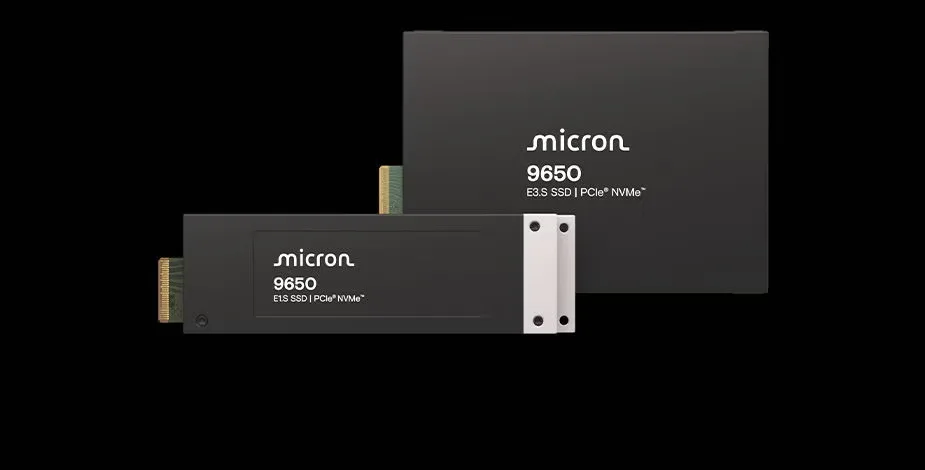
Micron began mass production of its 9650 NVMe SSD, the world’s first PCIe Gen6 solid-state drive, on February 13, 2026. This launch is a major step forward for data centers facing the increasing demands of artificial intelligence (AI) workloads. Designed specifically for the enterprise market, the 9650 aims to double the performance of its Gen5 predecessors, addressing critical bottlenecks in AI infrastructure.
PCIe Gen6: Defining Speed And Efficiency
The primary feature of the Micron 9650 is its adoption of the PCIe Gen6 x4 interface, paired with NVMe 2.0. This new standard doubles the available bandwidth compared to PCIe Gen5, a change essential for AI-driven data centers. In these environments, massive datasets are continually transferred between storage and accelerators, making storage performance a primary architectural constraint.
For data center operators, the 9650's specifications translate directly into clear benefits:
- Exceptional Speed: Sequential read speeds reach 28 GB/s (28,000 MB/s), with sequential writes reaching 14 GB/s (14,000 MB/s). This level of throughput means AI training models can ingest data faster, and inference engines can access large language models (LLMs) with low latency.
- High IOPS: The drive offers up to 5.5 million random read IOPS and 900,000 random write IOPS. For complex tasks like Retrieval-Augmented Generation (RAG), where rapid, granular data access is critical, this performance translates to faster insights and more responsive AI applications.
- Power Efficiency: The 9650's performance-per-watt efficiency is a key attribute. It achieves double the performance of PCIe Gen5 drives while maintaining the same 25-watt power state. This is vital as AI infrastructure already consumes a major and growing share of global electricity, and power availability is becoming a limiting factor in facility expansion. Data centers looking to meet sustainability goals will find this aspect especially attractive.
Under the hood, the 9650 utilizes Micron’s vertically integrated architecture, featuring their 9th-generation G9 TLC NAND. This ensures tight integration and optimization between the controller and the flash memory, maximizing both performance and reliability.
Micron 9650 NVMe SSD Specifications
The 9650 is available in two series: the 9650 PRO and 9650 MAX. The PRO series targets read-intensive workloads with capacities up to 30.72 TB and an endurance rating of 1 drive write per day (DWPD) for five years. The MAX series is designed for mixed-use workloads, offering capacities up to 25.6 TB and a higher endurance of 3 DWPD for five years. This allows data center architects to fine-tune their storage solutions based on specific application needs.
Stepping Up From Gen5: A Clear Performance Gap
Micron states the 9650 offers "up to 2x performance over Gen5 drives." While a direct apples-to-apples comparison with a specific PCIe Gen5 enterprise SSD isn't provided, we can infer the scale of the improvement.
Micron 9650 Vs. Typical PCIe Gen5 Enterprise SSD
This strong boost in raw throughput and IOPS directly addresses the escalating "storage performance is a primary architectural constraint" issue in AI infrastructure, moving beyond a mere marketing claim. The ability to move data at 28 GB/s can greatly reduce the time spent waiting for data, allowing GPUs and other accelerators to operate at their full potential.
However, the "world's first" title for a new interface standard always has a caveat. While Micron has conducted "thorough interoperability testing across the PCIe Gen6 ecosystem over the past 18 months," widespread adoption still depends on the readiness of the entire server ecosystem. CPUs, motherboards, and network interface cards must all be Gen6-compliant to fully utilize the 9650's potential. We anticipate a slower ramp-up for widespread Gen6 infrastructure deployment than the SSD's immediate availability might suggest.
Moreover, while Micron highlights the drive's strong performance-per-watt, we must acknowledge that advanced technology inevitably commands a premium price. For many data centers, the immediate cost of upgrading not just the SSDs but potentially the entire server platform to Gen6 might be a difficult proposition, at least in the short term. This makes the 9650 an early adopter's dream, but perhaps a future-proof investment for others.
Impact Of The Micron 9650 Launch
Micron's launch of the 9650 NVMe SSD signals the industry's direction, going beyond a typical product announcement. The focus on PCIe Gen6 is a direct response to the insatiable demands of AI workloads, which are quickly outstripping current infrastructure capabilities. For data center operators, the 9650 offers an effective solution to critical bottlenecks, allowing for faster AI model training, more efficient inference, and the smooth handling of complex data-intensive tasks like Retrieval-Augmented Generation.
The emphasis on energy efficiency is also a major talking point. As power consumption becomes a limiting factor for data center expansion, drives that offer twice the performance at the same power envelope are necessities for sustainable growth, not mere improvements. This aligns perfectly with Micron's altered strategy, having recently moved its interest out of the consumer memory market by discontinuing the Crucial brand. The company is now firmly entrenched in the high-margin, high-performance enterprise segment, where innovations like the 9650 can have a profound impact. This is not a drive for your gaming PC; it's a workhorse for the AI factories of tomorrow.





Comments