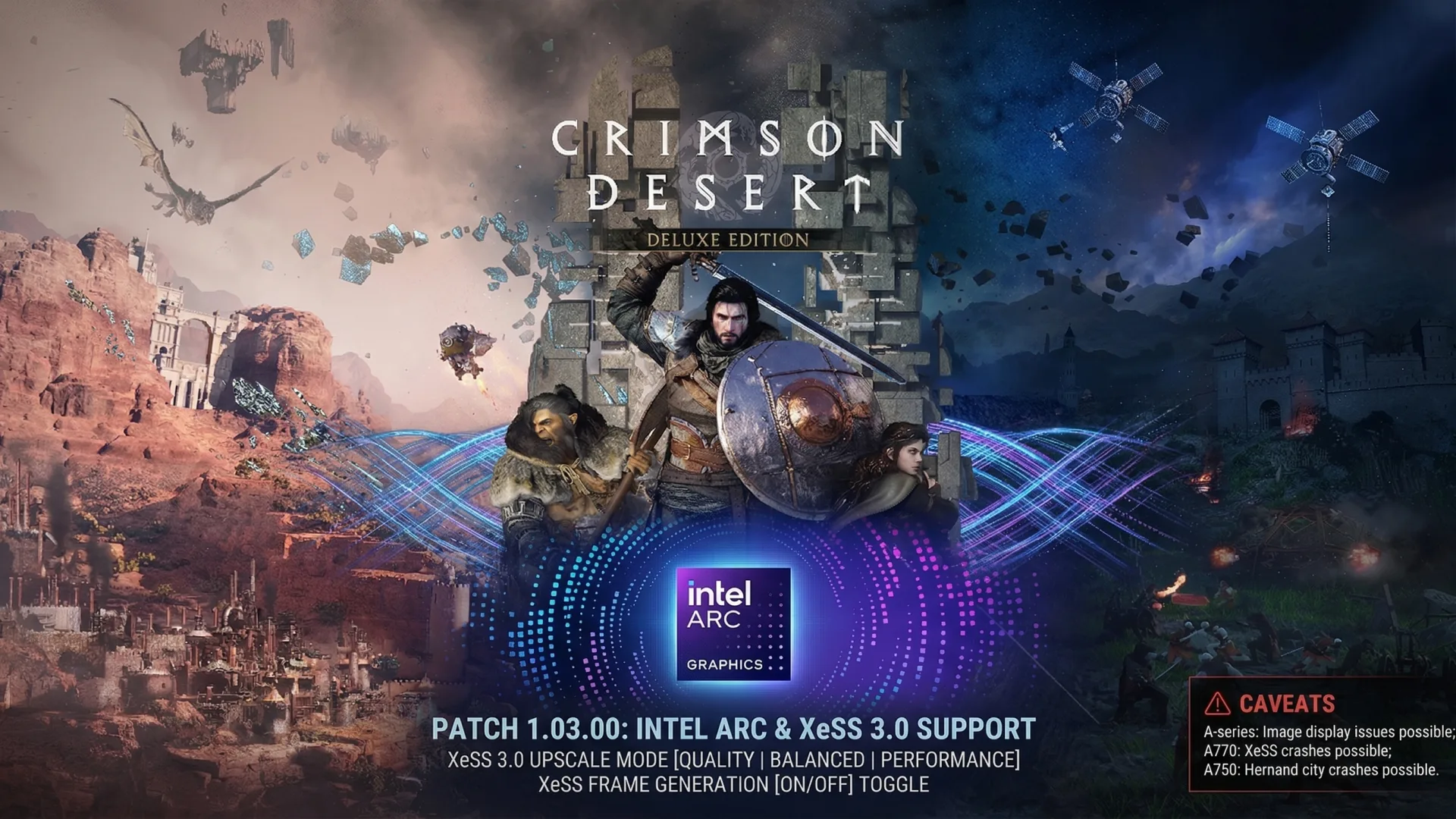
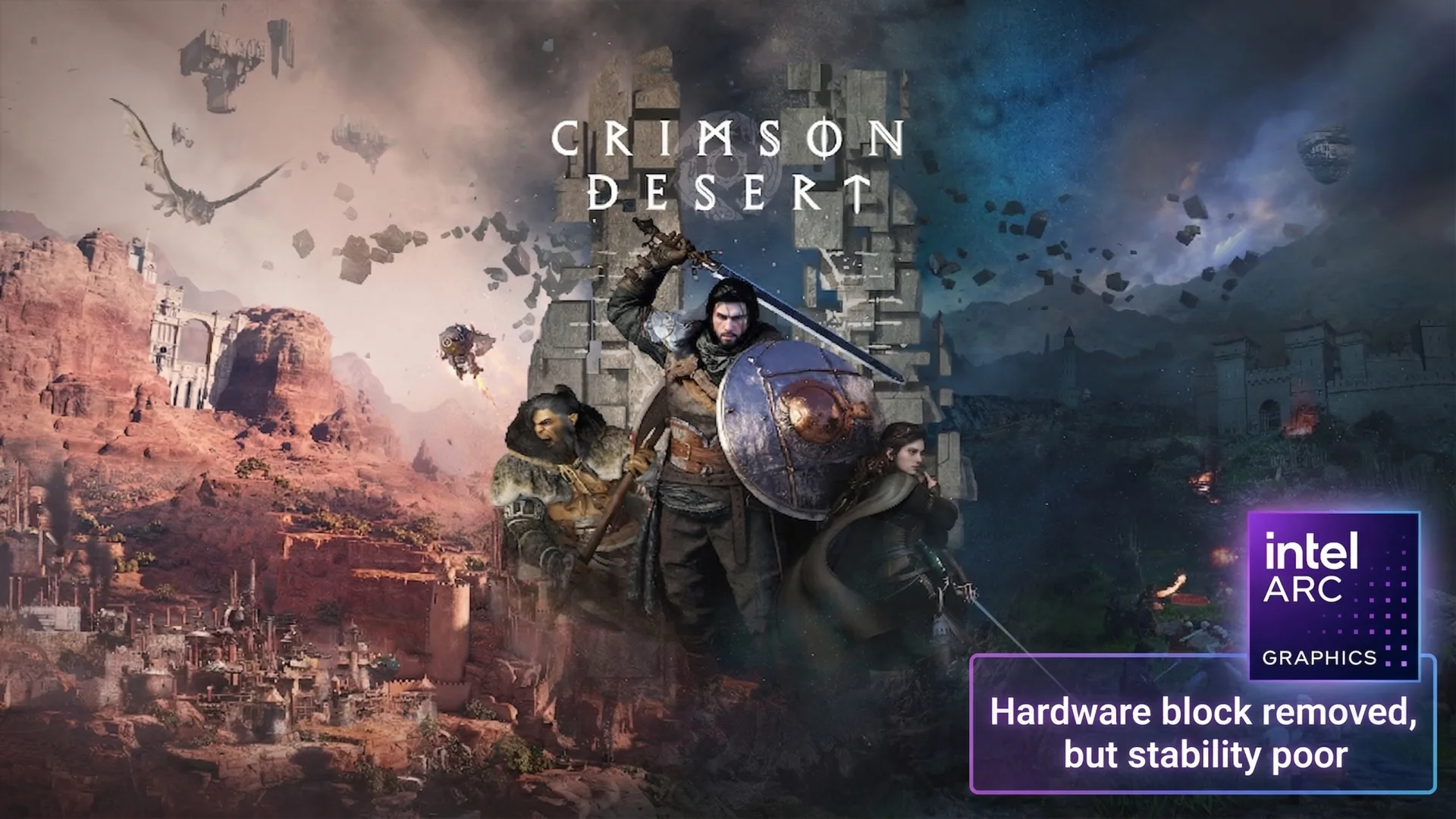
Pearl Abyss has done the thing Intel Arc owners were asking for at launch: Crimson Desert officially supports Intel Arc GPUs as of Patch 1.03.00, released April 11, 23 days after the game's March 19 debut.
That patch doesn't just flip a compatibility flag. It also adds Intel XeSS 3.0 under Settings > Video > Upscale Mode and a separate Intel XeSS Frame Generation toggle, as detailed in the official patch notes on the Crimson Desert site. In practical terms, Arc users now have first-party access to the same kind of image upscaling and frame-generation stack PC players increasingly expect in a big-budget release.
But the second half matters just as much: the official support arrived with official warnings attached.
Pearl Abyss has noted that Arc A-series users may see broken image output or no display when XeSS 3.0 or XeSS Frame Generation is enabled; Arc A770 users may crash when using XeSS; and Arc A750 users may crash in the Hernand city area. The company also notes that compatibility and performance will continue to improve over time. That makes this less a clean fix than a formal opening of the door.
What changed between launch and now
The context here is hard to ignore. Before this patch, Arc support was either absent or effectively restricted, and community testing suggested Intel's Game On driver 32.0.101.8629 could get the game running for at least some users, though not cleanly. As both Tom's Hardware and Notebookcheck documented, that interim state persisted until Patch 1.03.00 landed.
There was also public friction around the launch stance. Pearl Abyss later apologized for "confusion" over prior Intel GPU support messaging, a reversal confirmed in the coverage above. That doesn't tell us exactly why support arrived on April 11 instead of March 19, and it would be too neat to pin that on one cause. Still, the sequence is clear: launch controversy, a brief driver-assisted gray zone, then official support with caveats.
What the new XeSS options actually signal
The new settings matter because they suggest Pearl Abyss didn't just enable basic boot support. The patch adds a visible XeSS 3.0 option and a separate XeSS Frame Generation switch, which points to a more deliberate integration path.
Here's the short version of what's in the game now:
That separate frame-generation toggle is especially interesting. It suggests Crimson Desert is treating Intel's stack in a way that resembles how other modern PC games expose upscaling and frame generation as related but distinct options. That usually gives users more control, but it also creates more combinations to validate. The bug list may reflect exactly that problem: support is present, yet some combinations still break.
Why this is still messy on Arc A-series
The known issues list is specific enough to be useful, and specific enough to show this isn't finished.
If you're on Arc A-series, enabling XeSS 3.0 or XeSS Frame Generation can result in broken image output or no display. If you're on an A770, using XeSS can cause crashes. If you're on an A750, there's a location-specific crash in Hernand city. As both VideoCardz and TweakTown reported, those same problem areas were flagged in the updated notes.
What does that imply? Most plausibly, that basic compatibility and advanced feature support are not the same thing. Getting a game to recognize and run on Arc hardware is one layer. Getting XeSS upscaling and frame generation to behave consistently across A750 and A770 cards, drivers, Windows builds, and specific scenes is another. The Hernand city crash note, in particular, points toward a narrower game-engine or asset interaction rather than a broad "Arc is broken" explanation.
That distinction matters because readers are likely to compress all of this into one verdict. The patch doesn't support that. It shows progress, but in a heavily qualified form.
The driver side complicates the picture
There's also a software stack issue underneath all this. Intel's driver support for XeSS 3 Multi-Frame Generation has its own floor: as of April 12, the cited minimum graphics driver is 32.0.101.8425 or later, and a later WHQL 32.0.101.8509 release expanded MFG support beyond Panther Lake systems. The cited Windows requirement is also fairly modern: Windows 10 64-bit 22H2 or later, or Windows 11 64-bit 21H2 through 25H2.
That doesn't prove every Arc owner with the right driver and OS will get the same result in Crimson Desert. In fact, the known-issues list argues against assuming that. But it does suggest some of the roughness here may sit at the boundary between game integration, driver maturity, and hardware generation support.
There's another wrinkle: Intel's broader XeSS 3 guidance includes multiple frame-generation modes, and 2X Frame Generation is the recommended balance point, especially on 120Hz-plus displays. Crimson Desert's patch notes don't spell out whether every mode is exposed the same way in-game, so readers should be careful not to assume the full theoretical XeSS 3 menu automatically translates into stable, practical options on every Arc card right now.
What this says about PC feature support now
The bigger lesson here is less about one patch and more about how modern PC support often arrives in layers.
A game can "support" a GPU in the official sense and still have major caveats around the premium features attached to that GPU. Crimson Desert now has official Arc support. It also now has official documentation saying some Arc A-series users may get no display when using the marquee Intel graphics options.
That contradiction is awkward, but it's not unusual anymore. The badge comes first, the clean matrix of stable driver-and-feature combinations comes later. Sometimes much later.
For Pearl Abyss, the addition of XeSS 3 and frame generation likely broadens the game's technical feature set on paper and gives Arc users a proper menu path instead of a workaround. For Arc owners, though, the practical question is narrower: does your particular card, driver, OS build, and settings combination survive contact with the game?
As of April 12, the answer appears to be: sometimes, and not reliably enough to call the problem fully closed.
What players should take away for now
If you're tracking Crimson Desert specifically, here's the grounded version:
- Arc support is now official, and that's a real change from launch.
- XeSS 3.0 and XeSS Frame Generation are now in the game menu, which suggests meaningful Intel feature integration rather than a hidden workaround.
- Arc A-series users should still expect instability, especially with XeSS and frame generation enabled.
- A770 and A750 owners have model-specific issues called out by the developer, which is useful because it means Pearl Abyss is at least identifying problem cases rather than treating Arc as one undifferentiated bucket.
- If you want to test the new path, make sure you're on a recent Intel driver and a supported Windows build first, then treat XeSS and Frame Generation as settings to verify carefully rather than assume safe by default.
That last point is the practical one. Crimson Desert has moved from "not officially supported" to "officially supported, with a warning label." For Intel users, that is progress. It just isn't a settled fix yet.


Comments