
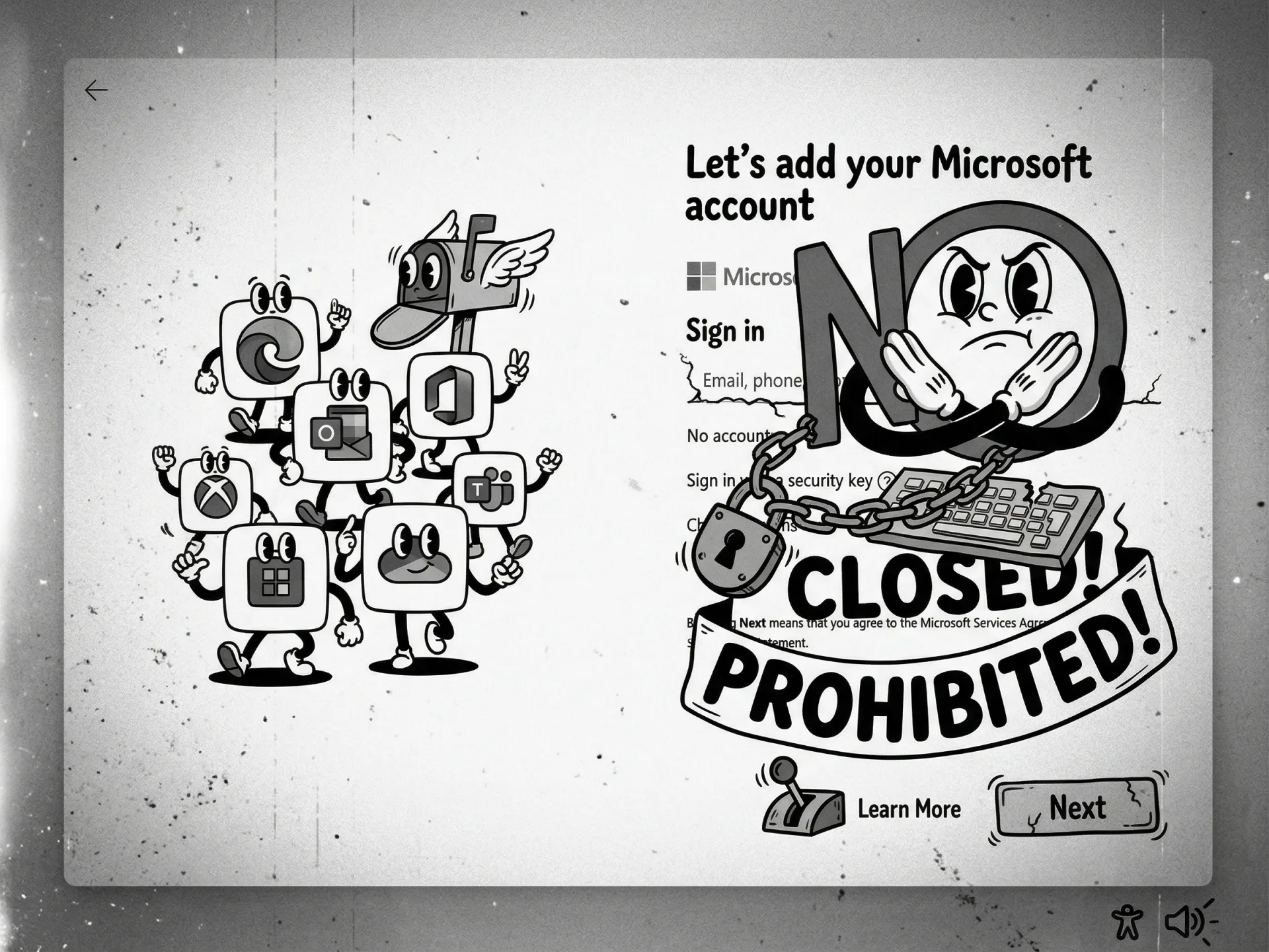
Mozilla is accusing Microsoft of using Edge and Copilot to reinforce its control over Windows, and the broad shape of that argument is easy to understand even before you get into the weeds. The browser fight on Windows has never been just about who has the nicer tabs. It's about what the operating system promotes, what it surfaces, and what it quietly makes harder to avoid.
What's more useful here is separating the parts we can actually verify from the parts that are still interpretation.
The clearest confirmed piece is that Microsoft has built Windows-specific mechanisms for pushing Edge as the default browser. Microsoft's own policy documentation shows an Edge setting called , available on Windows in Edge 113 and later, with support documented in Microsoft Learn's Edge browser policy reference. The setting lives under the standard Edge policy registry path on Windows and can be turned on or off by admins.
That does not, by itself, prove anti-competitive intent. But it does show something important: the default-browser campaign is not incidental UI clutter. It is a managed, policy-governed part of Edge on Windows.
What the Windows-specific controls actually show
Mozilla's argument gets traction from a detail that sounds boring until you think about what it implies: this policy support is Windows-only. According to the material reviewed here, is supported on Windows and not supported on macOS, Android, or iOS.
That matters because it narrows the issue. This is not just "browser makers prompt users to become the default," which plenty of browsers do. It points to a more specific question: what happens when the browser, the AI assistant, and the operating system are all products from the same company?
Here's the part we can say with confidence:
That last point matters. The reviewed material says there is no built-in mechanism to block user cancellation of the default-browser prompt. In plain English: users can say no. So Mozilla's complaint, to the extent it rests on these verified controls, is not best understood as "Microsoft prevents browser choice." It is closer to "Microsoft repeatedly uses its OS position to steer that choice."
That's a narrower claim, but also a more credible one.
Repetition is the point, not a single prompt
Another detail from the reviewed material strengthens Mozilla's line of attack: prompts may reappear after major Windows updates because feature updates can reset default app associations.
Again, caution is needed here. A reset after major updates is not the same thing as a deliberate campaign to override a user's preference every week. But from a user-experience standpoint, the distinction can blur fast. If the result is that people keep seeing prompts to return to Edge, then the practical effect is ongoing friction around leaving Microsoft's defaults behind.
That broader pattern has been visible in Windows coverage for years. Commentators have repeatedly flagged Edge prompts and Windows nudges as aggressive, even when they stop short of preventing a user from switching browsers. A recent piece from Windows Central captures the tone of that criticism, while Windows Forum rounds up user responses to Edge's auto-launch behavior and argues that startup hooks, search integration, and repeat prompts have made the browser feel increasingly tied to the OS itself.
Mozilla doesn't need every one of those complaints to be legally decisive. It only needs to show that Windows gives Microsoft unusually privileged channels for steering users toward its own browser and AI surfaces.
Where Copilot enters the picture
The complication in 2026 is that this is no longer just a browser-defaults story. It's also an AI distribution story.
The reviewed material includes evidence that Windows has policy-level controls for taskbar chat surfaces, and Microsoft has publicly confirmed that it sees Edge as part of its Copilot future, not as a side project. The company has also been reorganizing Copilot leadership and product direction around a more unified AI strategy, as The Verge reported. Separately, reporting has pointed to Microsoft evolving Edge rather than replacing it with an entirely separate AI browser product.
Microsoft has since officially confirmed a broader pullback on Copilot inside Windows itself. In a March 20, 2026 Windows Insider Blog post, Pavan Davuluri, EVP of Windows + Devices, said Microsoft would be "more intentional" about how and where Copilot integrates across Windows and is reducing "unnecessary Copilot entry points," explicitly naming Snipping Tool, Photos, Widgets, and Notepad.
That doesn't prove Mozilla's specific accusation in full. But it does make the complaint more structurally interesting.
If Edge is a browser, Copilot is an assistant, and Windows is the distribution layer for both, then the competitive question is no longer just whether Microsoft prefers its own browser. It's whether the browser and the assistant can reinforce each other through operating-system placement. A browser prompt on its own is one thing. A browser prompt combined with taskbar AI entry points, system defaults, and Windows-level recommendations is another.
The available evidence supports the existence of some of those building blocks. It does not, on the facts here, fully map every alleged mechanism Mozilla may be complaining about. But the rollback is no longer just something outside observers inferred from product changes; Microsoft itself has acknowledged the issue and announced a course correction.
Mozilla has its own AI angle here
There's another reason this dispute deserves more than a shrug: Mozilla is not complaining from a position of trying to keep AI out of the browser. Firefox itself introduced an AI Controls dashboard in version 148, released on February 24, 2026, as documented in Mozilla's own developer release page and tracked by Releasebot's Firefox 148 notes.
So this is not a simple "Mozilla dislikes AI integration" story. It looks more like Mozilla is arguing that AI features are acceptable, but bundling them with OS-level distribution advantages is something else.
That distinction may matter a lot. Browser makers can all build AI panels, assistants, and controls. They cannot all put those features into the Windows taskbar, system prompts, and default-app flows with the same degree of native access.
Why regulators would care, even if this specific complaint is still just a complaint
You don't need to assume Mozilla is right about every detail to see why this lands in a sensitive regulatory moment for Microsoft.
The European Commission issued a Statement of Objections in June 2024 in the Teams bundling case under Article 102 TFEU, the EU rule aimed at abusive conduct by dominant firms. Under EU competition law, penalties in such cases can run up to 10% of global annual revenue, which is consistent with how EU antitrust fines are generally structured, as Wikipedia's overview of European Union competition law explains. The FTC opened an investigation in late 2024 that includes scrutiny of Microsoft's OpenAI relationship.
Those cases are not the same as Mozilla's browser complaint. They should not be blurred together. But they do provide context: regulators are already paying attention to how Microsoft combines adjacent products and distribution power. In that environment, a complaint about Windows steering users toward Edge and Copilot is likely to get a more serious hearing than it might have a few years ago.
That doesn't mean Mozilla's claim wins on the merits. It means the argument is arriving at a time when the theory behind it is more legible.
The weak spots in Mozilla's argument, based on what's actually verified
There are also limits to how far the current evidence goes.
First, the verified material here shows a prompting and policy framework, not a hard technical block against rival browsers. Users can reject prompts. Admins can disable the campaign. That makes the conduct look more like persistent steering than outright foreclosure, at least on this record.
Second, the mere fact that Windows contains policies for taskbar chat surfaces or browser campaigns does not automatically prove those pieces are being used together in the exact way Mozilla alleges. The connective tissue may be real, but on the facts available here, some of that remains inference.
That still leaves Mozilla with a plausible complaint. It just means the strongest version of the case, for now, is also the most modest one: Microsoft appears to have built Windows-level pathways that can repeatedly favor Edge, and the rise of Copilot may increase the competitive significance of those pathways.
What to watch next
If you're trying to figure out whether this turns into a real competition issue rather than another round of browser sniping, a few practical markers matter:
- Official documentation changes: If Microsoft expands Windows-only Edge or Copilot promotion controls, that would strengthen Mozilla's case.
- Regulatory references to tying or self-preferencing: If EU or US regulators start describing Windows, Edge, and Copilot as linked distribution channels, the issue gets more concrete.
- Enterprise policy behavior: The existence of admin controls already suggests Microsoft knows these prompts matter in managed environments. Wider enterprise guidance around disabling them would be telling. There is also a notable fresh update to Microsoft's auto-install story: Microsoft Learn documentation updated April 6, 2026 says the company has "temporarily disabled" automatic installation of the Microsoft 365 Copilot app on eligible Windows devices with Microsoft 365 desktop apps, citing a technical issue. That does not erase Mozilla's criticism, but it is a concrete change in rollout status worth noting.
- Firefox's own product positioning: Mozilla now has AI controls in Firefox too, which means its complaint is likely to focus less on AI itself and more on the advantages that come from owning the operating system.
For users, the immediate takeaway is conditional rather than dramatic. There is solid evidence that Microsoft has a Windows-specific framework for promoting Edge as the default browser, and that matters more in an era where browser choice also shapes AI entry points. What is not yet settled, on the record here, is how far those mechanisms go beyond nudging into conduct regulators would treat as unlawful tying or exclusion.






Comments