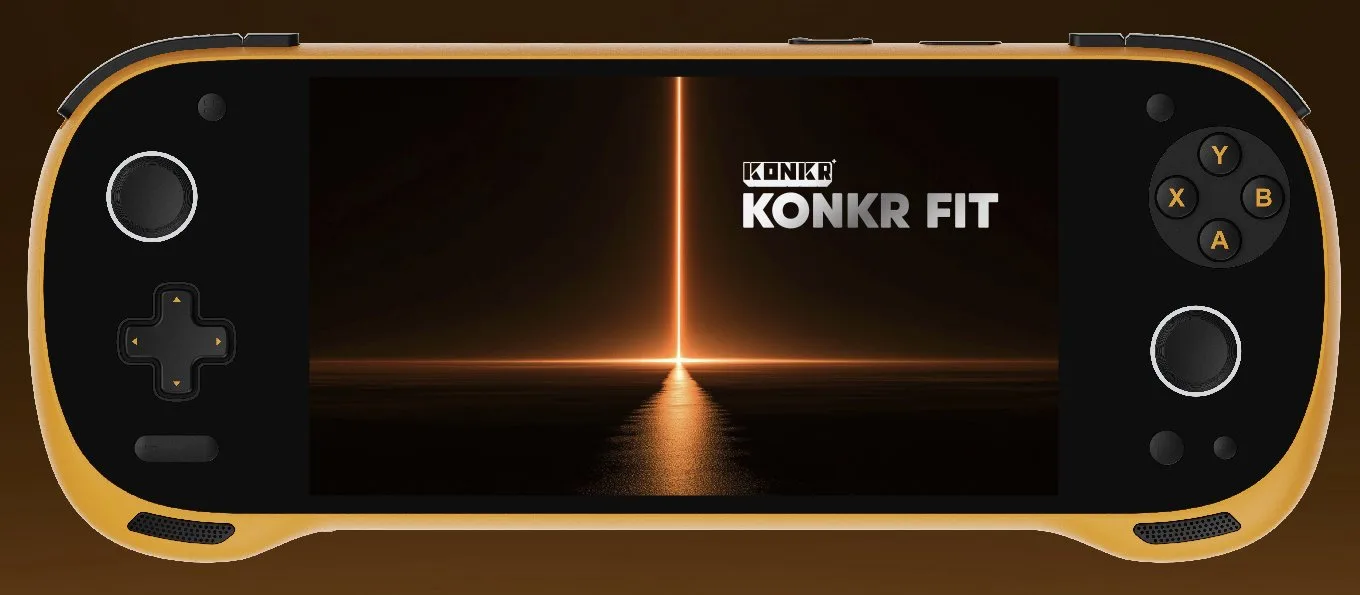
AYANEO is venturing into new territory with the KONKR Fit, the inaugural Windows-based gaming handheld under its freshly minted KONKR sub-brand. Positioned as a "value-focused" alternative to existing premium devices, the KONKR Fit aims to fuse high-end AMD silicon with a battery-first approach and a larger OLED screen. On paper, it sounds like a compelling package for portable PC gamers who want power without necessarily paying for a top-tier brand name, but as we’ve learned with AYANEO, the real story often lies beyond the spec sheet.
The Hardware Blueprint: What's Inside?
When we look at the KONKR Fit's reported specifications, there are certainly some standout elements designed to grab attention:
- Processor & Graphics: At its heart is the newly unveiled AMD Ryzen AI 9 HX 470. With its 12 cores (four Zen 5 performance, eight Zen 5c efficiency) churning out 24 threads, this chip promises serious muscle. The integrated Radeon 890M graphics, based on the RDNA 3.5 architecture, should deliver strong gaming performance, though the touted 55 TOPS NPU for AI tasks feels like a future-proofing play rather than an immediate gaming benefit. We question how many handheld gaming experiences will truly tap into dedicated AI acceleration in the short term.
- Display: A 7-inch OLED panel at 1080p resolution and a 16:9 aspect ratio is a welcome sight. With 800 nits peak brightness, this is a clear step up in visual fidelity compared to the 6-inch LCD found on the earlier KONKR Pocket Fit. For a handheld, OLED truly makes a difference in vibrancy and contrast, which we appreciate for immersive gaming.
- Battery Life: Here’s where AYANEO is making a big claim: an 80Wh battery. This is larger than the 80Wh unit in the Lenovo Legion Go 2 (Official) and significantly outpaces the 49.2Wh of the Legion Go S. The intention is clear – extended gaming sessions without being tethered to an outlet. However, given the potential 40-watt TDP range, we're skeptical about how long that 80Wh will truly last when pushing demanding titles.
- Connectivity & Ports: Dual USB Type-C ports are a practical addition, allowing for simultaneous charging and accessory connectivity or even docking. This offers a good degree of versatility for those who want to use their handheld as a mini-desktop.
- Controls & Ergonomics: The inclusion of adjustable triggers, dual back buttons, and likely hall effect joysticks suggests a focus on customization and precision. The reported compact, ergonomic form factor, aiming for comfort similar to or slightly smaller than the ASUS ROG Ally, is a smart move, as comfort is paramount for long play sessions.
- Cooling System: An enhanced cooling design with a larger rear intake vent over the KONKR Pocket Fit is mentioned, supporting a wide TDP range of 3 to 40 watts. While flexible thermal tuning sounds ideal for balancing performance and battery, the article itself admits that real-world thermal performance at higher TDPs remains unproven. This is a critical unknown for a device aiming for "high-end AMD silicon."
- Operating System: Running native Windows ensures compatibility with the vast PC game library. This is a core strength of AYANEO's Windows handhelds and a key differentiator from Android-based devices, including their own Pocket Fit.
- Design & Color Options: “Retro Gray with red accents” and “Yellow” are certainly bold choices. AYANEO has a history of distinctive designs, and these options continue that trend, offering visual flair that stands out.
Handheld Heavyweights: A Quick Comparison
When considering a new handheld, how does the KONKR Fit stack up against the established players, especially in its most emphasized features?
The KONKR Fit clearly aims to lead in battery capacity and display technology compared to many direct Windows competitors. Its processor is also a generation newer than the Z1 Extreme found in the ROG Ally and original Legion Go, though direct performance comparisons for the new Ryzen AI 9 HX 470 are still scarce.
Challenging the Titans: AYANEO's Play for the Windows Handheld Crown
The KONKR Fit represents a significant pivot for AYANEO's KONKR sub-brand, moving from the Android-based Pocket Fit to the full Windows experience. This isn't just an iteration; it's a direct assault on the likes of the ASUS ROG Ally, Lenovo Legion Go 2, and even Valve’s Steam Deck. AYANEO is betting on a "high performance at a more accessible tier," which immediately raises our editorial eyebrows. How accessible can it truly be with next-gen AMD silicon and a premium OLED panel?
By emphasizing endurance with an 80Wh battery and visual quality via its 7-inch OLED screen, AYANEO is trying to differentiate itself beyond raw processing power alone. These are smart strategic choices, as battery life and display are often critical pain points for handheld gamers. However, the true test will be whether they can deliver on these promises consistently and affordably.
Clouds on the Horizon: Concerns and Caveats
Despite the promising specifications, there’s a significant amount of missing information and historical context that gives us pause:
- Release Date & Core Specs are MIA: As of January 19, 2026, we still lack an official release date, precise RAM, storage capacity, display refresh rate, and the exact Windows version. These aren't minor details; they are fundamental for any prospective buyer.
- The "Value-Focused" Paradox: AYANEO claims a "value-focused" position, yet pricing expectations suggest it "may exceed the cost of some existing handhelds." This is a contradiction that needs to be addressed immediately. If it's not significantly cheaper than, say, a ROG Ally, then the "value-focused" branding feels more like marketing jargon than a genuine market position.
- Cooling System’s Unproven Potential: The stated 40W TDP range is ambitious for a compact handheld. We remain highly skeptical about the cooling system’s real-world efficacy at sustained high-TDP levels. Thermal throttling could quickly negate the benefits of that powerful AMD chip.
- AYANEO’s Reputation: The elephant in the room is AYANEO’s history. The community has frequently voiced concerns about delayed launches and mixed customer service experiences. While new devices always bring excitement, past issues breed skepticism regarding reliability and consistent post-purchase support. For us, this track record means a wait-and-see approach is advisable before any pre-order buttons are clicked.
- Delayed Transparency: Full technical documentation and pricing are "expected to be revealed in the coming weeks." This typical AYANEO launch pattern means we're left speculating on crucial details for too long.
Verdict in Waiting: Potential Meets Precedent
The AYANEO KONKR Fit makes a bold entrance into the Windows handheld market, bringing together next-generation AMD silicon, a significant battery, and a vibrant OLED display. Its specifications suggest a device with strong potential, particularly for those prioritizing screen quality and theoretical endurance.
However, the multitude of unanswered questions – especially regarding pricing, cooling performance, and AYANEO's ongoing challenges with timely delivery and support – leave us cautious. For enthusiasts eyeing a high-end Windows handheld with a larger screen and longer potential runtime, the KONKR Fit could indeed become a serious contender. That is, of course, if AYANEO can deliver on its promises with transparency, reliability, and an actual "value-focused" price point. Until then, we’re reserving our full judgment.




Comments