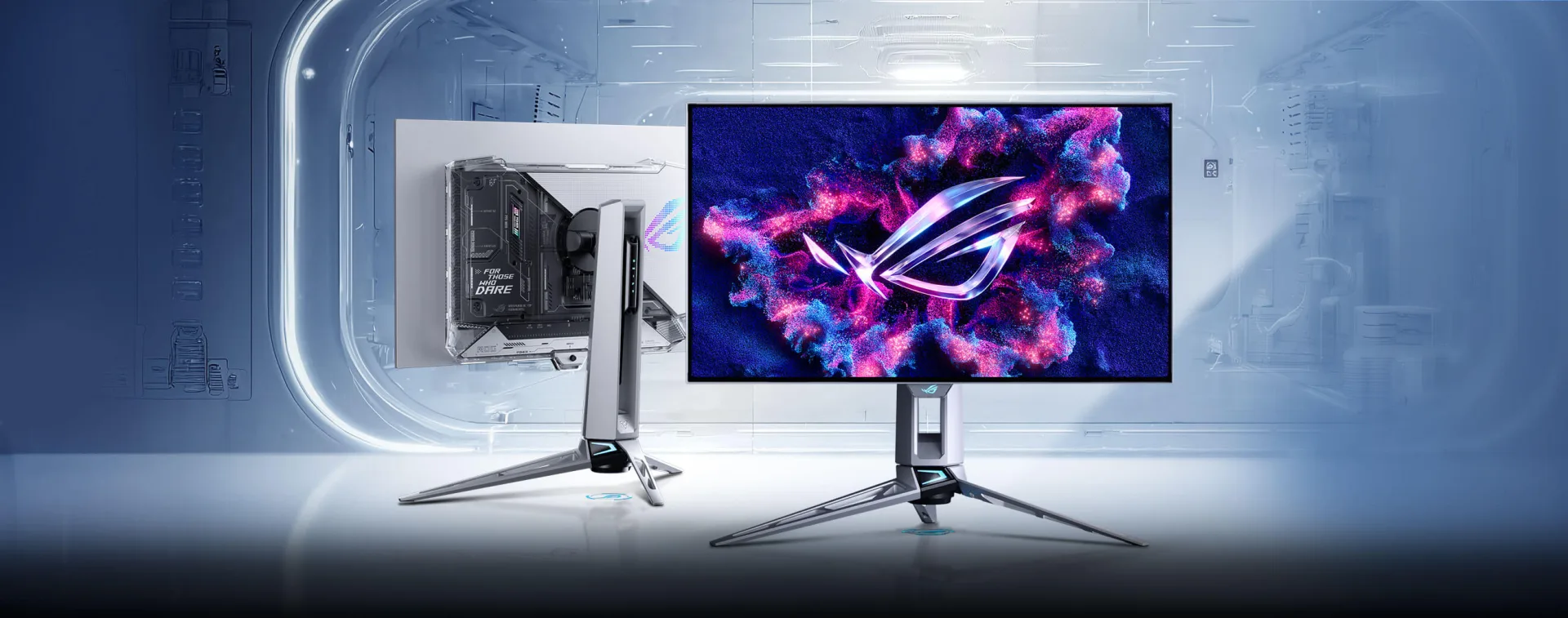
ASUS ROG has officially thrown its hat into the ultra-high refresh rate ring, opening pre-orders for its highly anticipated ROG Swift OLED PG27AQWP-W gaming monitor. This 26.5-inch WOLED display, first teased in 2025, is clearly targeting the most demanding competitive gamers with its unique dual-mode refresh rate, which can reach an astonishing 720Hz. We're looking at a premium offering here, priced at a US MSRP of $1,099, and while pre-orders are live, retailers are still awaiting stock.
The Pursuit of Speed: 720Hz – A Real Game Changer?
The ROG Swift OLED PG27AQWP-W’s headline feature is undoubtedly its ability to toggle between two distinct performance profiles. Gamers can choose a native 2560x1440 (QHD) resolution at 540Hz or drop down to 720p resolution for an eye-watering 720Hz. This flexibility is designed to cater to those who prioritize either crisp resolution or raw competitive speed above all else.
In our view, the pursuit of 720Hz, while technically impressive, raises questions about its real-world impact. While the jump from 60Hz to 144Hz, or even 240Hz, is profoundly noticeable, the tangible benefits of moving from 540Hz to 720Hz at a significantly reduced 720p resolution for typical competitive players might be negligible. We suspect this mode is a niche play, primarily aimed at esports professionals playing specific titles where every millisecond might count, or as a marketing flex. For the majority, the QHD 540Hz mode is likely the sweet spot, offering an incredible balance of visual fidelity and speed that few can rival. Professional gamers often prioritize the lowest possible input lag and highest refresh rates, even at the cost of resolution, but whether the difference between 540Hz and 720Hz translates to a meaningful competitive advantage for a significant portion of the player base remains to be seen.
Panel Technology That Elevates the Experience
Underpinning this monitor's ambitions is a 4th-Gen Tandem OLED panel. This isn't just a marketing buzzword; Tandem OLED technology aims to address some of the traditional weaknesses of OLED, namely peak brightness and longevity. ASUS claims this advanced panel delivers a 15% higher peak brightness, a 25% larger color volume, and a significant 60% increase in OLED lifespan compared to previous generations. These are welcomed improvements, as higher brightness enhances HDR content and greater color volume makes for more vibrant, lifelike images. The extended lifespan is particularly reassuring for a technology historically associated with burn-in concerns.
Further distinguishing the PG27AQWP-W is its TrueBlack Glossy™ display surface. This proprietary coating promises a zero-haze finish, which, according to ASUS, deepens blacks, boosts color vibrancy, and significantly reduces ambient reflections by 38% compared to earlier glossy WOLED panels. A glossy finish on an OLED is a double-edged sword: it can make colors pop and blacks incredibly deep, but reflections can be an issue in brighter environments. If ASUS has indeed managed to mitigate reflections by such a margin, this could be a standout feature, delivering sharper, more immersive images without the distracting glare often associated with glossy panels.
Performance Metrics and Connections for the Demanding Gamer
Designed with serious gamers in mind, the monitor boasts an incredibly fast 0.02 ms Grey-to-Grey (GtG) response time, which virtually eliminates motion blur and ghosting. This is a critical specification for competitive play, ensuring crisp visuals even in the most frantic action. It also supports both NVIDIA G-SYNC Compatible and AMD FreeSync Premium Pro adaptive sync technologies, guaranteeing tear-free gameplay across a wide range of graphics cards.
Color accuracy hasn't been overlooked either, with 99.5% DCI-P3 color saturation and 10-bit color depth, allowing it to display 1.07 billion colors. For HDR content, it offers a peak brightness of 1500 cd/m² and carries VESA DisplayHDR™ 500 True Black certification, promising an impactful HDR experience with deep blacks and bright highlights.
Connectivity options are mostly robust:
- 2x HDMI 2.1 ports
- 1x DisplayPort 2.1 (UHBR20 with full 80Gbps bandwidth for uncompressed QHD@540Hz)
- 3x USB 3.2 Gen 1 Type-A ports
- 1x headphone jack
However, we can't help but voice a minor complaint: the absence of a USB-C port. In 2026, with many peripherals and even laptops relying on USB-C for power delivery and display output, omitting this port on a premium monitor feels like a missed opportunity and a step behind some competitors.
Mitigating OLED Concerns: ASUS OLED Care Pro
OLED technology, while offering unparalleled image quality, has historically been plagued by concerns of burn-in. ASUS addresses this head-on with its comprehensive ASUS OLED Care Pro suite. This includes features like Pixel cleaning, Screen Move, Screen Saver, Logo brightness adjustment, Outer dimming control, and Target mode. The Neo Proximity Sensor, which detects user presence and switches to a black screen when the user is away, is a smart addition to actively combat potential burn-in.
Beyond software, ASUS has engineered a custom heatsink and a unique internal airflow design for improved cooling, another crucial factor in prolonging OLED lifespan. Perhaps most reassuringly, ASUS backs the ROG Swift OLED PG27AQWP-W with a 3-year warranty that includes burn-in coverage. This warranty is a significant selling point, providing a level of confidence that has historically been lacking with early OLED adoption.
The monitor also includes an AI Assistant with features like AI Visual, Dynamic Crosshair, and Dynamic Shadow Boost. While these sound interesting, we tend to view such "AI" enhancements with a healthy dose of skepticism; often, they offer marginal improvements or are simply marketing fluff. The ergonomic stand, offering full adjustability, is a welcome standard feature for any premium gaming display.
Premium Price, Fierce Competition: Where It Stands
The ROG Swift OLED PG27AQWP-W is positioned at a suggested retail price of $1,099 USD. International pricing stands at £948.98 in the UK, approximately US$1,193 (8,499 Yuan) in China, and S$1,629.00 in Singapore. This places it firmly at the higher end of the gaming monitor market.
To put this pricing into perspective, let's consider some immediate rivals:
As the comparison highlights, LG's UltraGear 27GX790B-B is a direct competitor, utilizing the same 2-stack Tandem OLED panel and offering identical dual-mode refresh rates, but at a slightly lower MSRP of $999.99 USD. Crucially, the LG model includes a USB-C port, addressing a key omission from the ASUS. However, LG does not feature ASUS's proprietary TrueBlack Glossy coating, which could be a differentiating factor for users prioritizing visual clarity and reduced reflections. ASUS also offers the ROG Strix OLED XG27AQWMG, a more budget-friendly 27-inch WOLED option with a 280Hz refresh rate and a significantly lower MSRP of $599 USD. While a capable monitor, it lacks the extreme refresh rates and DisplayPort 2.1 connectivity of its pricier sibling.
Ultimately, the ROG Swift OLED PG27AQWP-W represents ASUS's commitment to pushing the boundaries of gaming display technology. While the 720Hz mode might be more about bragging rights for some, the QHD 540Hz mode, coupled with the 4th-Gen Tandem OLED, TrueBlack Glossy finish, and a reassuring 3-year burn-in warranty, makes a very strong case for itself. The absence of USB-C is a curious omission at this price point, but for gamers prioritizing peak performance and a stunning visual experience, this monitor is undoubtedly one to watch – provided they're willing to pay the premium.












Comments