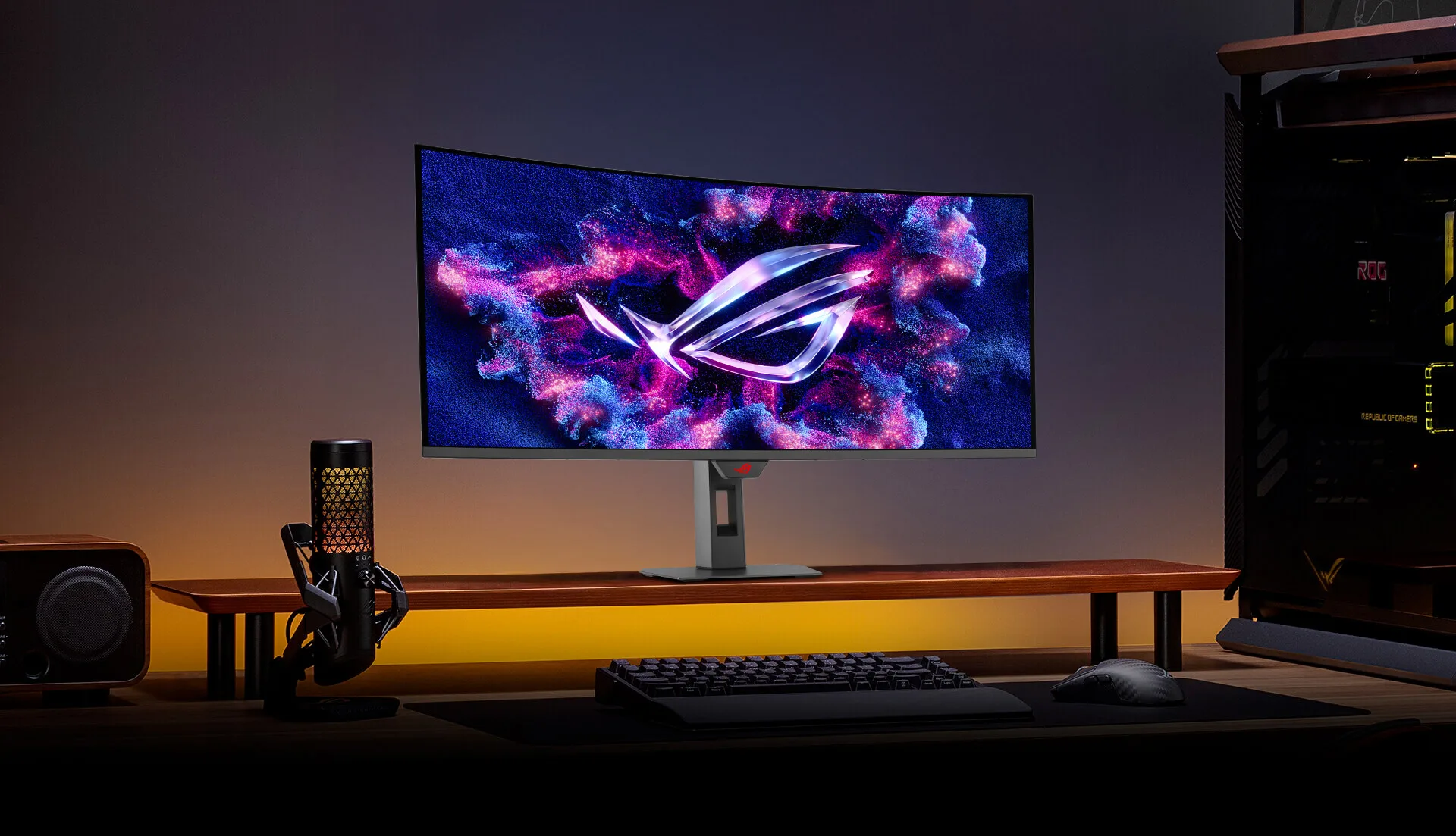
ASUS Republic of Gamers (ROG) is rolling the dice on convergence, launching the ROG Strix OLED XG34WCDMTG – an ultrawide gaming monitor that boldly integrates Google TV (Android 14) directly into its core. We've seen smart features in displays before, but this is a clear play to position the monitor as a central entertainment hub, aiming to blur the lines between a high-performance gaming screen and a full-fledged smart TV. The idea is simple: effortless switching between fragging opponents and binge-watching shows.
First unveiled at Computex 2025, the "TG" in the product name neatly tips its hand to the Google TV integration. This ambitious display is now hitting shelves, priced at $1,199 in the US. We're immediately left to wonder if the $200 premium over its non-Google TV sibling is truly justified for this level of integration.
Is Your Gaming Monitor Really a Smart TV Now?
The ROG Strix OLED XG34WCDMTG aims to be both a high-performance gaming display and a smart entertainment center, a vision we've seen other manufacturers like Samsung and LG pursue with their smart monitors. What sets ASUS apart here is the explicit integration of Google TV, potentially making it one of the first gaming monitors to feature Google's smart TV platform. This means users must sign in with a Google account for streaming services and apps, leveraging the familiar Android 14 interface. Other smart monitors exist with Google TV, such as the KTC A32Q8 or MSI Modern MD272UPSW, but those typically target lower refresh rates and different use cases than a premium gaming display.
For gamers who primarily use a PC or console, we question the real necessity of built-in Google TV. Both platforms already offer robust streaming apps, and a gaming rig can easily handle content consumption. While features like Chromecast, Miracast, and the included remote control certainly add convenience, we wonder how many hardcore gamers will forgo their primary input for the monitor's integrated smart features. That said, for users seeking a minimalist setup or those who might occasionally use the monitor without a dedicated gaming machine, the convenience of voice-activated features and content recommendations could be genuinely appealing.
The pre-installed NVIDIA GeForce NOW cloud gaming is a notable inclusion, theoretically allowing gaming without a separate PC or console. While a great option for some, it relies heavily on a strong internet connection, and we suspect most buyers of a $1,199 high-end gaming monitor will already possess capable local gaming hardware. Similarly, the Multi-Platform Streamer Plus feature, enabling direct streaming to platforms like YouTube, Facebook, and Twitch, sounds interesting on paper, but we'd be skeptical of its practicality and robustness compared to dedicated streaming software on a PC.
On the audio front, the monitor boasts Dolby Atmos technology delivered through its 5W embedded speakers. While Dolby Atmos is a premium audio standard, we're critically evaluating the impact of a 5W speaker setup for a truly "immersive cinematic sound" experience. Generally, small integrated speakers, even with Atmos branding, provide a diffused soundstage lacking the depth and accuracy of a dedicated soundbar or home theater system, let alone true overhead speakers. Pairing external Bluetooth headphones or speakers, which the monitor also supports, would likely offer a far superior audio experience.
The QD-OLED Advantage: Speed and Visuals Uncompromised
Beneath the smart TV layer lies a truly impressive gaming display. The ROG Strix OLED XG34WCDMTG features a 34-inch ultrawide (1800R curved) QD-OLED panel, utilizing second-generation technology from Samsung Display. This panel delivers a WQHD resolution of 3440 x 1440 pixels, a blistering 240 Hz refresh rate, and an exceptionally fast 0.03 ms Gray-to-Gray (GtG) response time. These specifications place it firmly in the top tier for competitive gaming, offering the buttery-smooth motion clarity that OLED is renowned for, virtually eliminating ghosting and motion blur.
Visually, the display supports Dolby Vision and is DisplayHDR 400 True Black certified, a standard that demands excellent black levels and contrast. It achieves a peak HDR brightness of 1000 nits and covers an impressive 99% of the DCI-P3 color gamut with 10-bit color depth, promising vibrant, lifelike colors and incredibly deep blacks. This level of visual fidelity makes the monitor suitable not just for gaming, but also for content creation and high-fidelity media consumption. For comparison, well-regarded ultrawide QD-OLED competitors like the Alienware 34 QD-OLED (AW3423DWF) typically offer 165Hz refresh rates, making the ROG Strix's 240Hz a significant step up for frame-rate enthusiasts. ASUS also offers the ROG Swift OLED PG34WCDM, which pushes to 240Hz, though without the Google TV integration. Gaming fluidity is further ensured through support for both G-Sync Compatible and FreeSync Premium Pro variable refresh rate (VRR) technologies, effectively eliminating screen tearing. For online play, Wi-Fi 6 connectivity offers high theoretical maximum speeds and reduced latency, a welcome addition for competitive online gaming.
Connecting to Your Command Center
Connectivity on the XG34WCDMTG is robust, offering two HDMI 2.1 ports and one DisplayPort 1.4, ensuring compatibility with the latest PCs and consoles. A versatile USB Type-C port provides 90W Power Delivery and DisplayPort Alt Mode, enabling convenient single-cable connectivity and charging for compatible laptops, a feature we always appreciate for decluttering a desk. The monitor also includes a USB Hub with two USB 2.0 ports and a headphone jack.
Ergonomically, the stand offers a good range of tilt, swivel, and height adjustment, allowing users to find their optimal viewing position. For those preferring alternative mounting solutions, the monitor is VESA 100 x 100 mm mount compatible. The inclusion of a remote control in the box is essential for navigating the integrated Google TV interface with ease, further emphasizing its smart TV aspirations.
Price and Peace of Mind
The ROG Strix OLED XG34WCDMTG carries a price tag of $1,199. This represents a $200 premium over its non-Google TV counterpart, the ROG Strix OLED XG34WCDG, which retails for $999. In our view, whether this $200 premium for Google TV is worthwhile largely depends on an individual's use case and existing hardware. If you frequently find yourself wishing your gaming monitor doubled as a smart TV, and you lack alternative streaming devices or a powerful PC for media, then it might be a convenient upgrade. Otherwise, it's a feature that might not see much use for many gamers.
ASUS ROG has proactively addressed common concerns about OLED technology with its comprehensive ASUS OLED Care suite. This includes a Neo Proximity Sensor and other hardware and firmware functions designed to protect the OLED panel from burn-in. As a leading brand, ASUS ROG further backs this with a 3-year warranty that covers burn-in. This is a competitive offering, matching or exceeding warranties from competitors like Dell Alienware and MSI for their QD-OLED displays. However, some industry analysts suggest that while welcome, such warranties are often more of a marketing play, as systematic burn-in with active protection mechanisms typically takes longer than three years to become noticeable in real-world usage. Regardless, the presence of a strong warranty from ASUS provides a welcome layer of peace of mind for an investment of this caliber.




Comments