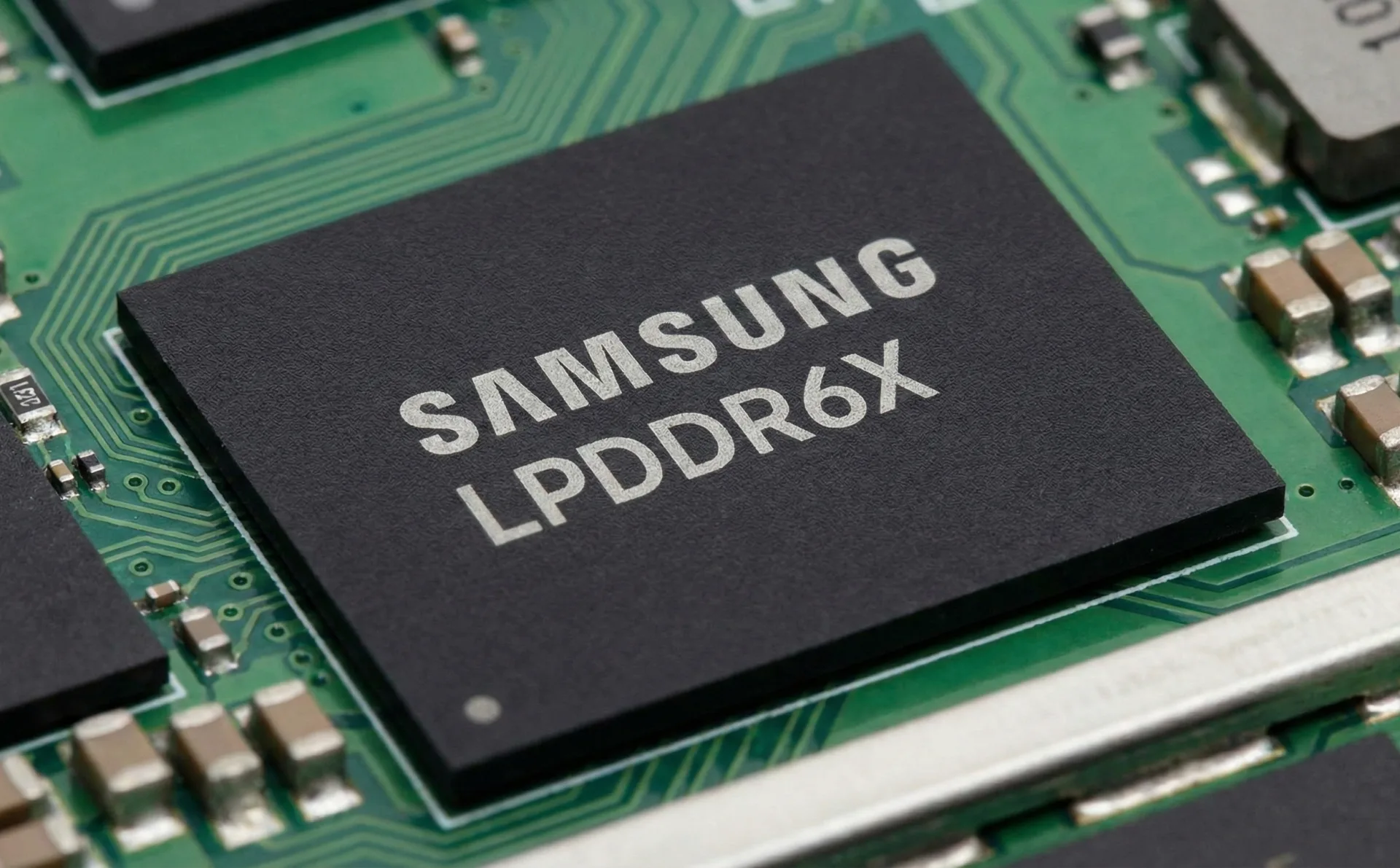
Samsung has officially thrown down the gauntlet in the AI memory race, beginning to ship samples of its advanced LPDDR6X memory to Qualcomm. This move, confirmed by Korean outlet The Bell, isn't just a routine delivery; it's a clear sign of an accelerated development push for the next generation of high-performance, low-power DRAM, which we believe is absolutely crucial for bringing sophisticated on-device AI to life.
We're seeing LPDDR6X emerge as a specialized iteration of the recently finalized LPDDR6 standard, engineered specifically to stretch the limits of capacity and performance for demanding AI workloads. Qualcomm is reportedly putting these samples through their paces for its upcoming AI250 accelerator chip. What has really caught our attention is the projected LPDDR6X capacity for the AI250, which is anticipated to exceed a colossal 1 terabyte (TB). That's a roughly 30% jump from its predecessor, the AI200, which is expected to support up to 768 gigabytes (GB) of LPDDR memory, a leap we see as vital for running ever-more complex AI models locally.
JEDEC's New Standard and Samsung's Ambitious Timeline
While the full specifications for LPDDR6X haven't yet been finalized by JEDEC, the global standards body for microelectronics, it builds directly on the newly established LPDDR6 standard. JEDEC officially finalized the LPDDR6 standard (JESD209-6) in 2025, setting initial speeds ranging from 10.67 Gbps to 14.4 Gbps. To put that in perspective, this is a notable upgrade from LPDDR5X, which topped out around 8.5 Gbps to 9.6 Gbps, and a substantial boost over the 6.4 Gbps of LPDDR5. Samsung unveiled its first LPDDR6 DRAM at CES 2026 and is gearing up for mass production in the second half of 2026, with commercial LPDDR6 products slated for 2027. However, the even more advanced LPDDR6X technology isn't expected for general availability before late 2027 or early 2028, reminding us that bleeding-edge advancements often require a little more patience.
LPDDR6 technology brings several key enhancements that we believe will reshape how on-device AI performs:
- Speed Boost: Initial speeds of 10.67 Gbps, with future variants projected to reach 14.4 Gbps and beyond, directly translating to faster data processing for AI models.
- Energy Efficiency: A claimed 21% improvement in energy efficiency compared to LPDDR5, a critical factor for extending battery life in mobile devices and reducing power consumption in AI accelerators.
- Dynamic Power Management: Advanced dynamic power management and a dual VDD2 supply, which we expect will contribute to more consistent performance and greater efficiency under varying workloads.
- Bandwidth Maximization: An expanded I/O count and a dual subchannel architecture designed to maximize bandwidth, allowing more data to be accessed and processed simultaneously.
- Enhanced Security: Robust security mechanisms, including protected carve-out regions and on-die ECC, crucial for safeguarding sensitive data and maintaining data integrity in AI applications.
- Flexible Architectures: Support for flexible burst lengths (32 or 64 bytes) and various memory interfaces (96-bit, 192-bit, and 384-bit), offering greater adaptability for diverse chip designs and AI workloads.
LPDDR vs. HBM: The Battle for AI's Memory Future
The strategic positioning of LPDDR technology, particularly LPDDR6 and LPDDR6X, as a viable alternative to High Bandwidth Memory (HBM) for future AI accelerators, marks a significant industry trend we've been tracking closely. We've long seen HBM touted as the ultimate solution for high-performance computing due to its sheer speed, but its production is notoriously complex, leading to increased costs, higher power consumption, and frequent supply shortages.
While HBM undeniably offers higher raw speeds, we believe the industry is increasingly realizing that LPDDR, with its simpler and more economical manufacturing process, offers a more stable and cost-effective supply. This makes it an incredibly attractive option for scaling AI capabilities across a broader range of devices, moving beyond specialized data center hardware. For on-device AI, where cost, power envelopes, and thermal management are paramount, LPDDR's practical advantages might just give it the edge over HBM's brute force.
We anticipate seeing LPDDR6 debut in serious hardware later in 2026. Keep an eye out for it in high-end mobile processors like Qualcomm's Snapdragon 8 Elite Gen 6 and MediaTek's Dimensity 9600, as well as Intel's Panther Lake and AMD's Medusa Point for laptops. This isn't just about raw specs; it's about what these platforms can do with that increased memory bandwidth and efficiency.
Market Hurdles: Will LPDDR6's Price Tag Limit Its Reach?
The memory market for LPDDR6 is already heating up, with Chinese memory manufacturers also actively preparing for mass production in 2026. This indicates an increasingly competitive field, which traditionally would suggest downward pressure on pricing.
However, the path to widespread LPDDR6 adoption isn't entirely smooth. Industry whispers, notably from Digital Chat Station, predict significant price hikes for LPDDR6 memory in 2026. If these predictions hold true, we expect initial integration will be confined to "Pro-level" flagship processors. This could create a noticeable performance gap between premium and mainstream devices, potentially slowing the democratization of advanced on-device AI features, which we view with a degree of skepticism given the industry's push for pervasive AI.
Ultimately, Samsung's aggressive push with LPDDR6X samples to Qualcomm isn't just a delivery; it's a clear statement about the escalating memory demands of next-gen AI. We see this as a necessary, if potentially expensive, step to unlock the full potential of AI, from the devices in our pockets to advanced AI accelerators across the tech ecosystem.







Comments