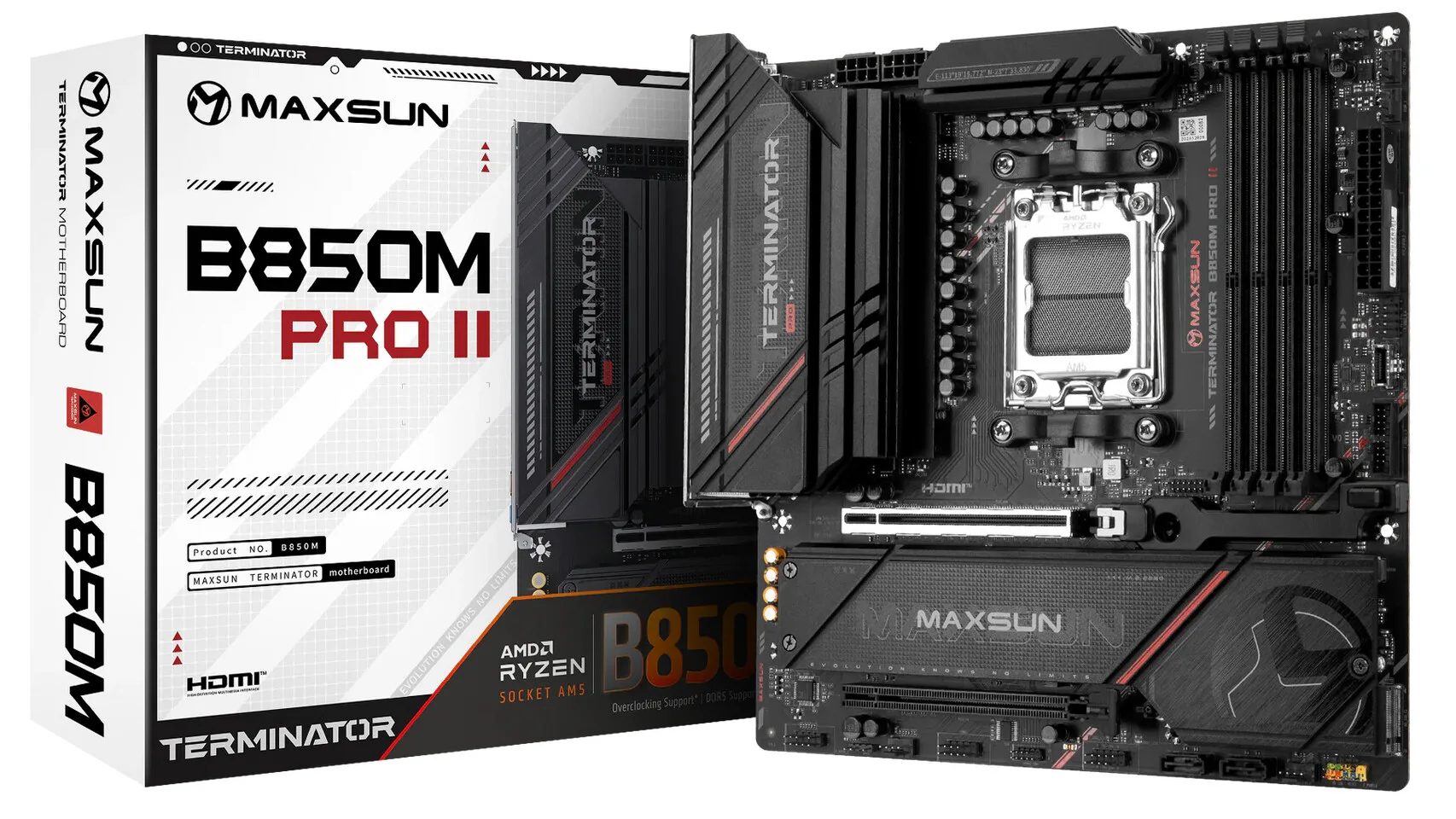
Maxsun, a recognized board partner for both Intel and AMD since 2002, has officially stepped into the spotlight with its new MS-Terminator B850M PRO II WIFI7 Motherboard, launched on January 29, 2026. This Micro-ATX board aims to pack a full feature set into compact builds for the latest AMD Ryzen processors on the AM5 platform. While Maxsun has built a solid reputation in Asian markets for balancing price, performance, and build quality, its presence in Western markets has been less pronounced. We believe this release is another move by Maxsun to gain a stronger global foothold, but the success of such ambitions often hinges on more than just specs.
The company claims the MS-Terminator B850M PRO II WIFI7 provides a "high-performance foundation" for next-generation PCs, focusing on advanced connectivity, power delivery, and an "enhanced user experience." These are bold promises, and as always, we approach such statements with a critical eye, eager to see if the hardware truly delivers on the marketing.
Navigating AMD's AM5 Chipset Evolution
At its core, the MS-Terminator B850M PRO II WIFI7 features an AMD B850 chipset and an AM5 CPU socket, ensuring compatibility with the newest AMD Ryzen processors, including the upcoming Ryzen 9 9950X3D. Maxsun has equipped it with a 12+2+1 VRM power delivery system, utilizing an 8-layer PCB and engineered to support CPUs drawing up to 300W. This configuration is certainly capable of handling demanding processors like the 9950X3D, especially considering the Ryzen 9000 series' efficiency. However, for enthusiasts pursuing extreme, sustained manual overclocking, higher-end X870E boards with more phases might offer greater headroom and stability.
It's also worth noting the B850 chipset itself. Our analysis suggests that the B850 is largely a refresh of the B650 chipset, with the primary distinction being a mandatory PCIe 5.0 slot for the main M.2 drive on B850 boards, where it was optional for B650. Some older B650E boards already offered comprehensive PCIe 5.0 support for both the GPU and M.2 slots, which, in certain aspects, makes them a more "extreme" option than a standard B850 board. The true advantage here for the B850 lies in likely offering native out-of-the-box support for Ryzen 9000 CPUs, potentially saving users a BIOS update.
For memory, the motherboard includes four DDR5 DIMM slots, accommodating up to 192 GB of RAM. The stated support for DDR5-8000, with overclocking potential reaching DDR5-9000 MT/s, sounds impressive. Such speeds, if reliably achievable, would undeniably contribute to peak system responsiveness, especially in memory-intensive tasks and high-refresh-rate gaming.
Embracing Next-Gen Wireless, With a Caveat
The MS-Terminator B850M PRO II WIFI7 is indeed "staying ahead of the curve" by integrating Wi-Fi 7 (802.11be) via a MediaTek MT7925 module. This is a welcome upgrade, offering significant advancements over Wi-Fi 6E, including 4K-QAM modulation for approximately 20% higher theoretical data rates and Multi-Link Operation (MLO) for improved latency and reliability. However, we observed that while Wi-Fi 7 is theoretically capable of 320MHz channel bandwidth, the MediaTek MT7925 module specified here supports a 160MHz channel bandwidth. This means users won't experience the absolute maximum theoretical throughput Wi-Fi 7 can offer, though 160MHz is still a substantial improvement for wireless networking. Bluetooth 5.4 is also a nice touch for peripheral connections, and the Realtek RTL8125D controller provides reliable 2.5G Ethernet for wired needs.
A total of 16 USB ports are listed, with a mix of modern and legacy options:
- USB-C 10G: 1 (front header), 1 (rear)
- USB 5G: 6
- USB 2.0: 8
While having ample USB ports is generally a positive, the inclusion of eight USB 2.0 ports feels somewhat dated for a "next-gen" motherboard. In our view, a more balanced allocation with additional 5G or 10G ports would better serve modern peripherals and external storage devices, many of which can benefit from higher bandwidth.
Storage and Expansion: PCIe 5.0 Dominates
Storage capabilities are quite extensive, featuring two PCIe 5.0 x4 M.2 slots and an additional PCIe 4.0 x4 M.2 slot. This allows users to leverage the full bandwidth of high-speed NVMe SSDs, a definite plus for fast loading times and data transfers. Expansion slots include one PCIe 5.0 x16 slot, which is crucial for the latest graphics cards, and one PCIe 4.0 x4 slot for other expansion cards. For audio, the board relies on a Realtek ALC897 audio codec. While the press release touts "high-fidelity audio," the ALC897 is a common, cost-effective solution found on many budget to mid-range boards. Audiophiles are unlikely to consider it truly "high-fidelity" and would typically opt for an external DAC or a board with a more premium codec like the ALC1200 or ALC4080.
A New BIOS and Subtle Aesthetics
Maxsun has also focused on improving the user experience with an "all-new PTM UI BIOS," which is said to be "redesigned for easier navigation" with "larger icons, more buttons, and a mobile-inspired design." While accessibility improvements are always welcome, we are often skeptical of "mobile-inspired" interfaces on a PC BIOS, as they can sometimes simplify functionality to the point of frustrating advanced users. We'll reserve final judgment on its intuitiveness until we get hands-on. Aesthetically, the board features a futuristic black and grey color scheme with integrated RGB lighting, which is a fairly standard offering in today's motherboard market.
The Missing Piece: Availability and Pricing
The Maxsun MS-Terminator B850M PRO II WIFI7 Motherboard has officially launched, but Maxsun has not yet disclosed a global release date or the Manufacturer's Suggested Retail Price (MSRP). This lack of pricing information is, in our opinion, the most critical piece of the puzzle. Maxsun's products are largely targeted at the Chinese market, and their global availability can be inconsistent. Without a firm price, it's impossible to properly assess the board's competitiveness against established players like ASUS, MSI, and Gigabyte in the Micro-ATX AM5 segment, many of which already offer Wi-Fi 7 and PCIe 5.0 support. Maxsun's ability to "strike a good balance between price, performance, and build quality" needs to translate into a compelling value proposition outside its home market to truly make an impact. We await further announcements with keen interest.




Comments