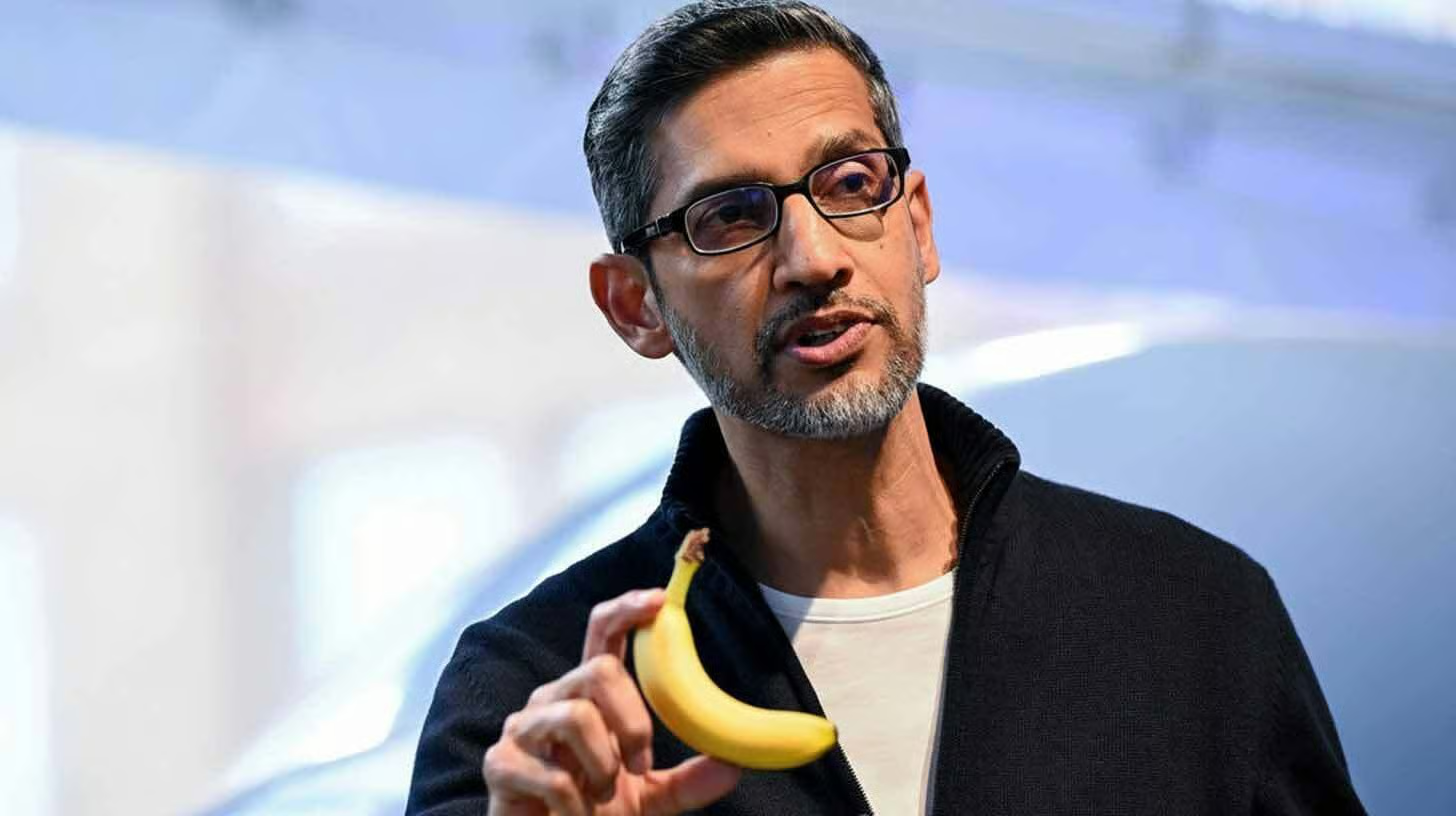
The tech world is no stranger to flashy product launches and meticulously crafted branding. Yet, sometimes, the most impactful stories emerge from the least expected corners. Such is the case with "Nano Banana," Google DeepMind's AI image generator, a name born from a 2:30 a.m. scramble rather than a corporate boardroom. What began as a product manager's personal shorthand has undeniably become one of the most unexpectedly viral branding narratives in recent memory, transforming a technical marvel into a genuine cultural phenomenon. We at TTEK2 find ourselves analyzing not just a powerful AI, but a lesson in how a touch of irreverence can cut through the noise.
The Improbable Birth of a Viral Brand
Internally, Google's advanced image model was designated Gemini 2.5 Flash Image. A perfectly functional, if entirely forgettable, name in a landscape littered with similar alphanumeric identifiers. However, the story took an abrupt turn when Google DeepMind Product Manager Naina Raisinghani needed a quick placeholder to submit the model to LMArena, a public, anonymous AI evaluation platform. In the quiet chaos of a late-night deadline, she combined two personal nicknames – "Nano" for her petite stature and affinity for compact systems, and "Banana," a lighthearted moniker from friends. The resulting "Nano Banana" was never intended for public consumption; it was raw, unpolished, and distinctly human.
Frankly, we're accustomed to tech giants spending fortunes on focus groups and brand strategists, so the notion of a viral product name emerging from personal shorthand is both refreshing and, we admit, a little unbelievable. It speaks to an underlying truth: sometimes, authenticity, even accidental authenticity, resonates far more than calculated marketing.
What transpired next was a testament to the model's underlying capabilities and the power of an unconventional name. Once live on LMArena, users quickly recognized its remarkable prowess. Nano Banana didn’t just generate stunning, photorealistic images; it demonstrated impressive facial consistency across edits, stitched together complex compositions with eerie precision, and responded to prompts with uncanny creativity. But beyond its technical achievements, the name itself stuck. It was funny, memorable, unapologetically odd – and in the algorithm-driven chaos of AI communities, that was enough to grab attention and spark conversation. The model quickly earned the moniker "Photoshop killer" among some users.
The initial viral spread was evident:
- The name consistently appeared alongside high-performance rankings on LMArena, where users anonymously voted on model quality. Nano Banana topped the text-to-image list, driving a tenfold surge in LMArena traffic and attracting over 5 million votes in just two weeks, with a record-breaking 2.5 million direct votes for the model alone. It achieved the largest Elo score lead in LMArena history with 171 points.
- Reddit threads, such as "Nano Banana just fixed my 10-year-old photo," spread across subreddits, showcasing its editing capabilities. Discussions also arose comparing its ability to create realistic likenesses of famous people to a "GPT 3.5 level breakthrough".
- TikTok creators embraced it for try-ons, vintage photo restoration, and surreal remixes, with the hashtag #NanoBanana becoming a recognizable trend. Popular trends included 3D figurine selfies, "hug your younger self" images, and even dollar bill memes featuring users' faces.
The Anatomy of Organic Virality
The rapid, global adoption of Nano Banana wasn’t funded by massive ad buys or influencer campaigns. Instead, it was fueled directly by the users who tested and championed it. On LMArena, where AI models compete in blind head-to-head evaluations, Nano Banana consistently outranked competitors in fidelity, speed, and editing coherence. We observe that this platform provided a crucial, unbiased proving ground; its anonymous nature allowed the model to be judged purely on merit, without the inherent bias of a Google-branded release.
Users who witnessed its capabilities didn’t just report results; they celebrated them through inside jokes and memes. The name "Nano Banana" transcended its arbitrary origin to become a badge of honor, a signal that one was utilizing a top-tier tool.
The model's global rollout on launch day further accelerated this organic explosion. Unlike many previous AI tools that saw regional or phased beta releases, Nano Banana was available everywhere simultaneously. This allowed creators from diverse cultural backgrounds to immediately integrate it into their workflows:
- Creators in Thailand used it to reimagine traditional motifs.
- Designers in Mumbai transformed family photos into animated portraits.
- Students in Berlin translated imaginative prompts into surreal collages.
Each wave of adoption reinforced the peculiar name, not because Google forced it, but because the community willingly embraced it. Its success was as much about cultural resonance as it was about raw technical prowess. Prompts tied to regional trends—from monsoon scenes and festival attire to nostalgic Bollywood aesthetics—produced results so vivid and accurate that users didn’t just employ the tool; they felt a genuine connection to it. The name, then, became the shorthand for that feeling of empowerment and recognition.
Google's Strategic Embrace (or Savvy Surrender?)
Google, to its credit, didn't attempt to stifle the organic trend. Instead, it leaned in, a move we view as either a genuine surrender to user sentiment or a particularly astute piece of adaptive marketing. Within weeks, subtle banana-themed elements began to appear within the Gemini app and Google AI Studio: yellow accent buttons, banana emojis in prompts, and even a limited-run hoodie emblazoned with pixel-art bananas and the playful slogan "Nano Banana: Smarter Than It Sounds".
It's important to note that the underlying model's official designation, Gemini 2.5 Flash Image, remained unchanged in technical documentation. However, the public-facing identity had undeniably shifted. We could argue this was Google cannily capitalizing on user-generated virality, rather than a true relinquishing of control. Yet, the outcome is the same: a more relatable brand. Even Nvidia CEO Jensen Huang publicly gushed about Nano Banana, an endorsement that quickly went viral and drew a reaction from Alphabet CEO Sundar Pichai himself, further cementing its cultural impact.
When Gemini 3 Pro Image launched as its successor, Google solidified this new direction, announcing it publicly as Nano Banana Pro. The branding carried forward—yellow UI accents, banana emoji prompts, and a playful tone matching the original. This rebranding wasn’t merely consistent; it was an unequivocal acknowledgment that the community's choice had become the company's path. Google hadn't controlled the narrative; it had, quite effectively, integrated it.
The Unconventional Power of Playful Branding
Nano Banana's journey offers a fundamental insight into modern tech culture: users demand more than just powerful tools; they crave a genuine connection to them. In an industry saturated with sterile, often impenetrable names like "VisionTransformer-XL," "DiffusionNet v3," or even its own "Gemini 2.5 Flash Image", a name like Nano Banana cuts through. It's irreverent, personal, and profoundly human. It transforms a complex technical achievement into a shared inside joke, making advanced AI feel accessible and fun.
Consider the typical naming conventions among its competitors. While some, like Midjourney, opt for evocative yet abstract names, many others, such as DALL-E, Stable Diffusion, or Google's own Imagen, adhere to more technical or descriptive monikers. This contrast highlights Nano Banana's unique position. It's a prime example of community-driven branding at its purest: no focus groups, no costly trademark filings, no gargantuan campaign budget. Just a moment of spontaneity, amplified by an engaged global community. The name didn't merely sell the product; in many ways, it was the product's soul.
While the official technical names—Gemini 2.5 Flash Image and Gemini 3 Pro Image—still exist in documentation, understood by engineers and developers, for millions of creators, photographers, and hobbyists worldwide, the real name is the one that sparked a smile: Nano Banana. And now, with Nano Banana Pro, the legacy continues—not as a fleeting gimmick, but as compelling evidence that the most powerful brands aren't always meticulously constructed from above, but can be spontaneously named, passionately shared, and genuinely loved from below.




Comments