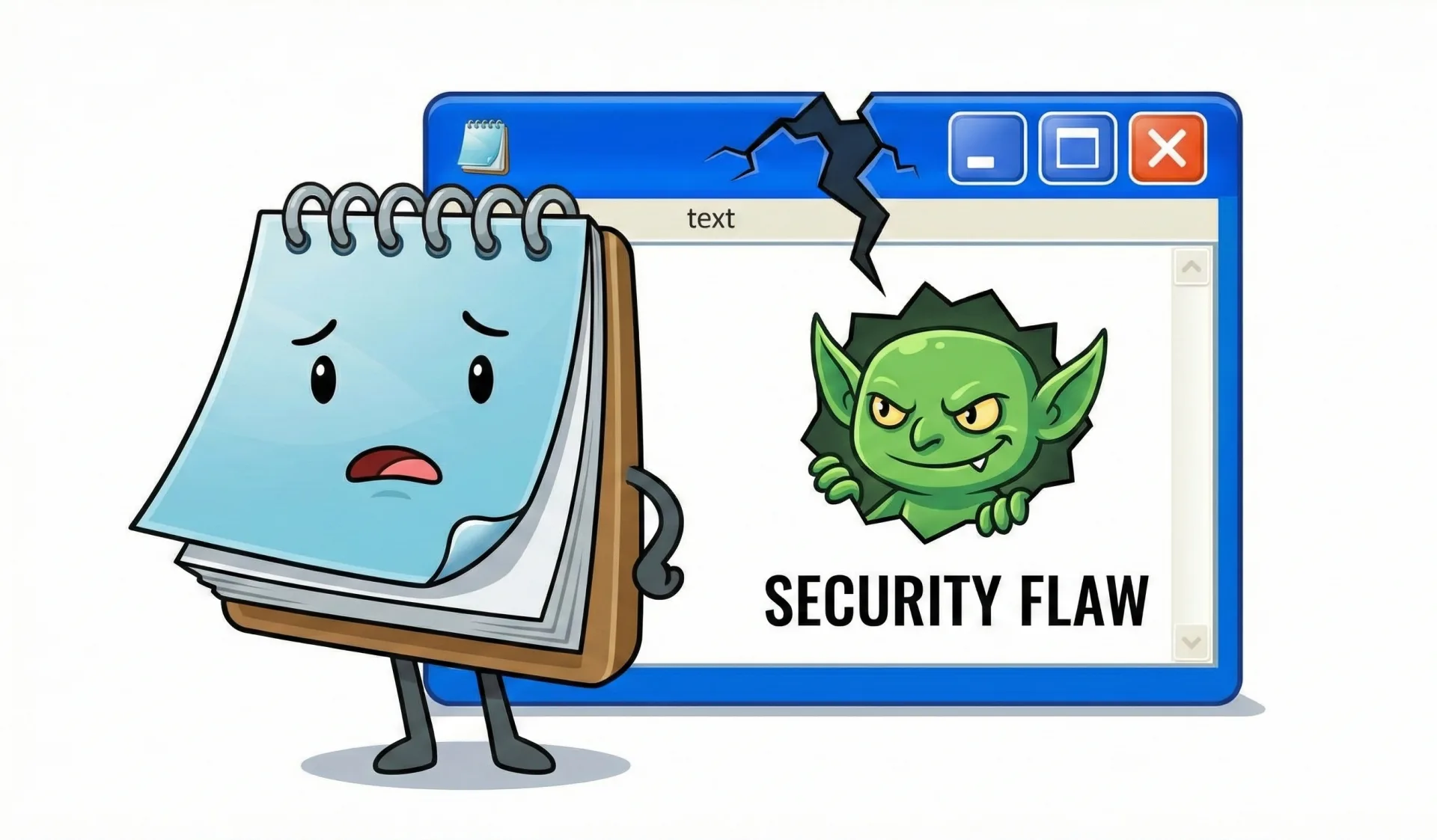
Microsoft has rolled out an urgent security update for its modernized Windows 11 Notepad app, addressing a critical "Remote Code Execution" (RCE) vulnerability, officially tracked as CVE-2026-20841. Rated with a high-severity CVSS v3.1 base score of 8.8 and classified as 'Important' by Microsoft, this flaw was publicly disclosed and patched on February 10, 2026, as part of the company's routine February Patch Tuesday security update. The vulnerability impacts versions of the Microsoft Store-distributed Notepad app prior to build 11.2510, requiring users to actively update their Notepad app via the Microsoft Store for protection.
Notepad's Unthinkable Flaw: Remote Code Execution in a Text Editor
It's astonishing to think that Notepad, a bedrock of Windows simplicity since version 1.0, could be at the center of a high-severity RCE vulnerability. Yet, here we are. The flaw, categorized as CWE-77 or "Improper Neutralization of Special Elements used in a Command" (command injection), could grant an attacker the power to execute arbitrary code on a user's system. A CVSS score of 8.8 positions this firmly in the "High" severity range, just shy of "Critical," indicating a significant potential for impact on confidentiality, integrity, and availability.
While Microsoft reports no known active exploitation of CVE-2026-20841 at the time of disclosure, we view this with a healthy dose of skepticism, especially given how quickly security researchers Cristian Papa, Alasdair Gorniak, and Chen (Delta Obscura) discovered and reported it. Conflicting early reports regarding proof-of-concept (PoC) exploits quickly gave way to BleepingComputer demonstrating a functional PoC, proving that the theoretical can rapidly become the practical. This swift development underscores the immediate danger such a flaw poses once publicly known. Community reactions have ranged from dismay to outright criticism, with many questioning the wisdom of adding complex features to a tool traditionally prized for its straightforwardness. As one user on Reddit lamented, "Notepad software seems to be really over engineered for such a simple concept."
Social Engineering's New Playground: How Notepad Became a Weapon
The attack mechanism for CVE-2026-20841 is disturbingly elegant in its simplicity, hinging entirely on social engineering. An attacker merely needs to trick a user into opening a specially crafted Markdown (.md) file. The real kicker? The user then clicks a malicious link embedded within that file. Prior to this patch, Notepad's default behavior of rendering Markdown and supporting clickable links allowed it to launch unverified protocols. Crucially, this could occur without triggering Windows security warnings, effectively giving malicious links a free pass to your system.
We find this lack of warning deeply concerning. An application like Notepad, long considered a safe and simple utility, unexpectedly becoming a vector for executing local or remote files and commands fundamentally undermines user trust. If successfully exploited, the malicious code would run with the permissions of the logged-in user. This could lead to a cascade of severe consequences, from data theft and malware deployment to complete system compromise if the user holds administrative privileges. This vulnerability specifically targets the modernized Notepad app, which, since May 2025, gained features like Markdown support, tabs, and AI helpers. Thankfully, the legacy binary remains unaffected.
The Patch and Its Imperfections: A Critical Look at Microsoft's Fix
The remedy for CVE-2026-20841 is delivered automatically via the Microsoft Store, rolling out as Notepad version 11.2510 or later. To protect themselves, users must:
- Update the Notepad app immediately to version 11.2510 or newer through the Microsoft Store.
- Enable automatic app updates in Windows Settings to ensure future security patches are applied without delay.
- Exercise extreme caution when encountering untrusted Markdown files or clicking links within unexpected documents, regardless of the new warnings.
While we appreciate the swift delivery of the fix, we believe the implementation leaves room for improvement. As part of the patch, Notepad now displays warnings when users click links that diverge from the standard 'http://' or 'https://' protocols, including schemes like 'file:', 'ms-settings:', 'ms-appinstaller:', 'mailto:', and 'ms-search:'. However, this new warning behavior has already drawn criticism. Relying on user interaction, even with a warning, can still be exploited through sophisticated social engineering tactics, effectively tricking users into proceeding with malicious links. As security researchers have pointed out, "although exploitation depends on the victim opening the Markdown file and Ctrl-clicking the link, such interaction is routinely achieved through social engineering".
The Price of Progress? Notepad's Bloatware Problem
The Notepad app has come a long way from its humble beginnings. Its modernization for Windows 11, including distribution via the Microsoft Store, has introduced new functionalities like Markdown preview, basic table formatting, and RTF text display. However, this increased feature set, in our view, has directly expanded its potential attack surface. The community reaction is telling: many users and experts lament the "bloat" and argue that text editors don't need network functionality or AI features if they introduce such significant security vulnerabilities. This sentiment is only amplified by Microsoft's previous decision to discontinue WordPad for Windows 11, positioning Notepad as a primary text editor and, consequently, a more tempting target for attackers.
The irony is not lost on us: in an effort to make Notepad more versatile, Microsoft has inadvertently made it a more complex, and thus potentially more vulnerable, application. This forces us to question the balance between adding "helpful" features and maintaining core security and simplicity.
Beyond Notepad: A Hectic Patch Tuesday for Microsoft
The February 2026 Patch Tuesday was, unfortunately, far from quiet. Microsoft's extensive security rollout addressed a total of 58 vulnerabilities across various products. What truly stands out, however, is the inclusion of fixes for six actively exploited issues and three publicly disclosed zero-day vulnerabilities. This is a stark reminder of the relentless and evolving threat landscape facing users and enterprises.
Among these critical fixes were several security feature bypasses, including vulnerabilities in Windows Shell (CVE-2026-21510), the MSHTML Framework (CVE-2026-21513), and Microsoft Word (CVE-2026-21514). Each of these, like the Notepad flaw, could allow attackers to circumvent protection mechanisms that would typically warn users before opening malicious files, or execute code. The sheer volume and severity of these patches, particularly the actively exploited zero-days, highlight the ongoing efforts by Microsoft to secure its vast ecosystem against sophisticated threats. For users, it underscores the paramount importance of staying vigilant and ensuring all systems and applications are updated promptly.








Comments