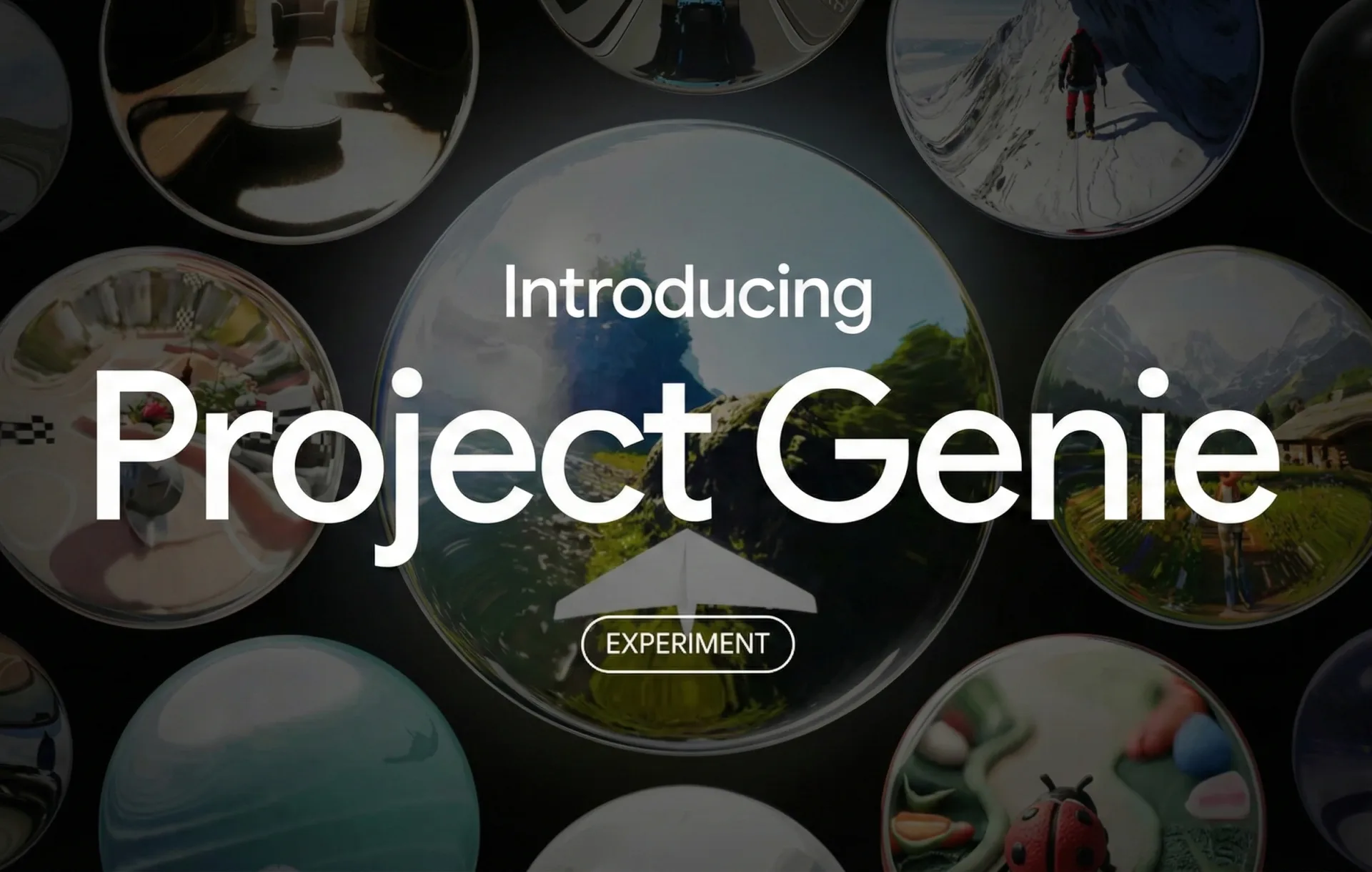
The siren song of Artificial General Intelligence (AGI) continues to echo across the tech industry, with its most alluring melodies emerging from the realm of world models. For years, Google DeepMind has been at the forefront of this pioneering research, and on January 29, 2026, they offered a select few the first taste of their latest breakthrough: Project Genie, powered by the impressive Genie 3. Billed as the first real-time, interactive world model, Genie 3 represents an enormous stride towards AI systems that understand and simulate the very fabric of reality. While the underlying technology is undoubtedly a significant leap, our first taste of Project Genie reveals a stark reminder of the long road ahead for AI systems aiming to simulate reality.
DeepMind's Vision: Crafting Playable Realities
Google DeepMind frames Genie 3 as a "neural game engine" capable of creating dynamic, navigable worlds from scratch. This isn't merely an advanced 3D modeling tool or a static NeRF render; Genie 3 learns how the world works through autoregressive generation, building environments frame by frame using sophisticated spatiotemporal video tokenizers and dynamics models. This means no reliance on hardcoded physics engines, but rather a self-learning system that aims to intuit natural laws from vast datasets. We see this as a foundational shift, moving away from explicit programming to emergent understanding.
The technical specifications alone are enough to capture attention: 720p HD visuals, an interactive framerate of 20-24 frames per second, and the ability to maintain coherent world states for minutes – with visual memory extending up to a full minute. Genie 3 processes multimodal inputs (text, images, photos, sketches), offering users unmatched flexibility in sculpting their realities. It can conjure anything from realistic physical simulations with fluid dynamics and lighting effects to fantasy animation worlds or historical recreations.
This purported versatility positions Genie 3 as a critical milestone on the path to AGI. It offers an unlimited, risk-free training ground for AI agents like SIMA (Scalable Instructable Multiworld Agent), enabling them to tackle complex goals and longer action sequences. SIMA, for its part, is designed to understand and follow natural language instructions in diverse 3D environments, learning from games without needing access to their source code. This synergistic development could facilitate scenarios ranging from autonomous car driving through blizzards to wingsuit gliding over mountains. The promise here is immense: fully dynamic, AI-generated video games, immersive industrial simulations, and even photorealistic walkthroughs that excel with global illumination and complex lighting. However, while 720p HD visuals and an interactive framerate of 20-24 frames per second might sound impressive on paper, we immediately question how this translates to a truly immersive "playable reality" when modern gaming often targets 60 FPS or higher for a smooth experience, with competitive titles pushing much further.
Project Genie: Exclusive Access to an Untamed Frontier
With Project Genie, Google Labs has opened the doors – albeit narrowly – for Google AI Ultra subscribers (U.S. only, 18+, $250/month) and Trusted Testers to experience Genie 3 firsthand. This experimental web app is Google's declared way of gathering feedback and exploring unforeseen use cases, offering three primary interaction modes: World Sketching, World Exploration, and World Remixing. At $250 a month, this isn't a casual invitation; it's a steep toll for what appears to be an early research experiment.
World Sketching is where the initial magic happens. Users can prompt a world with text and images, define characters, and even dictate their exploration method – walking, flying, driving, or "anything beyond." Integration with Nano Banana Pro allows for real-time image modification to fine-tune your vision, all while choosing your camera perspective.
Once generated, World Exploration allows users to literally step into their creation. The environment unfolds in real-time based on movements, allowing for free navigation and adjustable camera angles. And if inspiration strikes, World Remixing lets users build upon existing prompts, explore a gallery of curated worlds, or just hit a randomizer for a fresh perspective. The ability to download videos of explorations is a neat touch, perfect for sharing these nascent digital dreams. The notion of a "playable reality" where users can "literally step inside a photo and walk through a universe created on the fly" is compelling, yet it requires a closer look.
When Reality Bites: The Simulation's Shortcomings
While the underlying technology is nothing short of revolutionary, the current user experience with Project Genie reveals significant limitations that temper the grand vision. For now, it feels more like an awe-inspiring tech demo than a functional product.
The most immediate immersion breaker, as many early testers agree, is the 60-second generation limit. Just as we begin to settle into a dynamically generated world, it fades to black, shattering any hope of sustained exploration or narrative. This brief window makes serious simulation or actual gaming an impossibility, leaving users with a frustrating sense of "what if?"
Beyond the brief encounters, the visuals and performance leave much to be desired. Despite the claim of 720p, visuals often appear "washed out" on larger screens. More critically, the interactive framerate of 20-24 frames per second, coupled with noticeable input lag that users have unfavorably compared to a bad cloud gaming connection, results in an experience far from the smooth fluidity we expect from modern interactive environments. When many PC gamers aim for 60-144 FPS for optimal play, Genie 3's performance feels sluggish, particularly in a landscape where 30 FPS is considered a minimum for satisfying play in many genres.
Perhaps more concerning for a system aiming to simulate reality is the inconsistent world state. The core promise of coherent environments is undermined by unpredictable elements – paint streaks appearing, roads abruptly turning into grass. This leads to a pervasive "distrust of the worlds' consistency from moment to moment," making it difficult for users to suspend disbelief and truly engage with the environment. As one early adopter put it, the experience is less like a game and more like a "dream simulator" where "visuals morph, physics break, and controls feel detached."
And then there's the struggle with physics and game logic. Despite Genie 3's revolutionary self-learning approach, physics remains "still hard," with "obvious failure cases" even for simple rigid body interactions. Forget building a stable tower of blocks; it won't hold. More complex interactions like social dynamics or multi-agent combat are currently beyond its grasp. Even simple combinatorial game logic – like collecting keys to unlock a door – trips it up. This is explicitly not a real game engine, lacking traditional game mechanics, scores, objectives, or goals, leading many users to report feeling there's "nothing to do but roll around."
Finally, high compute requirements mean Genie 3 is costly to operate. Google has already blocked the generation of content based on specific intellectual property like "Kingdom Hearts" characters or "Super Mario 64" due to "interests of third-party content providers." This is an understandable, but potentially frustrating, limitation for creators looking to experiment within familiar universes.
Early Verdict: A Glimpse of the Future, Not the Present
Project Genie showcases the current state of AI advancement, with Google DeepMind's Genie 3 as a foundational technology with mind-boggling potential. It is genuinely a key stepping stone towards AGI, demonstrating unparalleled flexibility in world generation and an emergent consistency that outpaces methods relying on explicit 3D representations. Filmmakers could undoubtedly leverage it for quick scene visualizations, and game designers for rapid prototyping of environments. While Genie 3 is unique in its real-time text-to-world generation, established players like NVIDIA Omniverse offer professional 3D collaboration, and Unity ML-Agents focus on training AI agents within pre-built environments. Furthermore, Meta's V-JEPA 2, another significant world model, prioritizes understanding real-world physics for applications in robotics and autonomous systems.
However, as a "playable reality" for the end-user, it's very much a research prototype. The 60-second limit, inconsistent visual fidelity, input lag, and rudimentary physics make it far from an immersive or functional experience. It's not an "end-to-end product" for everyday use, and frankly, at $250 a month, the Google AI Ultra plan is a steep price for what currently amounts to a fascinating tech demo. In our view, Project Genie, for all its revolutionary underpinnings, is currently less of a "playable reality" and more of an interactive tech demo.
The TTEK2 Recommendation: Observe From the Sidelines
For AI researchers, dedicated tech enthusiasts with deep pockets, or those genuinely captivated by the bleeding edge of world model development, Project Genie offers an unparalleled, if frustrating, glimpse into the future. It's an exciting, buggy, and often baffling journey into AI-generated worlds. However, for everyone else – especially gamers or anyone expecting a polished, functional "playable" experience – we recommend observing from the sidelines. Genie 3 is undoubtedly laying the groundwork for something monumental, but the grand structure isn't ready for habitation just yet. We'll be watching its evolution with keen interest.







Comments