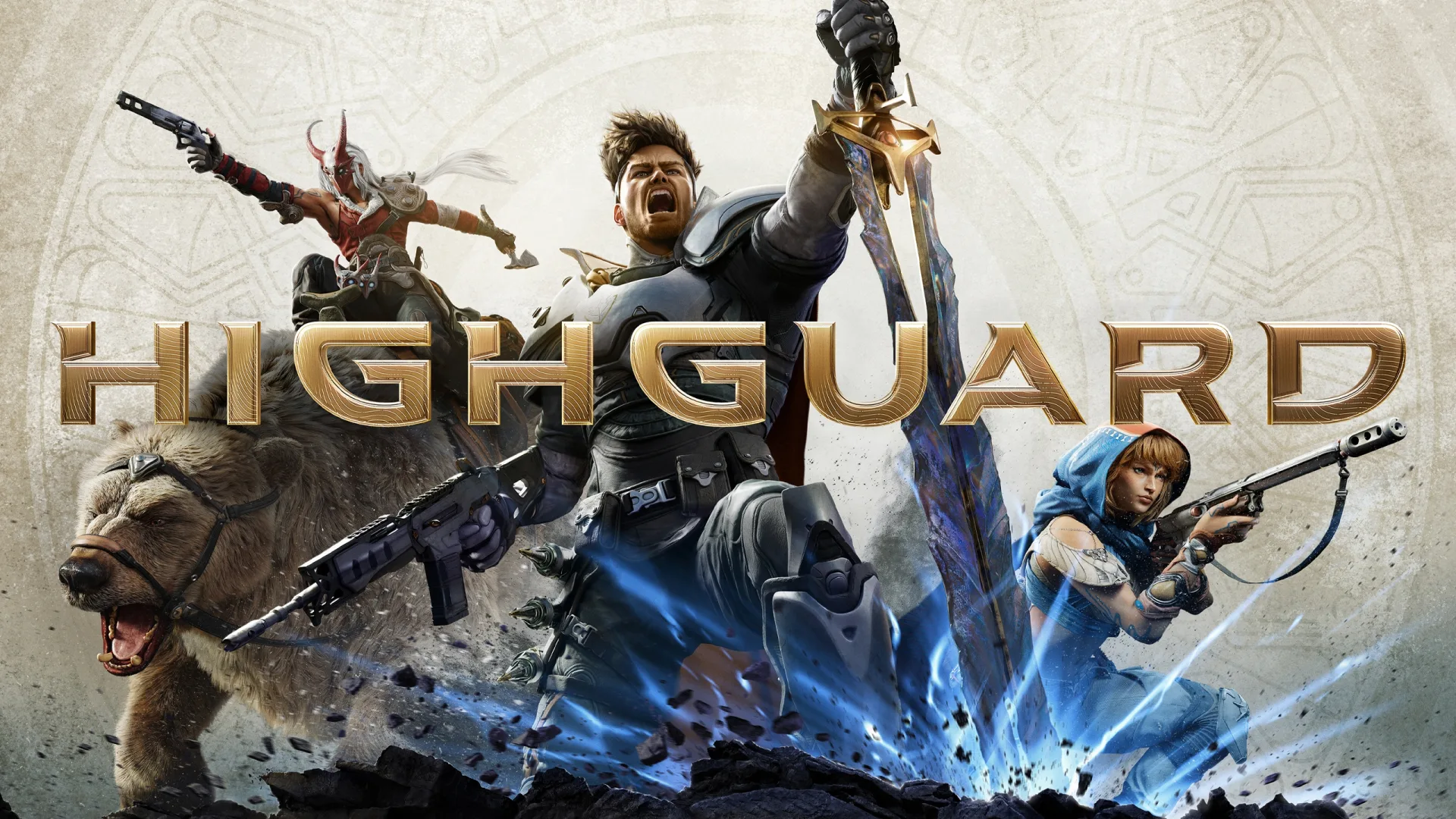
The video game industry is a ruthless battleground where launching a new title demands more than just code; it requires a delicate dance of hype, execution, and timing. Wildlight Entertainment, a studio boasting a lineage of ex-Respawn Entertainment talent—the minds behind giants like Titanfall, Call of Duty, and Apex Legends—stepped into this arena with Highguard on January 26, 2026. Touted as a free-to-play online PvP raid shooter, Highguard arrived not with a bang, but with a whimper, having been preceded by a whirlwind of pre-launch controversy only to be met by a torrent of post-launch issues. The immediate result? An alarming player exodus in its first 48 hours.
The question for us isn't merely "What is Highguard?" but rather, "Can this title, despite its star-studded development team, justify our valuable time after such a catastrophic debut?" We’ve taken a closer look at the unfolding chaos.
High Hopes, Hard Fall: Highguard's Rocky Road to Launch
Wildlight Entertainment's 100-person team, including approximately 60 veterans from the revered Apex Legends and Titanfall franchises, promised to deliver a fresh perspective on the online multiplayer genre. Highguard blends fantasy aesthetics, unique hero abilities (think lightning bolts and ice walls), and modern weaponry (shotguns, assault rifles) into what we initially hoped would be an engaging 3v3 MOBA-like experience. The core loop involves players fortifying a base, scavenging the environment for loot, and then engaging in combat to dismantle the enemy's stronghold. Movement, a characteristic strength of their previous work, was promised to be fluid, allowing for satisfying running, sliding, climbing, and leaping.
This impressive background understandably fueled significant anticipation. However, Highguard's path to launch was anything but smooth, culminating in a disastrous reveal. The game closed The Game Awards in December 2025 with what was widely described as an "oblique trailer" that left audiences baffled and, frankly, disappointed. The trailer amassed a staggering 17,000 dislikes against only 1,800 likes. Wildlight Entertainment CEO Dusty Welch himself later conceded that they rushed an "entertainment-focused" trailer, regretting the missed opportunity to clearly showcase the game's unique loop. Following this public misstep, the studio retreated into near-radio silence until launch, allowing negative early buzz to fester. In our view, this was a critical error, starkly illustrating that in 2026, launching a new game demands not just a strong product but also a meticulously managed narrative.
A Muddled Identity: Gameplay Lost in Translation
Highguard does manage to deliver some genuinely fun moments. We observed that Reddit users and Vice.com authors widely praise its solid shooter fundamentals and gunplay, a clear nod to the team's shooter pedigree. The raid phase, where teams strategically select and fortify their base, is consistently highlighted as genuinely enjoyable and an interesting test of skill. The smooth traversal system also lives up to expectations, a testament to its ex-Respawn developers.
Yet, these positives are quickly overshadowed by a series of perplexing design choices that leave Highguard feeling like a game struggling to define itself, attempting to be "too many" things at once.
- Pacing Problems: The expansive map, seemingly designed around a "spirit horse" traversal concept, feels ill-suited for 3v3 gameplay without dedicated PvE elements. We found matches often stretched out, feeling uneventful and lacking meaningful confrontation outside of base assaults. As several community members on Reddit pointed out, upwards of 80% of combat often devolves into a standard "Defuse-like" mode, focusing predominantly on objectives.
- The "Gear-Up" Grind: The initial two-minute phase, requiring players to mine crystals with an axe and scavenge for weapons and resources, is almost universally criticized as "boring" and "unengaging." The looting system, with its increasing rarities, feels largely pointless, and the crystal farming mini-game comes across as an unnecessary mechanic clumsily integrated into the experience.
- Social Isolation: In a game that demands coordinated objectives, Highguard launched with glaring omissions: basic game chat and party features were absent. This oversight makes effective teamwork nearly impossible for random matchmakers, heavily favoring premade teams and alienating casual players.
- Lack of Content: With only a single game mode available, the core loop quickly becomes repetitive, failing to sustain long-term player interest. This shallow content offering is particularly problematic for a free-to-play title trying to establish a foothold.
Paul Tassi of Forbes.com accurately observes that the gunplay is merely "fine at best." This assessment highlights a significant concern for us; it’s a far cry from the stellar, reactive shooting experiences the developers are known for. We found it to be merely adequate, certainly not the tight, satisfying combat we associate with the Apex Legends team.
Technical Stumbles and a Confused Aesthetic
The game's ambition is further hobbled by pervasive technical issues. Immediately following launch, PC players reported widespread performance problems, frame-rate drops, and a persistent blurriness, even at 100% resolution scale, exacerbated by forced motion blur. Optimization appears to be severely lacking. Compounding these issues is the unexpected requirement for Secure Boot and TPM 2.0, which, as many frustrated users on Steam and Reddit noted, prevented numerous players from even launching the game. Frequent server disconnections and audio problems, such as inaccurate directional sound, further plague the experience.
Visually, Highguard struggles with a clear identity. The discordant blend of fantasy elements and modern assault rifles creates an unsettling aesthetic. Reddit users describe the art style as generic, a "mismatch of Medieval, Overwatch, steampunk, WWI, modern, futuristic, fantasy magic, and biopunk-futurist gun skins, lacking cohesion." Character designs fail to clearly communicate their unique abilities, and the dialogue is universally panned as poorly written and "cringey." All of these visual and narrative missteps contribute to the pervasive feeling that the game "feels like a beta test demo," a sentiment we wholeheartedly agree with.
The Exodus: A Bleeding Playerbase
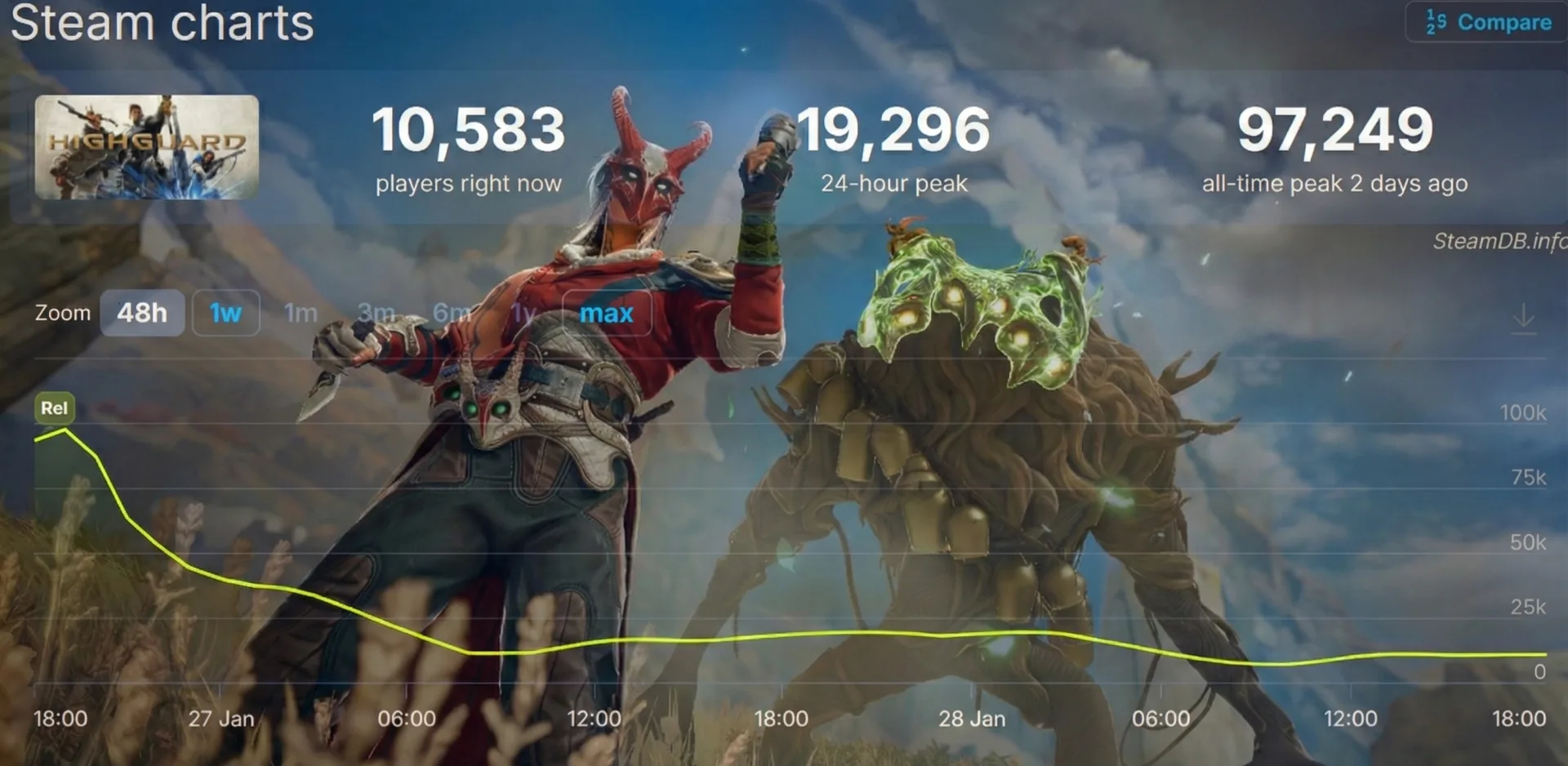
The most damning indictment of Highguard's struggles is its player retention. After an initial peak of 97,249 concurrent players on Steam—a respectable, if not spectacular, number that handily surpassed Concord's dismal 697 peak—the game hemorrhaged players at an alarming rate. By January 27, 2026, just 24 hours after launch, the player count had plummeted by over 80%. Within 48 hours, it plunged by a staggering 92.9% from its peak, sinking to as low as 6,927 concurrent players. This rapid decline in the notoriously competitive multiplayer live-service market represents a critical blow that Highguard may never recover from. The accumulated total of over 16,000 negative reviews on Steam reflects this widespread disappointment, clearly indicating a fundamental failure to meet player expectations.
Wildlight's lead designer reportedly stated they were hoping for a core group of fans, not necessarily massive player counts. However, losing over 90% of its initial peak in just two days is far beyond what any "core group" can sustain long-term. In an era where Apex Legends surprised the world with its launch and became a genre stalwart, and Fortnite reportedly generates $5 billion annually, the current market dynamics severely challenge Highguard's very survival. Valve's own MOBA-inspired game, Deadlock, currently in development with positive beta tests, sets an exceptionally high bar for any new entrant. Highguard is currently nowhere near it.
Our Verdict: A Missed Shot and a Steep Climb Ahead
Highguard presents a tragic case of promising ingredients mixed into an unappetizing dish. While the core shooter mechanics and the fluid traversal hint at the considerable talent within the development team, the muddled identity, fundamental design flaws (such as a boring early phase and ill-suited maps), crucially missing social features, and pervasive technical issues collectively create an experience that feels rushed and profoundly unfinished.
So, is Highguard worth your time and money right now? Our answer is a resounding No. Even as a free-to-play title, the game demands your precious time, yet what it offers in return is a frustrating, unpolished, and rapidly dwindling experience. The existence of expensive in-game currency only adds insult to injury, asking players to invest in a demonstrably unstable product.
The gaming community can be harshly judgmental and possesses long, bitter memories. Wildlight Entertainment faces an arduous uphill battle to salvage this project. Highguard requires a radical overhaul of its core loop, significant technical improvements, and a much clearer vision for what it truly wants to be. Until such drastic changes are implemented, we consider this a critical misfire from a studio with immense potential—and one to unequivocally avoid.

Comments