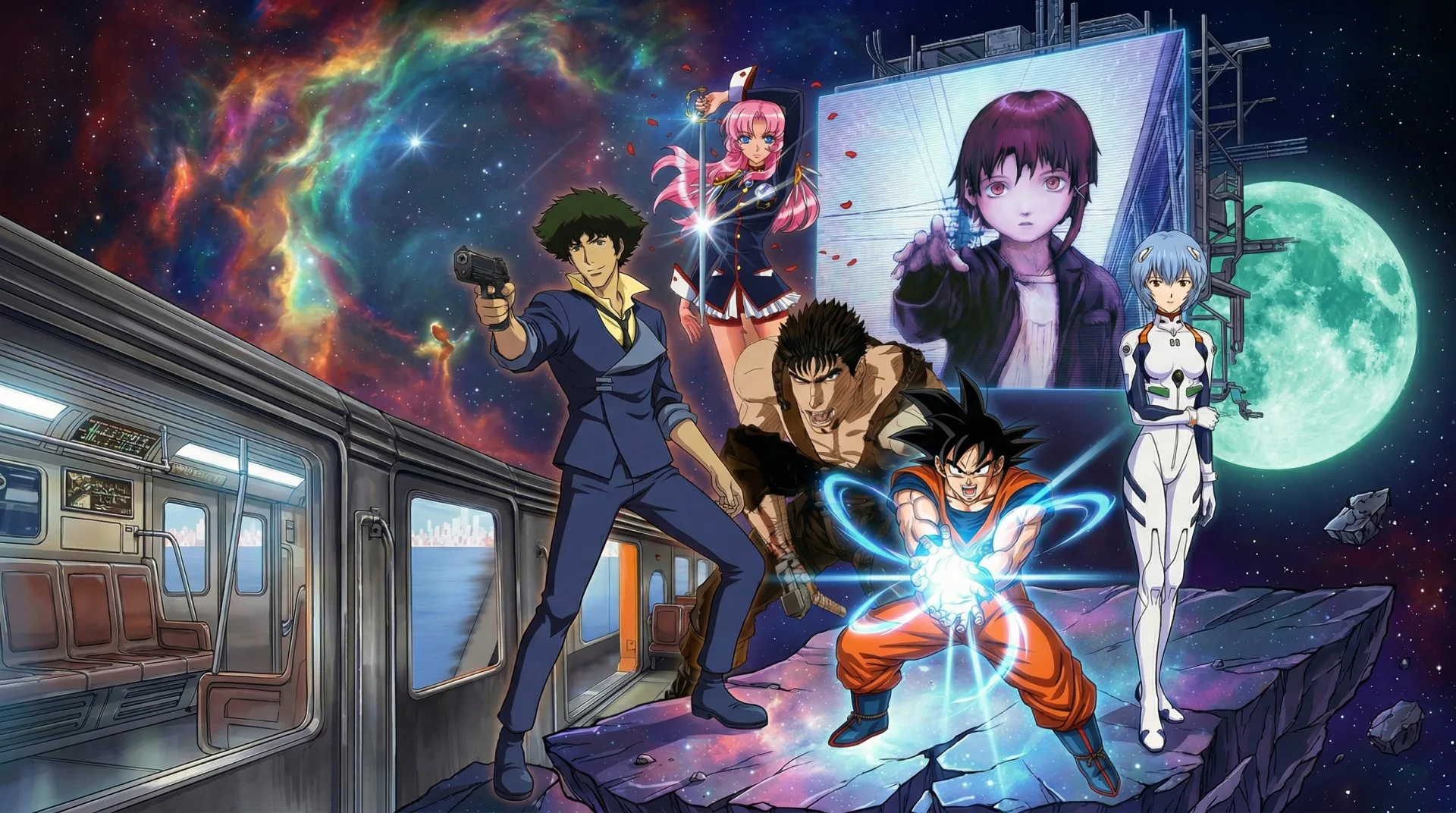
The 1990s gave anime one of its strangest, richest runs. This was the decade when giant robots got depressed, cyberpunk got philosophical, magical girls went global, and viewers outside Japan first figured out that animation could be stylish, unnerving, funny, sad, and adult all at once.
Ranking the 35 best anime from the '90s is messy on purpose. Popularity alone doesn't get you there. Neither does pure critical prestige. The usual mix is storytelling, animation, influence, cultural reach, fan loyalty, and whether a show still feels alive decades later. By those measures, a few titles sit comfortably at the top. After that, things get argumentative fast — which is exactly how a good anime list should work.
One quick caveat: some long-running franchises overlap the decade from the late '80s into the early '90s, and some claims around awards, availability, and modern relevance are firmer than others. But the broad shape of the canon is pretty clear. If you want the best anime of the '90s, start here.
The undisputed top tier
These are the shows and films that define the decade. If you only have time for a handful, make it this handful.
Neon Genesis Evangelion still has the strongest claim to No. 1 because it changed the way TV anime could think. Its giant-robot setup gradually gives way to emotional collapse, existential anxiety, and fractured narrative framing. That wasn't entirely unprecedented in anime, but the way Evangelion did it — cumulative character damage, abstract late episodes, a refusal to tidy itself up — landed like a shock. Later psychological and deconstructive anime owe it a lot, directly or indirectly.
Cowboy Bebop is the easier recommendation, and for many people it'll be the actual favorite. Sunrise's animation still moves beautifully, the genre blending still feels cool rather than forced, and Yoko Kanno's jazz score remains one of the medium's signature achievements. What keeps Bebop this high is that the style isn't a shell. Its episodic structure hides a slow, sad build toward inevitability. It gets better on rewatch.
Ghost in the Shell belongs with those two because its influence extends well beyond anime fandom. The 1995 film helped codify cyberpunk's visual and philosophical mood: urban drift, body-machine uncertainty, long stretches of contemplation broken by sudden violence. It also sits in that transitional production moment where hand-drawn work met increasingly sophisticated digital compositing.
Sailor Moon has the broadest mainstream footprint of this top group after Pokémon, but unlike Pokémon it's also a regular critics' favorite. It remains one of the clearest examples of a series that was commercially huge and genuinely artistically important. You can still see its afterlife in cosplay, merchandise, reboots, and how magical-girl storytelling is discussed.
Serial Experiments Lain is the one here that demands the most patience. It's elliptical and cold by design. But if you want a '90s anime that feels eerily contemporary in its treatment of online identity, alienation, and mediated reality, this is the one. Its influence on later cyberpunk and psychological anime is well documented.
The prestige favorites just below the summit
If the top tier is the canon's marble pedestal, these are the titles sitting one step down: still essential, just a bit more divisive or more niche in their appeal.
Utena is one of the decade's boldest works, full stop. It can be opaque, and that's part of the point. It takes shoujo iconography and turns it into something confrontational, theatrical, and deeply influential. Not everyone will love its repetition or symbolism-heavy storytelling. The people who do tend to never shut up about it.
Perfect Blue is the harshest watch in this section. Satoshi Kon's film remains a reference point for psychological anime thrillers because it is so exact about disorientation. The blurred boundary between performance, spectatorship, and identity is handled with a confidence that still bites.
Princess Mononoke is a different kind of prestige pick: larger, more accessible, and technically fascinating as one of the decade's clearest examples of hand-drawn artistry enhanced by digital post-production. If you want one '90s anime film to show someone who thinks animation is only for children, this is a very good choice.
Trigun has aged well because its tonal strangeness turned out to be the point. It starts loose and comedic, then keeps deepening until the silliness feels like camouflage. Plenty of shows mix genres now, but Trigun did it with a very specific melancholy.
Yu Yu Hakusho, Cardcaptor Sakura, and Escaflowne each represent a major lane of the decade: battle shonen, shoujo fantasy, and lavish cross-genre adventure. None feels like filler on this list.
The mainstream giants that shaped the global anime boom
This is where you find the shows that were everywhere — the titles that didn't just succeed, but changed what anime meant in North America, Europe, and far beyond.
Dragon Ball Z is not the most elegant series on this list, but it may be the most historically difficult to argue against. It played a huge role in normalizing anime on Western television and built a version of battle shonen pacing that later hits kept refining: training arcs, power jumps, rivalries, climactic transformations, all of it. The opening theme's global familiarity is part of that package.
Pokémon is the opposite case from Evangelion. Critics and hardcore fans don't usually rank it as the "best" in pure artistic terms, and that's fair. But if you're ranking by total impact, you cannot ignore a series that became the most widely distributed anime of the decade, licensed in over 200 countries and territories, continuously airing since 1997, and attached to an absurdly large merchandising machine. It's less a critical darling than a cultural weather system.
Rurouni Kenshin deserves mention both as a major historical action title and for how visibly it tied anime and pop music together in Japan. Ranma ½ matters because early international fandom spread through whatever channels it could find — fan tapes, mail trading, later digital sharing — and Ranma was one of the shows that really traveled in those circles.
Great Teacher Onizuka remains extremely watchable, though it comes with a caution label. Some of its humor and character framing, including the "comic relief pervert" material often cited by critics, has dated badly. Slam Dunk and Inuyasha are easier recommendations if you want long-form comfort viewing with huge historical weight.
The dark, strange, and adult corner of the decade
The '90s didn't just export action shows. They also made room for anime that were harsher, moodier, or simply more unsettling than TV gatekeepers in the West usually knew what to do with.
Berserk is the recommendation here if you want the decade's nastiest emotional weather. It's rough-edged, often static in that cel-era way, and all the better for it when the atmosphere clicks. The series' legacy is massive even if the adaptation itself feels incomplete.
Patlabor 2 has always been a little under-discussed outside more serious anime circles. That's a shame. It's one of the strongest arguments for anime as political cinema in the '90s, and one of the best examples of mature tone not requiring constant brutality.
The 08th MS Team is for viewers who bounced off grander, more operatic mecha. It pushes the genre toward a more grounded military register. The OVA titles in this section matter for another reason too: the home video market of the '90s, helped by VHS, LaserDisc, and rental stores, allowed anime to exist outside normal TV constraints. That ecosystem is a big part of why the decade feels so varied.
The adventurous middle of the list: smart, stylish, and worth your time
These are the titles that may not dominate every "best ever" debate, but they make this decade feel broad rather than top-heavy.
Magic Knight Rayearth has gained extra relevance because its influence on female-targeted fantasy adventure and proto-isekai storytelling looks clearer in hindsight. With a remake expected in 2026, it's also one of the older titles most likely to pull new viewers back to the source.
You're Under Arrest is easy to underrate because it's less flashy than the giant names around it. But every decade list needs at least one "watch this because anime should be allowed to feel lived-in" pick, and this is a strong one.
Tenchi Muyo! and Oh My Goddess! are historically important, but they're also where modern caveats get louder. Critics have long argued that some harem-era character writing leaned too heavily on objectification. That doesn't erase their influence; it just means they're best approached as both enjoyable artifacts and products of their time.
Yokohama Kaidashi Kikou is the secret handshake pick. It never had the broad mainstream profile of the heavy hitters, but among viewers who love contemplative anime, its reputation has only improved. If your tolerance for stillness is high, it can feel almost impossibly gentle.
Giant Robo and Lodoss War close the list because the '90s weren't just a TV decade. OVAs and fantasy epics remained crucial to how anime was made, rented, discussed, and remembered.
How to pick the right '90s anime for you
If you don't want to start at No. 1 and work downward, here's the simpler version.
Start with Evangelion if you want: psychological drama, mecha deconstruction, and a series that practically demands a second viewing.
Start with Cowboy Bebop if you want: the safest all-timer recommendation. Stylish, sad, funny, and very easy to fall into.
Start with Ghost in the Shell if you want: serious sci-fi and cyberpunk that still feels modern.
Start with Sailor Moon or Cardcaptor Sakura if you want: magical-girl anime that actually deserve their canonical status.
Start with Dragon Ball Z or Yu Yu Hakusho if you want: battle anime history, with all the energy and excess that implies.
Start with Perfect Blue, Lain, or Berserk if you want: something darker, stranger, or more psychologically abrasive.
Start with Pokémon if you want: the biggest cultural phenomenon, not necessarily the deepest artistic statement.
A note on censorship, dubs, and why some shows landed harder overseas
Part of the reason these titles aren't remembered equally has nothing to do with quality. The '90s international anime boom was heavily shaped by who could survive TV standards, who got pushed to home video, and who was edited beyond recognition. Broadcast anime often ran into content rules around violence, sexuality, alcohol, religion, and queer relationships, while direct-to-video releases had more freedom and often reached older fans first.
That split helped make Dragon Ball Z, Sailor Moon, and Pokémon household names, while darker or stranger works stayed in the "you had to know somebody" lane for years. It also produced some infamously awkward localization choices, including changed relationships, softened dialogue, and broad censorship. That history matters because the global canon wasn't built on merit alone. It was built on access.
What the decade still gets right
If we're picking the best of the best, Neon Genesis Evangelion is still the decade's defining anime, Cowboy Bebop is the one we'd recommend to almost anyone, and Ghost in the Shell is the film you simply shouldn't skip.
Our favorite "don't overlook it" picks are Revolutionary Girl Utena, Trigun, Cardcaptor Sakura, and Yokohama Kaidashi Kikou. They each show a different side of what the '90s could do.
What would we be careful with? Not "skip" exactly, but approach Tenchi Muyo!, Oh My Goddess!, and parts of Great Teacher Onizuka with some historical context. Their influence is real. So are the bits that have aged poorly.
Mostly, though, this is a decade with very few outright misses at the top end. The '90s gave anime many of its lasting arguments, and that's why the list still feels alive. People are still fighting over the order. Good. They should.







Comments